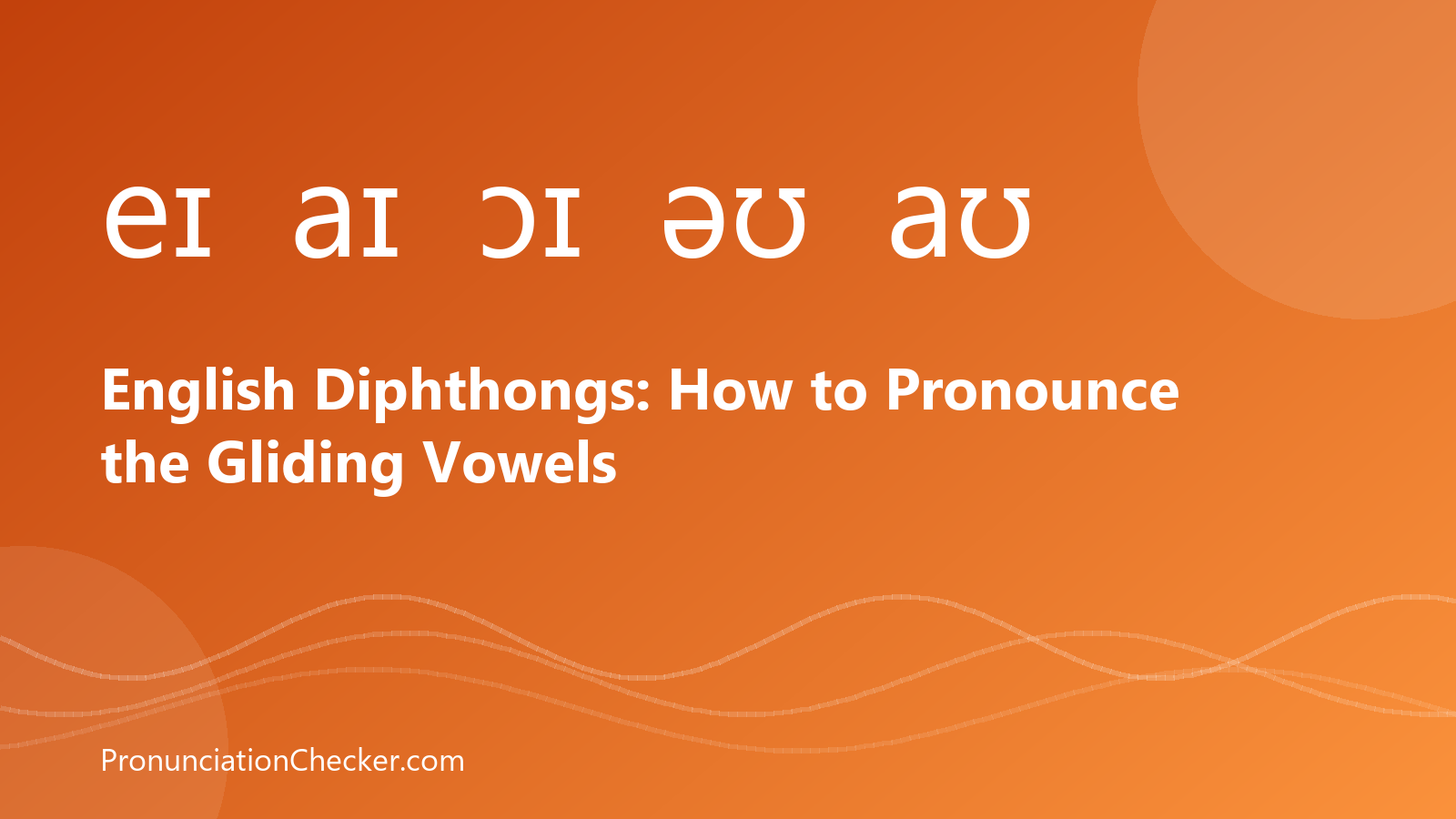
A diphthong is a vowel that moves. In day, your tongue starts in one position and glides to another during the vowel. English uses these moving vowels in some of its most common words: I, my, go, no, how, now, say, way, boy.
Many languages have diphthongs too, so this might seem easy. The difficulty is that English diphthongs are often written with a single letter, so learners who read before they listen replace them with a pure vowel. Late becomes let, coat becomes cot, and won't becomes want.
The English diphthongs
Phoneticians name English vowels after a keyword, which avoids spelling confusion. The table uses these standard keywords.
| Keyword | British (SSBE) | American (GA) | Examples |
|---|---|---|---|
| FACE | /eɪ/ | /eɪ/ | day, late, rain, eight, great, they |
| PRICE | /aɪ/ | /aɪ/ | my, time, high, buy, eye, island |
| CHOICE | /ɔɪ/ | /ɔɪ/ | boy, noise, coin, enjoy |
| GOAT | /əʊ/ | /oʊ/ | go, home, road, know, though, won't |
| MOUTH | /aʊ/ | /aʊ/ | now, house, town, loud, how |
| NEAR | /ɪə/ | /ɪr/ | here, beer, idea, clear |
| SQUARE | /eə/ or /ɛː/ | /ɛr/ | where, hair, care, their |
| CURE | /ʊə/ or /ɔː/ | /ʊr/ | tour, pure, sure |
The first five are called closing diphthongs because they glide toward a higher, closer tongue position, /ɪ/ or /ʊ/. The last three are centring diphthongs, gliding toward schwa. In American English they are not really diphthongs at all but a vowel followed by /r/. In modern British English they are changing: SQUARE is now often a long pure vowel [ɛː], and CURE words like sure and poor are increasingly pronounced with /ɔː/, the same as shore and pour.
How to make a diphthong
Three things matter.
- The first part is longer and stronger. In /aɪ/, most of the time is spent on /a/, and the /ɪ/ is a brief movement at the end. Learners who give both halves equal weight produce something like "ah-ee", two syllables instead of one.
- The glide is continuous. The tongue does not jump from one position to another; it slides. Say /aɪ/ very slowly, over three seconds, and you should hear every point in between.
- The end point is not fully reached. The /ɪ/ at the end of my is a direction, not a destination. The tongue moves toward it and stops short.
You can see and feel some of these movements. In PRICE and MOUTH the jaw closes during the vowel; watch it in a mirror. In GOAT and MOUTH the lips round at the end. In CHOICE they start rounded and spread.
The most common mistakes
Flattening FACE and GOAT. Spanish, Italian, Portuguese, French and German speakers often replace /eɪ/ with a pure [e] and /əʊ/ with a pure [o]. English listeners then hear a different word:
| Diphthong | Pure vowel | Diphthong | Pure vowel |
|---|---|---|---|
| late | let | coat | caught / cot |
| wait | wet | boat | bought |
| main | men | low | law |
| pain | pen | won't | want |
| sale | sell | so | saw |
The fix is to finish the glide. Say day and deliberately let the tongue rise toward the ee position at the end. For go, round your lips more as the vowel ends.
Adding a consonant. Some learners turn the glide into a real /j/ or /w/: my-y, go-w. This happens especially before a following vowel, as in going or playing. A small glide is natural there; a full consonant is not.
Making them too long before voiceless consonants. English shortens every vowel, including diphthongs, before /p t k f s θ ʃ tʃ/. Compare ride and write, eyes and ice, road and wrote: the diphthong in the second word is clearly shorter. Getting this right makes the following consonant easier to identify.
Differences between accents
The starting point of GOAT is one of the clearest markers of accent. SSBE has a central start, /əʊ/, which sounds like "uh-oo" to American ears. General American starts further back and rounder, /oʊ/. Australian English starts even more open, closer to /ɐʉ/.
PRICE and MOUTH also vary. In many Canadian and some American accents, both start higher before voiceless consonants, so about sounds different from loud in a way that is noticeable to other Americans. This is called Canadian raising. Learners do not need to produce these variants, but recognising them helps with listening.
Practice
- Slow motion. Say each diphthong over three seconds, feeling the glide: /eɪ/, /aɪ/, /ɔɪ/, /əʊ/, /aʊ/. Watch your jaw and lips in a mirror.
- Pairs. Read the table of pure-vowel pairs above aloud, recording yourself. A friend should be able to tell which column you are reading.
- Sentences. They came late again today. I don't know why you won't go home. How now, brown cow? The boy enjoyed the noisy toys.
Frequently asked questions
How many diphthongs does English have?
British English is usually described with eight: /eɪ aɪ ɔɪ əʊ aʊ ɪə eə ʊə/. American English has five true diphthongs, since the last three correspond to a vowel plus /r/.
Why does late sound like let when I say it?
Probably because you are using a pure vowel instead of a diphthong. English /eɪ/ glides from an e-like position toward i. Finish the glide by raising your tongue at the end of the vowel.
Is the vowel in go the same in British and American English?
No. British /əʊ/ starts in the centre of the mouth, while American /oʊ/ starts further back with rounded lips. Both glide toward /ʊ/.
Sources and further reading
- Cruttenden, A. (2014). Gimson's Pronunciation of English (8th ed.). Routledge.
- Wells, J. C. (1982). Accents of English, vol. 1. Cambridge University Press.
- Ladefoged, P. and Johnson, K. (2015). A Course in Phonetics (7th ed.). Cengage Learning.
Disclosure: this page links to Preply, a tutoring marketplace. If you book a lesson through that link we may earn a commission, at no extra cost to you. It does not change what is recommended here. See our disclaimer and privacy policy.
Hear every diphthong
Click the diphthong symbols on the interactive chart to hear each glide.
Open the IPA chart