Voicing, Aspiration, And Frication In Common Contrasts
Learn how English distinguishes bilabial and labiodental pairs through voicing and aspiration rather than spelling alone.
Train contrastive listening with focused pairs that expose the exact sound difference causing confusion. In this guide, you will work with voicing, aspiration, and frication in common contrasts and ground the lesson in examples like pat / bat, fan / van, pie / buy. The goal is not to memorize a label; it is to hear the acoustic contrast, map it to articulation, and build a repeatable practice loop.
Use the minimal pairs list while reading. That gives you a reference point for sound, transcription, and feedback, which is the fastest way to move from theory to usable pronunciation.
What changes inside the pair
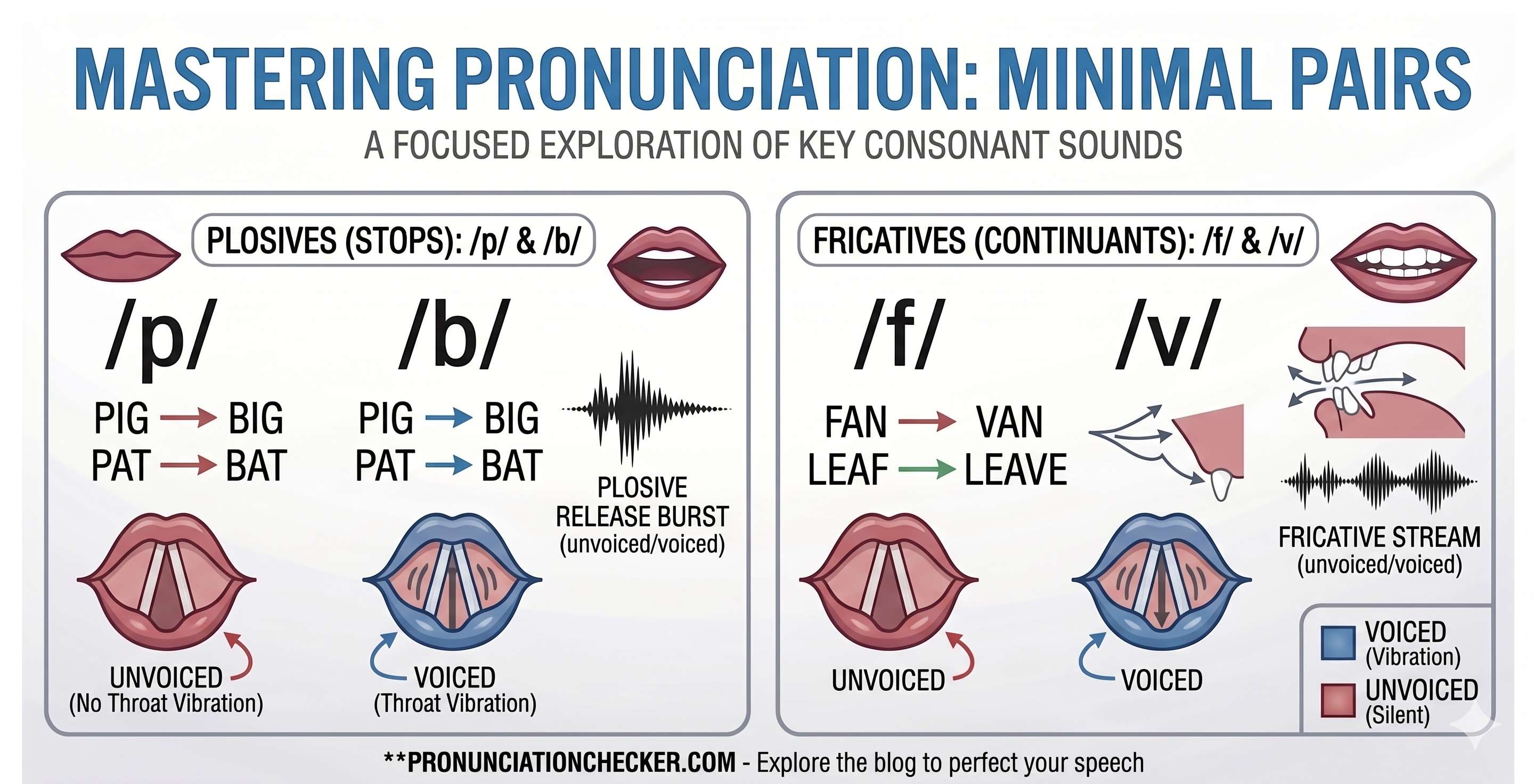
Minimal pairs work because they isolate one phonological difference at a time. In pat / bat; fan / van; pie / buy; fine / vine, everything else stays structurally stable, so your ear can focus on the exact sound that changes meaning. That is what makes minimal pairs one of the most efficient training tools in second-language phonology.
The core pairs and contrasts:
- Voicing pairs: pat / bat, pie / buy, peel / beel, pin / bin, pear / bear, pig / big
- Frication pairs: fan / van, few / view, fee / vee, fine / vine, four / vor, deaf / love
- Aspiration in stops: /p/ has aspiration in initial position, /b/ does not. Hear: 'a pea' vs 'a bee'.
- Combined difficulty: Learners who skip aspiration AND voicing: 'pan' vs 'ban' becomes harder.
For English learners, the important question is never only "Can I say the word?" It is "Can I hear the contrast before I say it?" If the answer is no, the pronunciation problem is partly perceptual, not just articulatory. That is why pair training should always begin with listening and only then move to production.
Articulation details that matter
The main contrast here is voicing, aspiration, and frication in common contrasts. Once you can describe that contrast in physical terms, you stop guessing. You know whether to move the tongue tip, change lip rounding, add aspiration, or keep the vocal folds vibrating. That precision is what turns a vague accent problem into a solvable one.
A drill plan that actually sticks
- Voicing drill: Hold a paper strip in front of your mouth to see the extra puff of air on /p/. Compare to /b/ (less air).
- Vocal fold check: Check vocal fold vibration for /b/ and /v/ while keeping the mouth shape fixed.
- Frication vs voicing: /f/ vs /v/ differ ONLY in voicing, so practice feeling the vibration difference.
- Pair sprint: Say pat/bat, fan/van, pie/buy slowly, then at normal speed.
- Sentences: 'Put the bat down' vs 'but the beat down' (shows both voicing and aspiration).
- Speed test: Practice with short sentences so the contrast is not lost once syllables connect.
What usually goes wrong
- Forgetting voicing on /b/: Using the same lip shape for /b/ as for /p/, but the vocal folds aren't vibrating.
- Over-aspirating /b/: Making /b/ too strong with extra air, so it sounds like /p/. Remember: /b/ is softer.
- Voiceless /v/: Saying /f/ instead of /v/ because the learner forgets to turn on the vocal folds.
- Frication shape mistake: Using the same frication setup for /p/ and /f/, which don't share a place of articulation.
How to turn this into practice
Use this article as a narrow practice loop: listen, describe the contrast in technical terms, imitate the sound, and check the result against a reliable reference. If you can explain the contrast in a sentence, you are much more likely to fix it in speech. That is the difference between passive reading and useful learning.
For the next step, keep the practice list small. One cluster, one contrast, one week. That is enough to produce real change without turning pronunciation study into noise.
Advanced Insights and Deeper Understanding
To truly master this concept, it's important to understand not just the mechanics, but the practical applications in real-world English usage. Many learners make the mistake of focusing solely on isolated examples without understanding how these principles apply in flowing, natural speech contexts.
The key to improvement is consistent practice combined with immediate feedback. When you work with pronunciation, you're training muscle memory as much as auditory perception. This dual approach—listening and producing—is what creates lasting change in your speech patterns.
Common Challenges and How to Overcome Them
Learners often face several predictable obstacles when working on this aspect of English pronunciation. Understanding these challenges in advance helps you prepare mentally and physically for the learning process.
The first challenge is recognizing the sound in natural speech. Isolated examples are easier to hear, but native speakers in natural conversation blend and reduce sounds. Start with clear examples, then gradually expose yourself to more natural speech contexts. Listen to podcasts, watch movies, and engage with authentic audio content.
The second challenge is producing the sound consistently. Your mouth, tongue, and vocal folds have years of muscle memory from your native language. Retraining these muscles takes time. The good news is that with focused practice—just 10-15 minutes daily—you'll see significant progress within weeks.
The third challenge is maintaining accuracy in spontaneous speech. When you're thinking about what to say, pronunciation can fall to the wayside. This is normal. The solution is to make pronunciation practice part of your daily routine, not something separate from communication practice.
Real-World Applications in Different Contexts
Understanding when and how to apply this knowledge is crucial. Different contexts—professional presentations, casual conversations, telephone calls, video conferences—each present unique challenges for pronunciation.
In professional settings, clarity is paramount. People are actively listening and expect clear communication. This is actually an advantage because native speakers will notice and appreciate your effort to communicate clearly. In casual settings, slight accent variations are less important than conversational flow.
In one-on-one conversations, you have the advantage of immediate feedback if misunderstanding occurs. In group settings or presentations, you need to be even more careful about clarity because there's less opportunity for clarification.
Progressive Practice Path for Mastery
Effective learning follows a specific progression. Don't try to do everything at once. Instead, follow this structured path:
- Week 1: Listening and recognition - hear the sound in various contexts, understand how it changes with surrounding sounds
- Week 2: Isolated production - practice saying the sound in isolation and simple syllables
- Week 3: Word-level integration - use the sound in real words, starting with common vocabulary
- Week 4: Connected speech - integrate into phrases and sentences
- Week 5+: Conversational integration - use naturally in spontaneous communication
Tools and Resources for Continued Learning
Having the right tools accelerates learning significantly. The pronunciation checker app provides immediate feedback on your production. Combine this with other resources for a comprehensive approach.
Online pronunciation dictionaries show IPA transcriptions and provide native speaker audio. YouTube channels dedicated to English pronunciation offer free video tutorials. Language exchange partners provide authentic conversation practice. Audio books allow you to listen to native speaker pace and intonation while following along with text.
The combination of these tools—reference materials, interactive apps, and real conversation—creates a complete learning ecosystem that addresses all aspects of pronunciation development.
Long-Term Strategy for Native-Like Pronunciation
Achieving native-like pronunciation isn't a destination but an ongoing process of refinement. Even native speakers evolve their speech as they age, move to different regions, and encounter new influences.
Set realistic long-term goals. Give yourself 6-12 months to develop noticeable improvement in clarity and accent. This timeline allows for consistent practice while giving your brain and mouth time to adjust and solidify new patterns.
Celebrate milestones along the way. When you can consistently produce a sound correctly in conversation, acknowledge that achievement. When someone doesn't ask you to repeat yourself in a situation where they used to, that's progress worth noting.
Remember that small, consistent effort over time produces better results than intensive cramming. A 15-minute daily practice session will transform your pronunciation more effectively than a 5-hour weekend marathon.
Ready to improve voicing, aspiration, and frication in common contrasts?
Use the linked resource to practice voicing, aspiration, and frication in common contrasts with immediate audio or transcription support.
Explore the related tool