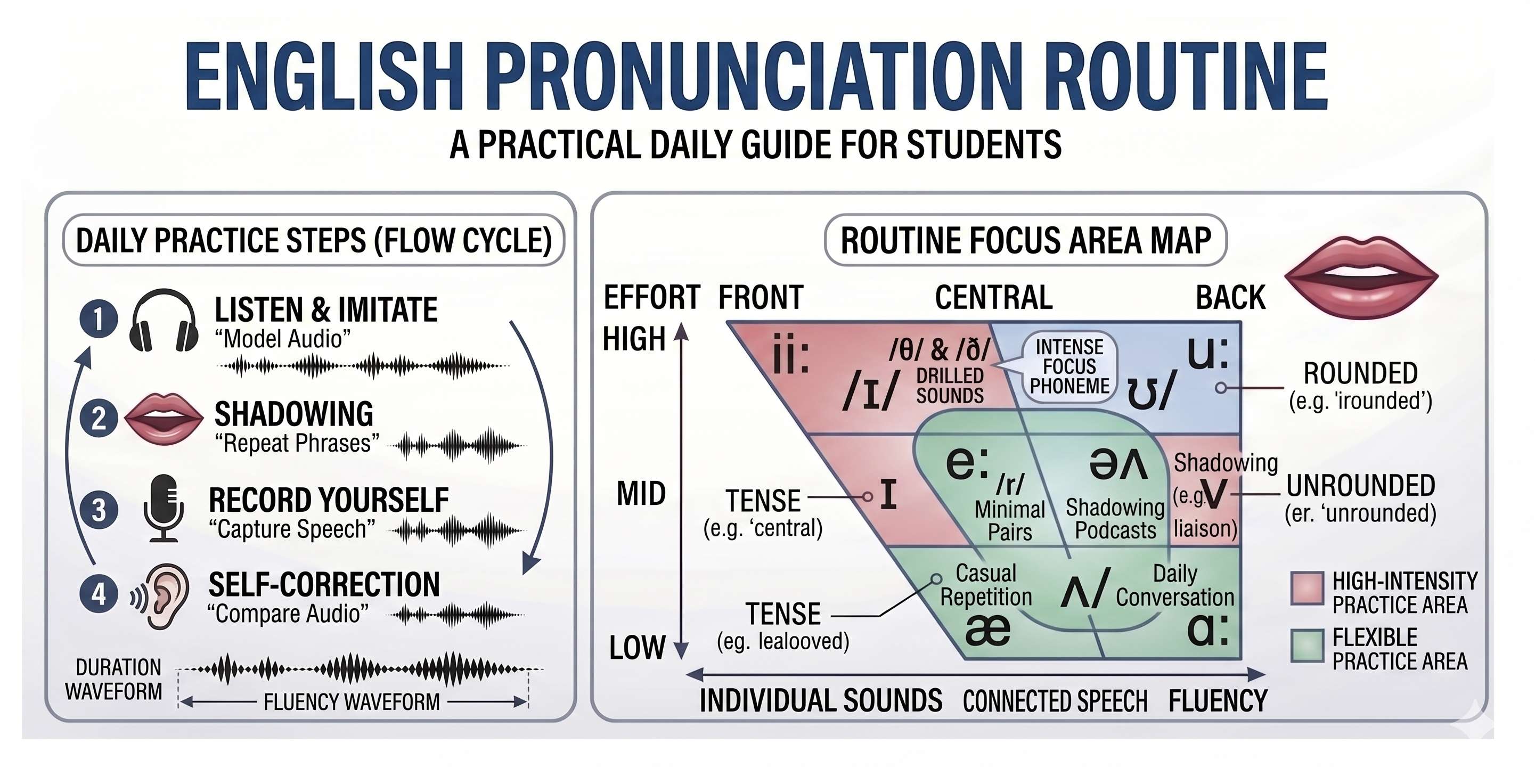
A routine is what turns occasional pronunciation practice into steady progress. Without one, sessions depend on mood and drift toward whatever feels comfortable, which is usually the sounds you can already make.
The routine below takes twenty minutes and follows a fixed order: warm-up, ear training, focused production, connected speech, shadowing and review. After it you will find how to spread targets across a week, how to carry the work into real conversation, and how to recognise and get past a plateau. If you only have fifteen minutes a day, the daily study plan is a shorter alternative built on the same principles.
Why a warm-up is not optional
Speaking a second language uses muscle configurations your face rarely adopts otherwise. Starting a practice session cold means the first several minutes are spent loosening up rather than learning, and it also means your first recordings misrepresent what you can actually do.
Three minutes is enough:
- Lip trill — blow air through loosely closed lips for ten seconds, three times. Loosens the lips and encourages steady breath support.
- Tongue stretches — touch the tongue tip to the alveolar ridge, then the soft palate, then behind the lower teeth, slowly, ten times. These are the three main positions English uses.
- Jaw release — open wide, hold, release, five times. Under-opening the jaw is the direct cause of the
/æ/error in cat. - Pitch glide — slide from your lowest comfortable pitch to your highest on an ah, five times. This is specifically preparation for English intonation range.
A routine you can run in twenty minutes
| Stage | Time | Activity |
|---|---|---|
| Warm-up | 3 min | Lips, tongue, jaw, pitch glides |
| Ear training | 4 min | Identification on your current target contrast, several voices |
| Focused production | 5 min | Word list on the target, recorded |
| Connected speech | 5 min | Sentences, then a short paragraph read aloud |
| Shadowing | 2 min | 30 seconds of natural speech, three passes |
| Review | 1 min | Listen to one recording, write two lines |
Spreading the load across a week
Doing exactly the same thing every day leads to boredom and to plateaus, because the same task stops producing new information. Vary the emphasis while keeping the target constant.
| Day | Emphasis |
|---|---|
| Monday | Perception — listening and identification only |
| Tuesday | Isolated production, recorded and reviewed |
| Wednesday | Sentences and reading aloud |
| Thursday | Rhythm and stress — tapping, humming, backchaining |
| Friday | Shadowing a longer clip |
| Saturday | Free speech recorded and reviewed against the target |
| Sunday | Rest, or a passive listening day with no evaluation |
Integrating with real conversation
Practice and conversation are separate skills, and trying to monitor pronunciation while talking to someone reliably damages both. A better approach is to alternate deliberately.
Before a conversation, spend two minutes on the target sound so that it is fresh. During the conversation, ignore pronunciation entirely and attend to meaning. Afterwards, if you can, record two minutes summarising what was discussed and listen for the target. This separates the monitoring from the communicating, which is what makes both possible.
The attention problem. You have a limited amount of conscious attention, and pronunciation, grammar, vocabulary and content compete for it. This is why a sound produced perfectly in a drill disappears in conversation. The solution is not to concentrate harder but to practise until the sound no longer requires attention — which takes weeks of repetition, not better focus.
Choosing material
- For shadowing: unscripted speech — interviews, podcasts, documentaries. Graded classroom audio is too slow and too evenly timed to teach English rhythm.
- For reading aloud: text you would plausibly say yourself. Reading literary prose aloud trains a register you will never use.
- For ear training: several different speakers. Training on one voice produces gains that do not transfer to new speakers.
- For free speech: topics you know well, so that content does not compete for attention with pronunciation.
Recognising a plateau and responding to it
Progress in pronunciation is not linear. Periods of rapid change alternate with weeks where nothing seems to shift, and the flat periods are normal consolidation rather than evidence of failure.
A genuine plateau — two or three weeks with no measurable change on a recorded test — usually means one of three things: the target is too broad and needs narrowing to one specific context, the practice has become passive repetition without evaluation, or perception has not actually reached the level production requires. Checking those three in order will normally identify the cause, and the third one is by far the most common.
Frequently asked questions
Do I really need to warm up before practising pronunciation?
It helps more than most learners expect. Speaking a second language uses muscle configurations your face rarely adopts otherwise, so starting cold means the first several minutes go on loosening up rather than learning, and early recordings misrepresent what you can do. Three minutes of lip trills, tongue stretches, jaw releases and pitch glides is sufficient.
Should I monitor my pronunciation while having a conversation?
No. Attention is limited and pronunciation, grammar, vocabulary and content all compete for it, so monitoring while speaking usually damages both the speech and the conversation. Practise the target for two minutes beforehand, ignore pronunciation entirely during the conversation, and if possible record a two-minute summary afterwards and review that instead.
What material should I use for shadowing?
Unscripted natural speech — interviews, podcasts and documentaries. Graded classroom audio is recorded slowly and with unnaturally even timing, so it does not teach the compression and reduction that give English its rhythm. For reading aloud, choose text you would plausibly say yourself rather than literary prose, which trains a register you will never use.
What should I do if I stop making progress?
Two or three weeks with no measurable change on a recorded test usually means one of three things: the target is too broad and needs narrowing to a single context, the practice has become repetition without evaluation, or your perception has not reached the level your production is attempting. The third is by far the most common, so test your identification accuracy before changing anything else.
Disclosure: this page links to Preply, a tutoring marketplace. If you book a lesson through that link we may earn a commission, at no extra cost to you. It does not change what is recommended here. See our disclaimer and privacy policy.
Get a routine built for you
If you would like help choosing targets, book a one-to-one session.
See 1-on-1 help