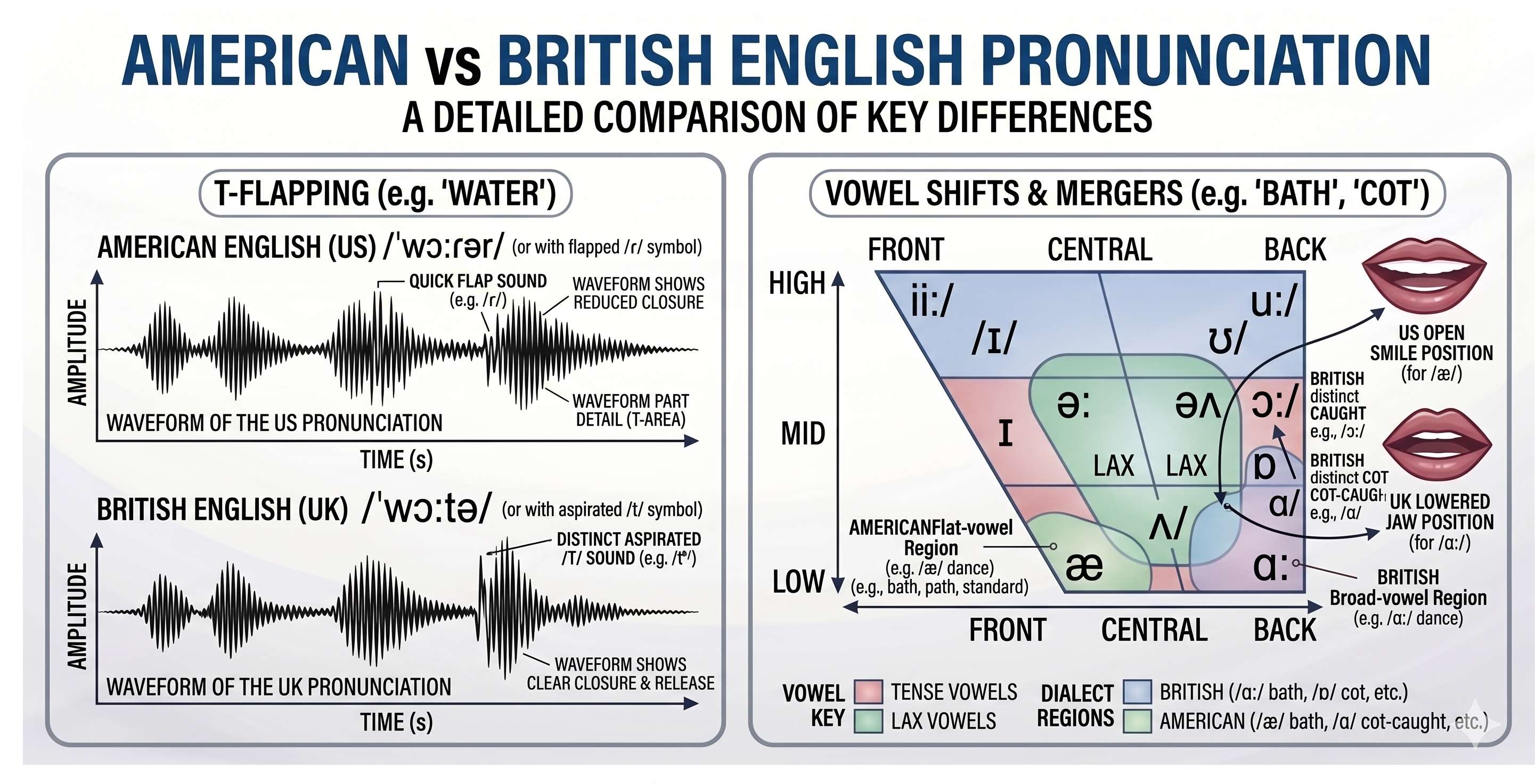
If you learned English from European textbooks and then moved to North America, or the other way round, you already know that the two standard accents differ in more than tomayto and tomahto. The differences are systematic. A handful of rules produce most of what you hear, and once you know them you can predict how an unfamiliar word will sound in either accent.
This guide compares General American (GA), the accent of most US national broadcasting, with Standard Southern British English (SSBE), the modern successor of what used to be called Received Pronunciation. Neither is more correct. The aim is to help you recognise both and to speak one of them consistently.
Quick comparison sets
Start with a small set of words that expose the biggest contrasts. Hearing the same spelling in both accents makes the pattern easier to spot than reading the rule alone.
- Rhoticity: car, hard, water, more, sister.
- BATH words: bath, dance, class, laugh, path.
- T-flapping: water, better, city, ladder, waiting.
- Yod-dropping: tune, new, duty, student, suit.
1. Rhoticity: The Case of the Pronounced /r/
The most defining difference between American and British English is rhoticity. General American is a rhotic accent, meaning the /r/ sound is pronounced wherever it appears in the spelling (e.g., car /kɑːr/, hard /hɑːrd/, water /ˈwɔːtər/).
In contrast, Standard British English is typically non-rhotic. The /r/ is only pronounced if it is immediately followed by a vowel sound. If it comes at the end of a syllable or before a consonant, it is dropped, often lengthening the preceding vowel or creating a schwa sound (e.g., car /kɑː/, hard /hɑːd/, water /ˈwɔːtə/).
2. The BATH Split: /æ/ vs. /ɑː/
Another major difference is how speakers pronounce words like bath, dance, ask, and laugh. This is known as the BATH split.
- American English: Uses the short, front "ash" vowel /æ/. So, bath is /bæθ/ and dance is /dæns/.
- British English (RP): Shifts this sound to the open, back vowel /ɑː/. So, bath becomes /bɑːθ/ and dance becomes /dɑːns/.
3. T-Flapping (The Alveolar Tap)
If you listen to an American speaker say water or better, you might notice that the 't' sounds more like a quick 'd'. This is called T-flapping or tapping (represented by the IPA symbol /ɾ/).
In General American, an alveolar tap occurs when a /t/ sits between two vowel sounds, and the second vowel is unstressed. In British English, a true, crisp /t/ is typically maintained (though some modern dialects use a glottal stop /ʔ/ instead).
4. Vowel Quality: The LOT and GOAT Vowels
Several vowel sounds have different qualities across the Atlantic:
- The LOT vowel: In British English, words like hot, lot, and box use the rounded back vowel /ɒ/. In American English, this vowel is unrounded and much more open, sounding closer to /ɑ/ (e.g., /hɑt/).
- The GOAT vowel: The "oh" sound in go, boat, or note is a diphthong in both accents, but starts differently. British English typically starts with a schwa /əʊ/ (e.g., /gəʊ/), while American English starts with a back rounded vowel /oʊ/ (e.g., /goʊ/).
5. Yod-dropping
Yod-dropping refers to the omission of the /j/ sound (the "y" sound) before a /u:/ after alveolar consonants (/t/, /d/, /n/, /l/, /s/, /z/).
American English heavily drops the yod in these environments. For example, tune is pronounced /tuːn/ and new is /nuː/. British English tends to keep the yod, resulting in /tjuːn/ and /njuː/.
How to Study the Patterns
English orthography is notoriously tricky because it preserves historical spelling patterns rather than current pronunciation. To avoid confusion:
- Commit to one accent model: Consistency is more important than achieving "native-like" perfection. Mixing a British /ɑː/ in dance with an American rhotic /r/ in hard can sound unnatural.
- Use Phonetic Transcriptions (IPA): Pair spelling with IPA transcriptions. Once you see the IPA form, pronunciation stops being a mystery.
- Focus on Minimal Pairs: Practice words side-by-side (e.g., American hot /hɑt/ vs. British hot /hɒt/) to train your ear to hear the acoustic contrast.
Turning Theory into Practice
Use this knowledge as a practical framework: listen to native speakers, describe the contrast you hear using these technical terms, and imitate the sound. Use a pronunciation checker or record yourself to verify your progress.
Keep your practice focused. Work on rhoticity one week, and T-flapping the next. Incremental, targeted practice is the key to producing real change without feeling overwhelmed.
The differences are systematic, not word by word
Learners often approach American and British pronunciation as two vocabulary lists to memorise. In fact a handful of systematic differences account for the overwhelming majority of cases, and learning the systems means you can predict new words rather than looking them up.
1. The R at the end of a syllable
This is the single largest difference. American English pronounces r everywhere; standard southern British English pronounces it only before a vowel.
| Word | American | British |
|---|---|---|
| car | /kɑːr/ | /kɑː/ |
| bird | /bɝd/ | /bɜːd/ |
| water | /ˈwɔːɾɚ/ | /ˈwɔːtə/ |
| hard | /hɑːrd/ | /hɑːd/ |
British speakers restore the /r/ when the next word begins with a vowel, so my car is here does have an audible /r/. The letter is not deleted from the accent; it is conditioned by what follows.
2. T between vowels
In American English, /t/ and /d/ between two vowels with the second unstressed become a quick flap, effectively a very short /d/. British English keeps a clear /t/.
This affects an enormous number of everyday words: water, better, city, party, letter, computer, little, bottle, matter, twenty, beautiful, later, forty, thirty, pretty. It also makes latter and ladder, and writer and rider, identical or nearly so in American speech.
British English increasingly replaces the same /t/ with a glottal stop in informal speech — bo'le for bottle, wa'er for water — which is a different outcome from the same underlying weakening.
3. The BATH vowel
In a specific set of words, southern British English uses the long back vowel /ɑː/ where American English uses /æ/. The set is defined historically: words where the vowel was followed by /f θ s n m/ plus another consonant.
- bath, path, laugh, grass, class, pass, glass, ask, task, dance, chance, plant, answer, after, castle, example, can't
This is not a universal British feature. Northern English speakers use /æ/ in all of these, exactly as Americans do. It is a southern British feature that became associated with the standard accent.
4. The LOT vowel
British English uses a rounded /ɒ/ in hot, not, dog, box, top, shop. Most American accents use unrounded /ɑː/, which is why American hot sounds closer to British hart without the r. For many American speakers cot and caught have also merged entirely.
5. Word stress differences
| Word | American | British |
|---|---|---|
| address (noun) | ADD-ress | a-DDRESS |
| garage | ga-RAGE | GARR-idge |
| advertisement | ad-ver-TISE-ment | ad-VER-tis-ment |
| laboratory | LAB-ra-tory | la-BOR-a-try |
| ballet | ba-LLET | BA-llet |
| adult | a-DULT | A-dult |
There is also a general pattern with -ary, -ery and -ory endings: American English keeps a secondary stress and a full syllable, while British English reduces or deletes it. Necessary has four syllables in American English and three in British; secretary and military behave the same way.
6. Individual words that simply differ
- schedule — SKED-ual (US) against SHED-ual (UK)
- either, neither — EE-ther (US) against EYE-ther (UK), though both occur in both
- tomato — to-MAY-to against to-MAH-to
- vitamin — VITE-a-min against VIT-a-min
- privacy — PRY-va-cy against PRIV-a-cy
- leisure — LEE-zhure against LEZH-ure
- herb — ERB, with silent h (US), against HERB (UK)
Which should you learn? Whichever you hear most in the context where you will actually use English. Neither is more correct, and both are fully intelligible worldwide. What matters is internal consistency: mixing American r with British bath, or British t with American stress, is more noticeable than either accent used consistently. Choose one, and when a dictionary gives both, take the one that matches your choice.
Frequently asked questions
What is the biggest difference between American and British pronunciation?
The letter r at the end of a syllable. American English pronounces it in car, bird and water; standard southern British English does not, though it restores the r when the next word begins with a vowel, so my car is here does contain an audible r. This single difference affects more words than any other feature.
Why does American water sound like wader?
Because American English turns /t/ and /d/ into a quick flap when they fall between two vowels and the following syllable is unstressed. It affects a very large set of everyday words — better, city, party, little, bottle, twenty, later — and makes pairs such as latter and ladder nearly identical. British English keeps a clear /t/, or increasingly replaces it with a glottal stop in informal speech.
Which words have the bath vowel difference?
A historically defined set where the vowel was followed by /f θ s n m/ plus another consonant: bath, path, laugh, grass, class, pass, ask, dance, chance, plant, answer, after, example and can't. Southern British English uses the long back vowel /ɑː/ in these; American English uses /æ/. Northern English speakers also use /æ/, so this is a southern British feature rather than a general British one.
Should I learn American or British pronunciation?
Whichever you hear most in the setting where you will actually use English. Neither is more correct and both are intelligible worldwide. What matters most is consistency, because mixing features — American r with a British bath vowel, or British t with American stress patterns — is more noticeable to listeners than either accent used consistently.
Disclosure: this page links to Preply, a tutoring marketplace. If you book a lesson through that link we may earn a commission, at no extra cost to you. It does not change what is recommended here. See our disclaimer and privacy policy.
Compare the two accents on your own words
Transcribe a paragraph into American and British IPA and spot the rhotic R, the BATH vowel and flapped T.
Open the IPA converter