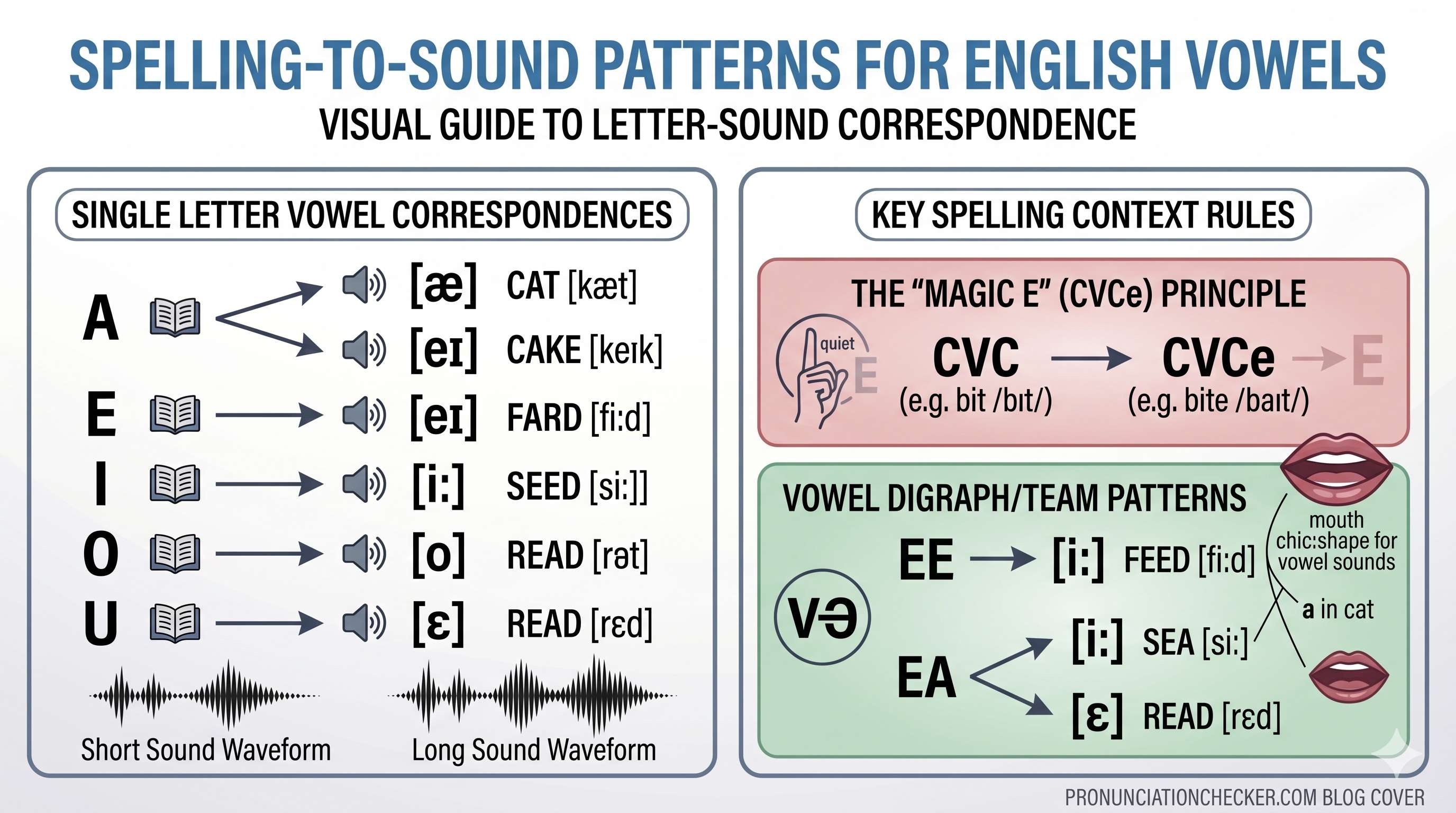
The letter a has at least six common pronunciations in English: cat, cake, car, call, about, any. Learners reasonably conclude that English vowel spelling is random. It is not. It is irregular, which is different: a handful of patterns predict the vowel correctly most of the time, and knowing them lets you make a sensible first guess at any new word.
This guide covers the four patterns that do most of the work (silent E, two-letter vowel spellings, vowels before R, and position in the word) and a strategy for the words that break them.
English spelling is irregular, not random
English vowel spelling has a reputation for chaos, and the reputation is partly deserved: the same letter sequence can represent several sounds, and the same sound can be spelled many ways. But the irregularity is historical rather than arbitrary, and the patterns that do exist cover a large majority of words.
The core cause is that English spelling was largely fixed by printers in the fifteenth and sixteenth centuries, and the Great Vowel Shift moved the long vowels afterwards. The spelling records the older pronunciation. That is why time is spelled with an i that once sounded like the i in machine, and why English a in late does not match the a of almost any other European language.
The silent E pattern
The most productive vowel rule in English: a single vowel letter followed by a single consonant and a final e takes its tense value, and the e itself is silent.
| Without E | Sound | With E | Sound |
|---|---|---|---|
| hat | /æ/ | hate | /eɪ/ |
| pet | /e/ | Pete | /iː/ |
| bit | /ɪ/ | bite | /aɪ/ |
| hop | /ɒ/ | hope | /oʊ/ |
| cut | /ʌ/ | cute | /juː/ |
Common exceptions worth memorising: have, give, live (verb), love, come, some, done, none, gone, one, are, were, there, where. Nearly all of these are extremely high-frequency words, which is exactly why they resisted regularisation.
Two-letter vowel spellings
| Spelling | Usual sound | Examples | Notable exceptions |
|---|---|---|---|
| ee | /iː/ | see, tree, green, sleep | very consistent |
| ea | /iː/ | eat, sea, team, clean | bread, head, dead /e/; great, break /eɪ/ |
| ai, ay | /eɪ/ | rain, day, train, play | said /e/; again varies |
| oa | /oʊ/ | boat, road, coat | broad /ɔː/ |
| oo | /uː/ or /ʊ/ | food, moon / book, good | blood, flood /ʌ/ |
| ou | /aʊ/ | house, out, loud | soup /uː/; touch /ʌ/; could /ʊ/ |
| ow | /aʊ/ or /oʊ/ | now, cow / know, show | must be learned per word |
| ie | /aɪ/ or /iː/ | pie, tie / field, piece | friend /e/ |
Vowels followed by R
An r after a vowel overrides the normal spelling rules entirely, and this group is highly regular — unusually so for English.
- ar →
/ɑːr/: car, park, start, hard, garden - or →
/ɔːr/: for, born, short, morning, north - er, ir, ur → all give
/ɜːr/: her, bird, turn, work, learn, earth, journey - air, are, ear →
/eər/: hair, care, bear, where, their - eer, ear, ere →
/ɪər/: beer, hear, here, near, career
That three-way merger of er, ir and ur is genuinely useful: her, sir, fur, word, heard and journey all contain the same vowel despite six different spellings.
Position within the word predicts a great deal
Two positional rules do more work than most learners expect:
- Unstressed syllables reduce to schwa regardless of spelling. The second vowel of doctor, colour, nation, pencil, eloquent, famous is
/ə/in every case, despite six different spellings. Once a syllable is unstressed, its vowel letter stops mattering. - Word endings are highly regular. -tion and -sion are
/ʃən/; -ture is/tʃər/; -ous is/əs/; -age in established words is/ɪdʒ/, as in village, message, package.
Where to put your effort. Learning stress placement pays more than memorising vowel spellings, because stress determines whether the vowel is reduced at all. Around one vowel in nine in running English is a schwa, and no spelling rule predicts those — the stress pattern does.
A practical strategy
- Learn the r-controlled group first. It is small, regular and covers a very large number of common words.
- Learn the silent E rule and its dozen high-frequency exceptions.
- Stop trying to predict unstressed vowels from spelling, and learn word stress instead.
- For any new word, look up the transcription rather than guessing. One lookup at the point of learning is cheaper than years of a fossilised error.
- Keep a personal list of words whose spelling misled you. That list will be short, personal and far more useful than any general exception list.
Frequently asked questions
Why is English vowel spelling so inconsistent?
Because spelling was largely fixed by printers in the fifteenth and sixteenth centuries and the Great Vowel Shift moved the long vowels afterwards, so the spelling records an older pronunciation. That is why the i of time once sounded like the i of machine, and why English a in late matches almost no other European language. The irregularity is historical rather than arbitrary.
What is the silent E rule?
A single vowel letter followed by a single consonant and a final e takes its tense value, and the e is not pronounced: hat becomes hate, bit becomes bite, hop becomes hope. It is the most productive vowel rule in English. The main exceptions — have, give, live, love, come, some, done, gone, one — are all very high frequency words, which is why they resisted regularisation.
Which vowel spellings are actually reliable?
The r-controlled group is the most regular part of English vowel spelling. ar gives /ɑːr/ in car and park, or gives /ɔːr/ in for and short, and er, ir and ur all merge into the same vowel, so her, sir, fur, word, heard and journey share one sound across six spellings. Learning this group first gives the best return for the effort.
Should I memorise vowel spelling patterns or word stress?
Word stress, if you have to choose. Roughly one vowel in nine in running English is a schwa, and schwa appears in every unstressed syllable regardless of how it is spelled — the second vowel of doctor, colour, nation, pencil and famous is the same sound despite five different spellings. No spelling rule predicts those, but the stress pattern does.
Disclosure: this page links to Preply, a tutoring marketplace. If you book a lesson through that link we may earn a commission, at no extra cost to you. It does not change what is recommended here. See our disclaimer and privacy policy.
Test your guesses
Predict the vowel from the spelling, then look the word up to check.
Open the IPA dictionary