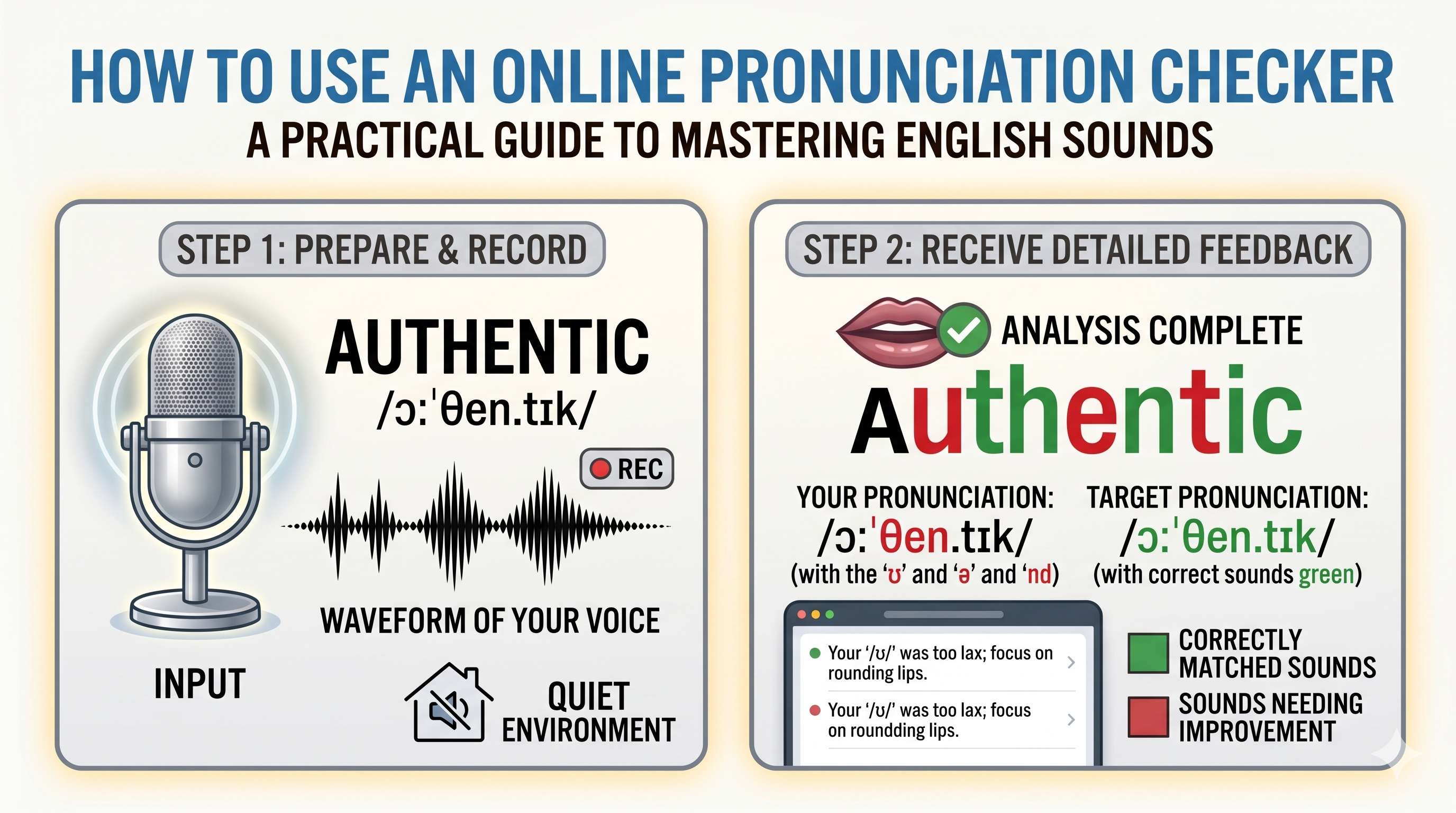
A pronunciation checker answers "how is this word said?" instantly and, if it uses speech recognition, "did I say it right?" as well. Used casually, that is a convenient lookup. Used deliberately, it is a feedback loop that can replace a surprising amount of tutoring for word-level problems.
This article explains what these tools actually measure (it is not the same thing a human listener hears), how to read their results, where they can mislead you, and how to combine them with other practice. For a quick first test, look up though, through, thorough and thought, then comfortable, Wednesday and clothes, words where spelling and sound go their separate ways.
What the tool is actually measuring
Understanding the mechanism prevents most of the frustration learners have with these tools. Browser-based pronunciation checkers generally use automatic speech recognition: your audio is converted to text, and the text is compared against the target word or sentence.
That has a specific consequence. The tool is not measuring how native you sound. It is measuring whether a recogniser, trained largely on native speech, produced the expected transcription. Those two things correlate, but they are not the same, and knowing the difference tells you which results to trust.
| What it detects well | What it detects poorly |
|---|---|
| Substituting one phoneme for another that creates a different real word | Rhythm and timing |
| Missing or inserted syllables | Intonation and pitch range |
| Word stress on the wrong syllable, often | Subtle vowel quality within the right category |
| Gross vowel errors | Aspiration and other allophonic detail |
| Consistently omitted final consonants | Whether you sound natural rather than merely correct |
The main practical limitation. A recogniser uses context to guess. Say a sentence and it may transcribe the target word correctly because the surrounding words made it the most probable option, even though your pronunciation was poor. Single words are a harsher and therefore more informative test than sentences.
Getting reliable results
- Test single words first. Context helps the recogniser and hides your errors. If a word fails in isolation, that is a genuine signal.
- Use minimal pairs as the test. Rather than checking whether ship is recognised, alternate ship and sheep and check whether the tool distinguishes them. If both come back as the same word, you have found a real merger.
- Repeat each word five times. Recognition is probabilistic. One failure means little; four failures out of five is a finding.
- Keep conditions constant. Same room, same distance, same device. A quiet room and 20 cm from the microphone, slightly off-axis to avoid plosive bursts.
- Check the accent setting. Most tools let you select a target variety. A recogniser set to British English will mark rhotic American pronunciations down, and vice versa.
Reading a low score correctly
A low score is information about a mismatch, not a verdict. Work through the possibilities in order before concluding your pronunciation is wrong:
- Recording problem — background noise, too far from the microphone, clipping. Listen back to your own audio first.
- Accent mismatch — you produced a valid pronunciation from a different variety than the one selected.
- Speed — recognisers handle moderate, evenly-paced speech best. Speaking unusually slowly can actually hurt the score.
- A genuine error — which is what you are looking for, and which is confirmed by repetition and by the pattern across related words.
The pattern matters more than any single result. If ship, bit, fill and live all fail while sheep, beat, feel and leave all pass, you have identified a specific vowel problem. That inference is worth far more than a percentage score on a single word.
What to pair it with
An automatic checker is one input among several, and its weaknesses are exactly the strengths of other methods.
| Method | Good for | Weak on |
|---|---|---|
| Automatic checker | Objective, instant, unlimited repetition, no embarrassment | Prosody; explaining why something failed |
| Self-recording | Rhythm, intonation, progress over time | Sounds you cannot yet hear |
| A teacher or native speaker | Diagnosis and articulatory instructions | Cost, availability, inconsistency |
| Minimal pair listening | Building the perceptual category | Does not test production |
The gap the checker fills is repetition without judgement. You can attempt the same word forty times in a row, which no human listener will do for you, and that volume of attempts with immediate feedback is genuinely valuable for motor learning — provided you interpret the output as a mismatch signal rather than a grade.
Frequently asked questions
How do online pronunciation checkers actually work?
Most use automatic speech recognition: your audio is converted to text and compared against the target. This means the tool is measuring whether a recogniser trained largely on native speech produced the expected transcription, not how native you sound. The two correlate but are not the same, which is why some results are informative and others are not.
Why did the tool accept my pronunciation when I know it was wrong?
Because recognisers use context to guess. In a full sentence, the surrounding words can make the target the most probable option even when your pronunciation was poor. Testing single words in isolation removes that help and is a harsher, more informative test. Testing minimal pairs is better still: check whether the tool distinguishes ship from sheep rather than whether it recognises either one.
What should I do if I keep getting a low score?
Work through four possibilities in order before concluding your pronunciation is wrong: a recording problem such as noise or microphone distance, an accent mismatch with the variety the tool is set to, speaking unusually slowly, which can hurt recognition, and only then a genuine error. Repeat each word five times, since recognition is probabilistic and one failure means little.
What can an automatic checker not tell me?
Rhythm, intonation, pitch range and allophonic detail such as aspiration — essentially everything above the level of the individual word. It also cannot explain why something failed. Its real strength is unlimited repetition without judgement: you can attempt the same word forty times with immediate feedback, which no human listener will do, and that volume is genuinely useful for motor learning.
Disclosure: this page links to Preply, a tutoring marketplace. If you book a lesson through that link we may earn a commission, at no extra cost to you. It does not change what is recommended here. See our disclaimer and privacy policy.
Run the workflow on one word
Look it up, listen, say it, then check what the recogniser heard.
Open the checker