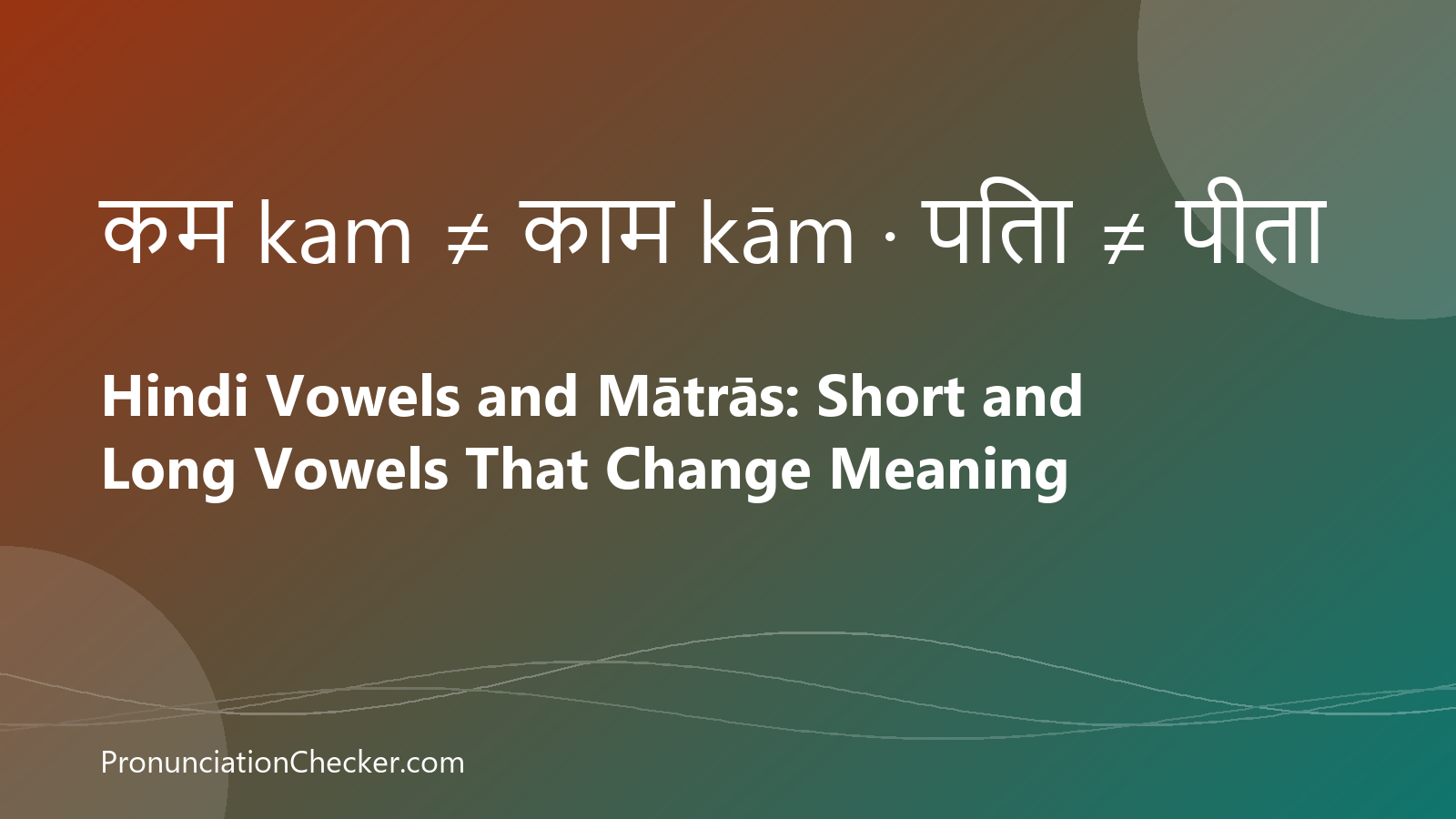
Hindi vowels are easier for English speakers than Hindi consonants, but one feature needs attention: short and long vowels are different phonemes. Kam means "less" and kām means "work"; pitā is "father" and pītā is "drinks". The difference is partly length and partly quality, much like English bit and beat.
The ten vowels
| Independent | Mātrā (on क) | Romanised | IPA | Like English... |
|---|---|---|---|---|
| क | a | [ə] | u in but | |
| ā | [aː] | a in father | ||
| i | [ɪ] | i in sit | ||
| ī | [iː] | ee in see | ||
| u | [ʊ] | oo in book | ||
| ū | [uː] | oo in food | ||
| e | [eː] | ay in day, without the glide | ||
| ai | [ɛː] | a in bad / e in bed, long | ||
| o | [oː] | o in go, without the glide | ||
| au | [ɔː] | aw in British law |
Two points often surprise learners. First, ए, ओ, ऐ and औ are all long vowels and have no short partners. Second, ऐ and औ are single, steady vowels in standard Hindi, not the diphthongs "ai" and "au" their romanisation suggests: hai "is" is [ɦɛː], not "high". (Some speakers, especially in the east, and many words in careful Sanskrit-style speech, do use diphthongs.)
How mātrās are written
- ा (ā) follows the consonant: क + ा = का.
- ि (i) is written before the consonant but pronounced after it: कि = ki.
- ी (ī) follows: की.
- ु (u) and ू (ū) go below: कु, कू. With र they attach differently: रु ru, रू rū.
- े (e) and ै (ai) go above: के, कै.
- ो (o) and ौ (au) follow with a mark above: को, कौ.
- No mātrā means the inherent vowel a: क = ka, unless it is deleted.
Short vs long: minimal pairs
| Short | Long |
|---|---|
| kam "less" | kām "work" |
| cal "walk!" | cāl "gait; trick" |
| pal "moment" | pāl "sail; raise" |
| din "day" | dīn "poor, humble" |
| mil "meet; mill" | mīl "mile" |
| pitā "father" | pītā "drinks" |
| sunā "heard" | sūnā "deserted" |
| kul "total; family" | kūl "riverbank" |
Quality matters as much as length. Short इ and उ are lax, like English sit and book; long ई and ऊ are tense, like see and food. Short अ [ə] and long आ [aː] differ even more: they are clearly different vowels, not just short and long versions of the same one.
Items in this drill: kam / kām; cal / cāl; pal / pāl; din / dīn; mil / mīl; pitā / pītā; sunā / sūnā; kul / kūl.
English habits to avoid
- Reading अ as the a of cat. Kam is closer to English come than to cam.
- Gliding ए and ओ. Ek "one" is a pure [eːk], not "ache" with a glide.
- Pronouncing ऐ and औ as diphthongs. Hai is [ɦɛː].
- Reducing unstressed vowels to schwa. Hindi keeps full vowel quality in all syllables, except that अ is itself a schwa-like vowel.
Phrases in this drill:
- मेरे पिता पानी पीते हैं।
- आज बहुत काम है।
- एक दिन हम मिलेंगे।
- मैंने गाना सुना।
- वह घर सूना है।
Frequently asked questions
How many vowels does Hindi have?
Standard Hindi has ten oral vowels, written अ आ इ ई उ ऊ ए ऐ ओ औ, plus the Sanskrit letter ऋ, which is pronounced as ri. Most vowels can also be nasalised.
Is the short a in Hindi like English "a"?
No. Short अ is [ə], a central vowel similar to the u in English "but" or the a in "about". Long आ is [aː], like the a in "father". Treating अ as the a of "cat" is a very common error.
Why is the mātrā for i written before the consonant?
It is a feature of Devanagari: the short i mātrā ि is written to the left of the consonant it follows in pronunciation. कि is ki, not ik. All the other mātrās are written after, above or below the consonant.
Sources and further reading
- Ohala, M. (1999). Hindi. In Handbook of the International Phonetic Association, 100–103. Cambridge University Press.
- Shapiro, M. C. (2003). Hindi. In G. Cardona and D. Jain (eds.), The Indo-Aryan Languages, 250–285. Routledge.
- Snell, R. and Weightman, S. (2003). Teach Yourself Hindi. Hodder and Stoughton.
Disclosure: this page links to Preply, a tutoring marketplace. If you book a lesson through that link we may earn a commission, at no extra cost to you. It does not change what is recommended here. See our disclaimer and privacy policy.
Practise Hindi out loud
Type any sentence, listen to a native voice, then record yourself and see which words a speech recogniser understood.
Open the practice page