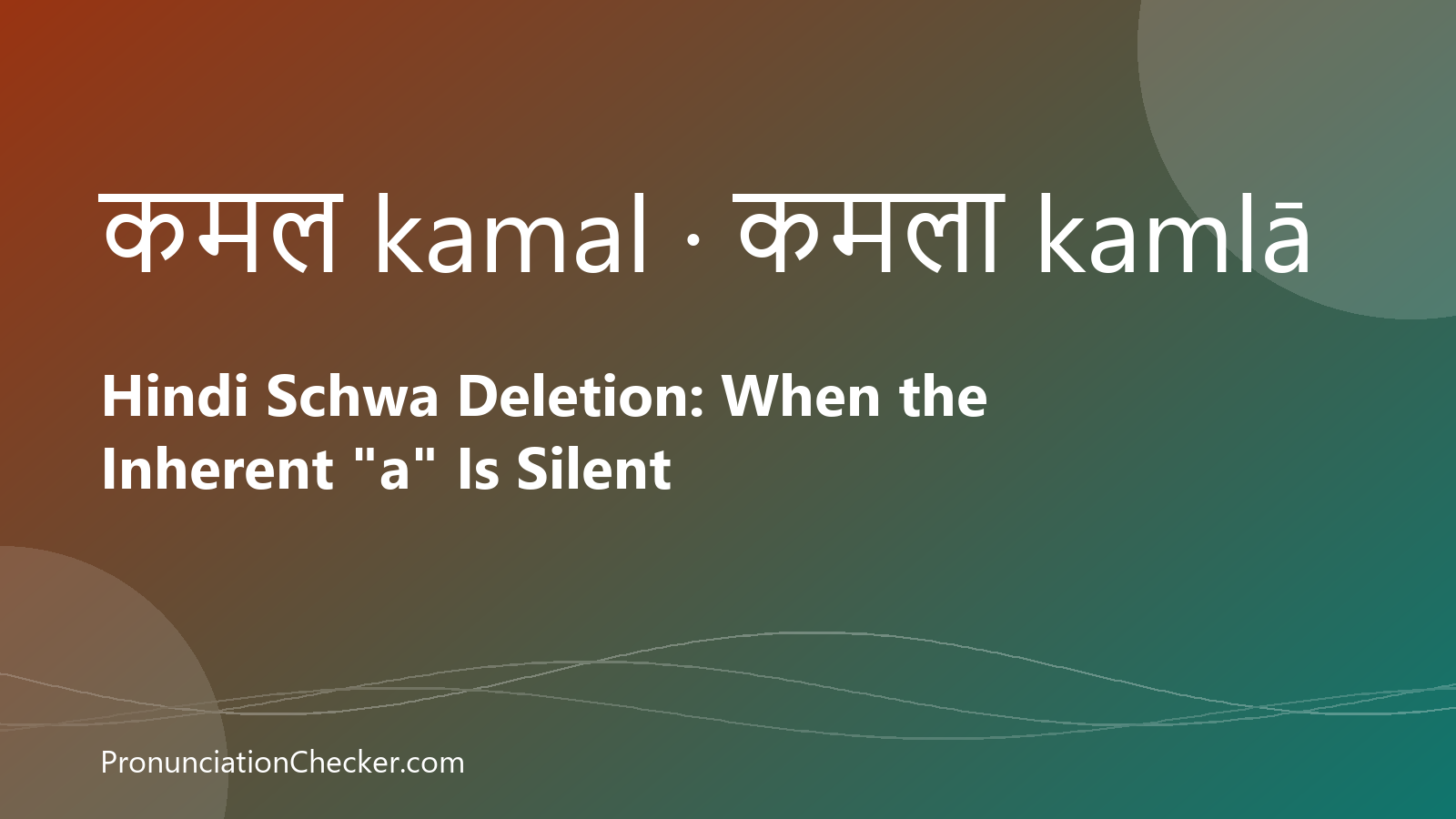
Every Devanagari consonant carries an inherent vowel, a short a pronounced [ə]. Read literally, कमल is ka-ma-la. But no Hindi speaker says that: it is kamal. And कमला is not kamalā but kamlā. The inherent vowel disappears in predictable positions, and learning the pattern is essential for reading Hindi aloud correctly.
Rule 1: the final schwa is dropped
A word-final inherent vowel is almost always silent:
- kamal "lotus" (not kamala)
- ghar "house"
- namak "salt"
- saṛak "road"
- rām
There are exceptions: when the final consonant is part of a cluster that would be hard to pronounce, the schwa often stays, especially in Sanskrit words: mitra "friend", śabda "word" (often śabd in speech), dharma/dharm. Colloquially, many of these also lose the final vowel.
Rule 2: the medial schwa between two vowels
Inside a word, a schwa is usually deleted when it stands between two consonants that are themselves surrounded by vowels. In the linguist Manjari Ohala's formulation, a schwa is deleted in the context V C _ C V: a vowel, a consonant, the schwa, another consonant, then a vowel.
| Written | Letter by letter | Pronounced | Meaning |
|---|---|---|---|
| ka-ma-lā | kam-lā | Kamala (name) | |
| a-pa-nā | ap-nā | one's own | |
| ja-na-tā | jan-tā | the public | |
| ra-ca-nā | rac-nā | creation | |
| sa-ra-kā-ra | sar-kār | government | |
| na-ma-kī-na | nam-kīn | salty |
Notice how namak keeps its middle schwa (the final one is dropped, and dropping the middle one too would leave namk), while namkīn drops it, because the long vowel ī now follows.
Rule 3: never create three consonants in a row
A schwa is kept if deleting it would create an unpronounceable cluster. This is why the rule is applied from the end of the word and checks its neighbours:
- samajh "understanding": final schwa dropped.
- samajhnā "to understand": the schwa after jh is dropped (V C _ C V with a-jh-_-n-ā), so the schwa after m must stay, giving sa-majh-nā, not samjhnā.
- badalnā "to change": the schwa after l goes, so the one after d stays: ba-dal-nā.
How to apply it in practice: work from right to left. Drop the final schwa. Then look at each remaining schwa from the end: if it has a single consonant and a vowel on each side, drop it, and move on; if dropping it would put three consonants together, keep it.
Compounds and prefixes
The rule applies within each part of a compound, not across the boundary. dhaṛkan "heartbeat" follows the rule; but a compound like rāj-mahal "royal palace" is read as rāj + mahal, and each part keeps its own pronunciation. Prefixes and suffixes can also block deletion, and many Sanskrit words in formal register keep more schwas than colloquial words.
Inflection changes pronunciation
Because the rule depends on what follows, adding an ending can change which schwas are pronounced:
- samajh → samjhā "understood": the ending -ā follows, so now the schwa after m is in V C _ C V and goes.
- pakaṛ "grip" → pakṛā "caught".
- namak → namkīn.
Which schwas are pronounced?
Choose an answer to see the explanation.
1. How is अपना pronounced?
- apanā
- apnā
- apan
Answer: apnā. The final vowel is ā; the medial schwa after p is between vowels a and ā with one consonant on each side, so it drops.
2. How is घर pronounced?
- ghara
- ghar
Answer: ghar. The final inherent vowel is dropped.
3. How is समझना pronounced?
- samjhnā
- samajhnā
- samajhanā
Answer: samajhnā. The schwa after jh drops; the one after m stays, to avoid the cluster mjhn.
4. How is सरकार pronounced?
- sarakār
- sarkār
- sarkāra
Answer: sarkār. Both the final schwa and the medial schwa after r are dropped.
Phrases in this drill:
- सरकार ने नई सड़क बनाई।
- अपना नाम लिखिए।
- मैं समझ गया।
- कमला बाज़ार गई।
- यह नमकीन बहुत अच्छा है।
Frequently asked questions
Why is Hindi not pronounced like Sanskrit?
Over many centuries, Hindi dropped the short a in many positions where Sanskrit kept it, but the spelling was not changed. Devanagari still writes the inherent vowel, so readers must know when to omit it.
Is schwa deletion ever optional?
Yes. In slow, careful speech, in Sanskrit loanwords, in poetry and in songs, speakers often keep schwas that are dropped in conversation. And compound words are treated as separate parts, so the rule applies inside each part.
Does Hindi write a virama to show a missing vowel?
Rarely in native words. The virama ्, which cancels the inherent vowel, is used in Sanskrit words and to form conjunct letters (क्ष, न्द). But ordinary schwa deletion is not shown in spelling: कमला is written without any mark, although the m has no vowel.
Sources and further reading
- Ohala, M. (1983). Aspects of Hindi Phonology, chapter 5: Schwa deletion. Motilal Banarsidass.
- Ohala, M. (1977). The treatment of phonological variation: an example from Hindi. Lingua, 42(2–3), 161–176.
- Choudhury, M., Basu, A. and Sarkar, S. (2004). A diachronic approach for schwa deletion in Indo-Aryan languages. Proceedings of the 7th Meeting of the ACL Special Interest Group in Computational Phonology, 20–26.
Disclosure: this page links to Preply, a tutoring marketplace. If you book a lesson through that link we may earn a commission, at no extra cost to you. It does not change what is recommended here. See our disclaimer and privacy policy.
Practise Hindi out loud
Type any sentence, listen to a native voice, then record yourself and see which words a speech recogniser understood.
Open the practice page