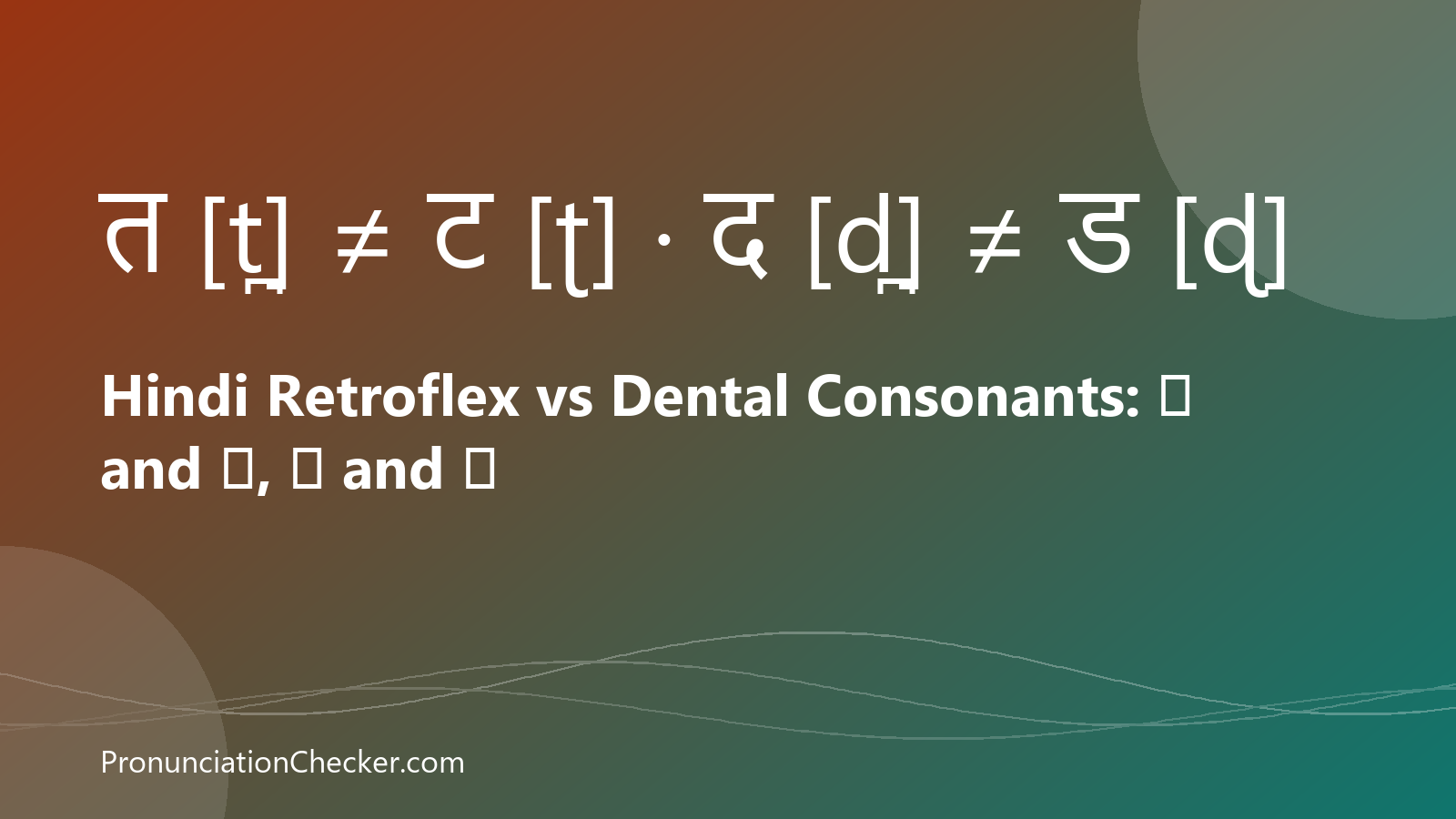
Where English has one t and one d, Hindi has two of each, and they distinguish words: dāl (lentils) and ḍāl (branch), tīn (three) and ṭīn (tin), dar (rate) and ḍar (fear). The difference is where the tongue tip touches, and English t and d sit awkwardly between the two.
Two places, one letter each
| Dental | Retroflex | |
|---|---|---|
| Tongue tip | against the back of the upper front teeth | curled up and back, touching behind the gum ridge |
| Sound quality | crisp, "thin" | hollow, "dark" |
| Voiceless | t, th | ṭ, ṭh |
| Voiced | d, dh | ḍ, ḍh |
| Nasal | n | ṇ (mostly in Sanskrit words) |
In romanisation, retroflex consonants are marked with a dot underneath: ṭ, ḍ, ṇ. In IPA they are [ʈ ɖ ɳ], and the dentals are [t̪ d̪ n̪].
Making the dental sounds
Put the tip of your tongue against the back of your upper front teeth, as if about to say the th of this, but make a full closure instead of friction. Release it cleanly. French, Spanish and Italian t and d are dental, so if you speak one of those languages, you already have them.
- tum "you" · tīn "three" · das "ten" · dūdh "milk" · patā "address"
Making the retroflex sounds
Curl the tongue tip upward and back so that its underside faces the roof of the mouth, and touch the area just behind the gum ridge. Then release it forward. The sound has a hollow, resonant quality. American English speakers can start from their r: say r, keep the tongue curled, and make a d from that position.
- ṭamāṭar "tomato" · ṭhaṇḍā "cold" · ḍar "fear" · ḍabbā "box" · ṭīn "tin"
Minimal pairs
| Dental | Retroflex |
|---|---|
| dāl "lentils" | ḍāl "branch; to put" |
| dar "rate" | ḍar "fear" |
| tīn "three" | ṭīn "tin" |
| tāl "rhythm; pond" | ṭāl "put off" |
| thānā "police station" | ṭhānā "resolved" |
Items in this drill: dāl (dental) / ḍāl (retroflex); dar (dental) / ḍar (retroflex); tīn (dental) / ṭīn (retroflex); tāl (dental) / ṭāl (retroflex); thānā (dental) / ṭhānā (retroflex).
The flaps: ड़ and ढ़
Between vowels and at the end of words, the retroflex ड and ढ usually become flaps, written with a dot below: ड़ [ɽ] and ढ़ [ɽʱ]. The curled tongue tip strikes the ridge once as it flicks forward, like a very quick retroflex d. These are among the most frequent sounds in Hindi:
- laṛkā "boy" · baṛā "big" · peṛ "tree" · paṛhnā "to read" · saṛak "road"
The flap is not the same as र r, which is a tap made further forward, on the gum ridge, without curling the tongue. Hindi speakers keep ड़ and र distinct, and replacing ड़ with an English-style d or r is a common learner error.
What this means for English words
Because English alveolar t and d sound retroflex to Hindi speakers, English loanwords in Hindi use ट and ड: टेबल ṭebal "table", डॉक्टर ḍŏkṭar "doctor", टीवी ṭīvī "TV". If you are an English speaker, this also tells you something useful: your natural t is closer to ट than to त, so the dental series is the one to practise most.
Phrases in this drill:
- मुझे दाल और चावल चाहिए।
- बच्चे को डर लगता है।
- पेड़ की डाल टूट गई।
- यह पानी बहुत ठंडा है।
- लड़का किताब पढ़ रहा है।
Frequently asked questions
Why do Indian English speakers pronounce t and d differently?
Because English t and d are made on the alveolar ridge, between Hindi's dental and retroflex places. Hindi speakers hear them as closer to retroflex ट and ड, and use those sounds when speaking English. This is the source of the characteristic Indian English t.
Is ड़ (ṛ) the same as ड (ḍ)?
No. ड is a retroflex stop, with full closure. ड़ is a retroflex flap: the curled tongue tip strikes the ridge once as it flicks forward. ड़ occurs between vowels and at the end of words (लड़का, बड़ा), while ड usually occurs at the start of words and after nasals (डर, ठंडा).
Which is harder for English speakers: dental or retroflex?
Both require adjustment, but English speakers usually find the dental series easier to learn to produce and the contrast harder to hear. Keeping them apart consistently is the main task.
Sources and further reading
- Ohala, M. (1999). Hindi. In Handbook of the International Phonetic Association, 100–103. Cambridge University Press.
- Ladefoged, P. and Bhaskararao, P. (1983). Non-quantal aspects of consonant production: a study of retroflex consonants. Journal of Phonetics, 11(3), 291–302.
- Ohala, M. (1983). Aspects of Hindi Phonology. Motilal Banarsidass.
Disclosure: this page links to Preply, a tutoring marketplace. If you book a lesson through that link we may earn a commission, at no extra cost to you. It does not change what is recommended here. See our disclaimer and privacy policy.
Practise Hindi out loud
Type any sentence, listen to a native voice, then record yourself and see which words a speech recogniser understood.
Open the practice page