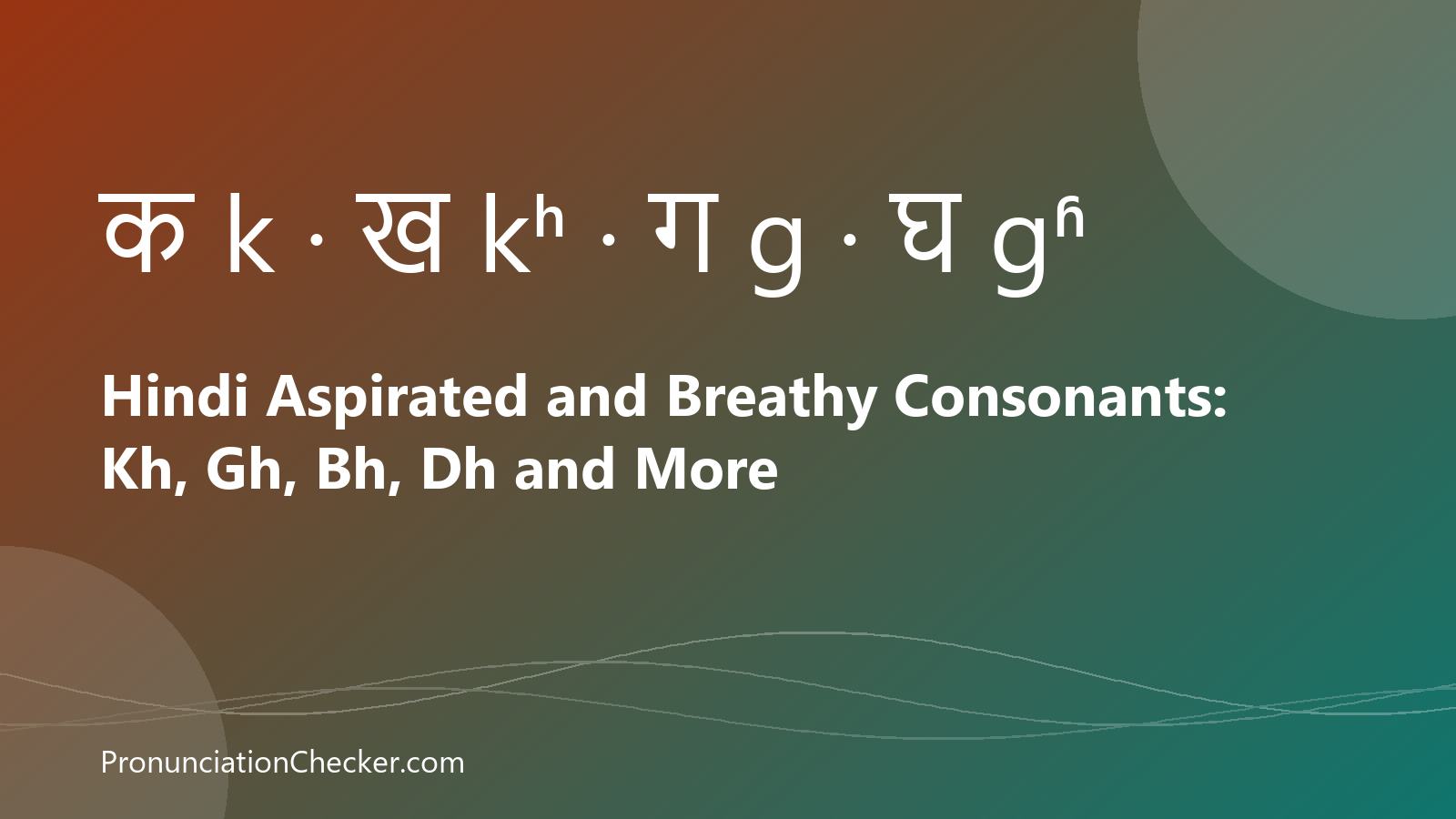
English has two kinds of stop consonant: voiceless (p, t, k) and voiced (b, d, g). Hindi has four, and all four change meaning. Kāl (time), khāl (skin) and gāl (cheek) differ only in their first consonant, and dān (donation) and dhān (paddy) differ only in breathiness. The same four-way contrast runs through every row of the Devanagari grid. For English speakers, this is the defining challenge of Hindi pronunciation.
The four-way contrast
| Type | Letters | How it is made | Example |
|---|---|---|---|
| Voiceless unaspirated | क च ट त प | no voice, no puff of air | kāl "time" |
| Voiceless aspirated | ख छ ठ थ फ | no voice, strong puff of air | khāl "skin" |
| Voiced | ग ज ड द ब | vocal folds vibrate | gāl "cheek" |
| Breathy voiced | घ झ ढ ध भ | vibrating with breathy, murmured release | ghar "house" |
Plain voiceless: no puff
This is the first adjustment. English speakers aspirate p, t, k at the start of words, so Hindi pal "moment" comes out as phal "fruit". To remove the aspiration, say English spin, stop, skin: after s, English p, t, k are unaspirated. Now say spin without the s. Hold your palm or a tissue in front of your mouth: it should not move for प, त, क.
Voiceless aspirated: a strong puff
The aspirated consonants are like English initial p, t, k but with even more air: phal, thālī "plate", khānā "food". Note that Hindi ph and th are not English f and th: फ is [pʰ] (though many speakers use [f] in some words) and थ is [t̪ʰ], a dental t with a puff, never the th of think.
Breathy voiced: the murmur
These are the sounds with no English equivalent. The vocal folds vibrate, but loosely, letting air leak through, so the release sounds breathy or sighing. Try these steps:
- Say English ahead slowly, with a voiced, "murmured" h in the middle, as in natural speech: [əˈɦɛd]. That h is breathy voice.
- Now put a b directly before it without a pause: a-bɦa. Keep voice going throughout; the breathiness should flow into the vowel.
- Try bhālū "bear", bhārat "India", dhūp "sunshine", ghar "house".
Two common errors: devoicing it into an aspirated voiceless sound (bhāī "brother" as phāī), or inserting a separate syllable ("b-hāī"). The breathy consonant is one sound, and the following vowel starts breathy and then clears.
Tip: breathy voice lowers the pitch of the following vowel. If you listen closely to bhāī, the vowel starts noticeably lower than in bāī. Imitating this pitch drop helps many learners.
Minimal pairs
| Plain | Aspirated / breathy |
|---|---|
| pal "moment" | phal "fruit" |
| kāl "time" | khāl "skin" |
| sāt "seven" | sāth "together" |
| kān "ear" | khān "mine (for minerals)" |
| dān "donation" | dhān "paddy" |
| bāg "garden" | bhāg "part; run!" |
| gaṛā "buried" | ghaṛā "clay pot" |
Items in this drill: pal / phal; kāl / khāl; sāt / sāth; kān / khān; dān / dhān; bāg / bhāg; gaṛā / ghaṛā; do / dho; tan / than.
Phrases in this drill:
- मेरा भाई घर पर है।
- मुझे फल खाना पसंद है।
- हम साथ में चलेंगे।
- धूप में मत बैठो।
- भारत बहुत बड़ा देश है।
Frequently asked questions
What does "breathy voiced" mean?
The vocal folds vibrate, as for a normal voiced sound, but they are held slightly apart so that extra air escapes, giving a murmured, sighing quality. In Hindi gh, jh, ḍh, dh and bh, this breathiness is heard mainly on the release of the consonant and the start of the following vowel.
Is Hindi "bh" like English "b" + "h"?
Not quite. It is a single consonant. English speakers often insert a clear h and a pause, "b-hārat". In Hindi the breathiness flows directly into the vowel: bhārat.
Are Hindi p, t, k like English p, t, k?
No. Hindi plain p, t, k have no aspiration at all, like the p in English spin. English initial p, t, k are aspirated, so to Hindi ears they sound like ph, th, kh.
Sources and further reading
- Ohala, M. (1999). Hindi. In Handbook of the International Phonetic Association, 100–103. Cambridge University Press.
- Dixit, R. P. (1989). Glottal gestures in Hindi plosives. Journal of Phonetics, 17(3), 213–237.
- Davis, K. (1994). Stop voicing in Hindi. Journal of Phonetics, 22(2), 177–193.
- Ladefoged, P. and Maddieson, I. (1996). The Sounds of the World's Languages, chapter 3 on phonation types. Blackwell.
Disclosure: this page links to Preply, a tutoring marketplace. If you book a lesson through that link we may earn a commission, at no extra cost to you. It does not change what is recommended here. See our disclaimer and privacy policy.
Practise Hindi out loud
Type any sentence, listen to a native voice, then record yourself and see which words a speech recogniser understood.
Open the practice page