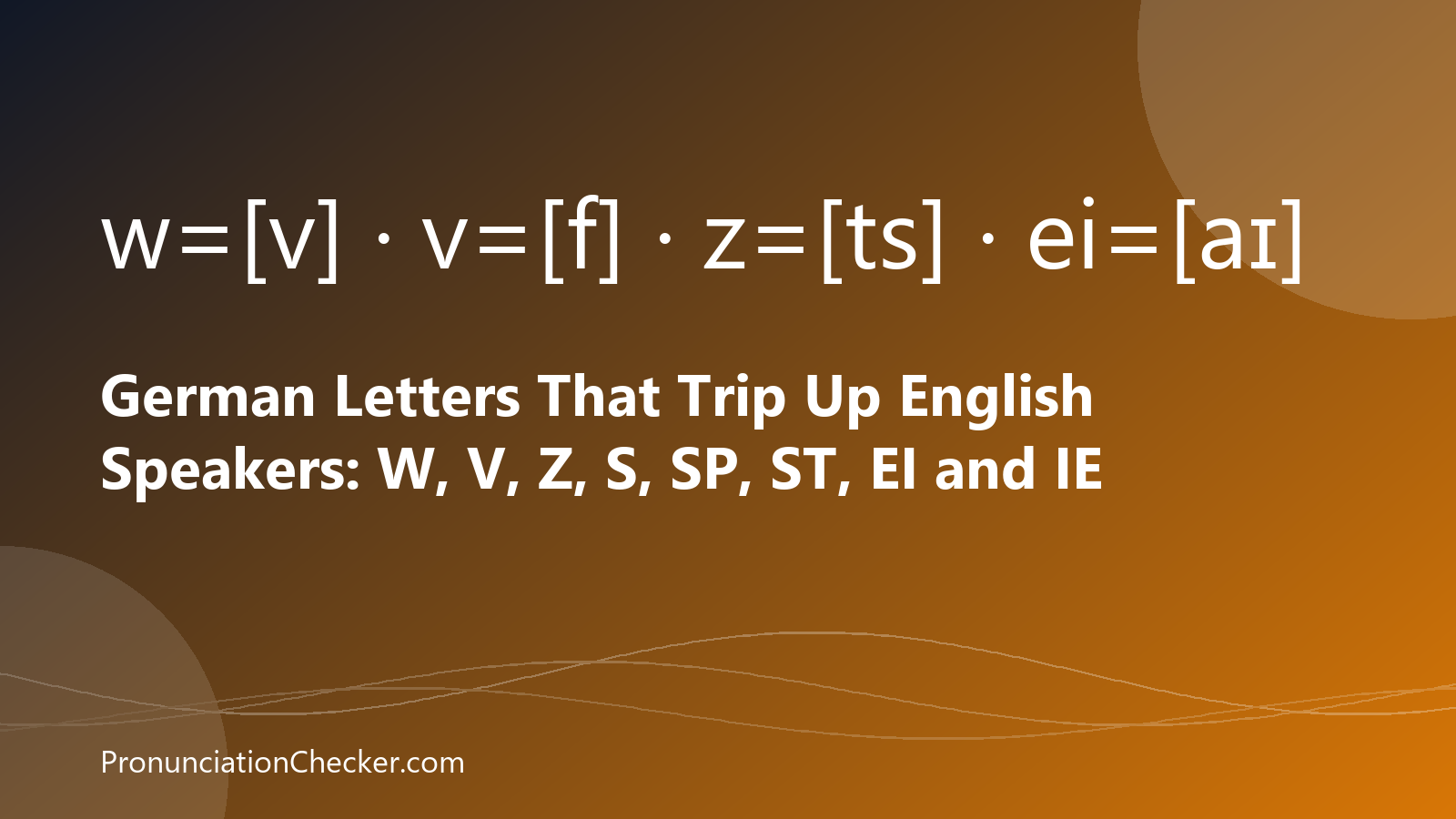
Most German letters sound roughly as an English speaker would expect. A small group do not, and because they appear in extremely common words (wie, was, wo, vier, viel, zu, zehn, sie, sein, mein), they cause errors in almost every sentence a beginner reads aloud. Here are the ones to fix first.
The quick reference
| Spelling | Sound | Like English... | Examples |
|---|---|---|---|
| w | [v] | v in very | |
| v | [f] (native words) | f in fine | |
| z, tz | [ts] | ts in cats | |
| s + vowel | [z] | z in zoo | |
| ß, ss | [s] | s in sun | |
| sp-, st- (start of stem) | [ʃp], [ʃt] | shp, sht | |
| sch | [ʃ] | sh | |
| ei, ai | [aɪ] | eye | |
| ie | [iː] | ee in see | |
| eu, äu | [ɔʏ] | oy in boy | |
| au | [aʊ] | ow in how | |
| j | [j] | y in yes | |
| qu | [kv] | kv | |
| pf | [p͡f] | p + f together |
W and V
Historically, German w was pronounced like English w, but it shifted to [v] centuries ago. Meanwhile v in native words became [f]. The result is a trap for English readers: wie is "vee", and vier is "feer". (wine) and (fine) differ only in [v] vs [f]; and (cousin) sound like "vetter" and "fetter".
Loanwords are the exception: v is [v] in , , and . If a word looks international, try [v].
Z
German z is always [ts], never the English [z]. English has the same sound at the end of words (cats, bits), so the only difficulty is putting it at the start. Practise by saying cats, then dropping the ca: ts... Zeit. Common words: , , , , , , , .
S, SS and ß
A single s before a vowel is voiced [z] in standard northern pronunciation: , , . At the end of a syllable it is [s]: , , . ss and ß are always [s]; the choice between them shows vowel length: ß after long vowels and diphthongs (, , ), ss after short vowels (, , ). Switzerland does not use ß at all.
At the start of a stem, sp and st are [ʃp] and [ʃt]: , , , . Inside or at the end of a stem, they are [sp] and [st]: , , , . In the north around Hamburg, some older speakers say [st] everywhere, famously "über den s-pitzen S-tein s-tolpern", but this is regional.
EI and IE
These two look alike and sound completely different. The rule of thumb: pronounce the name of the second letter in English. ei ends in i, so it says "eye": , , . ie ends in e, so it says "ee": , , .
They can even meet in one word: , , vs .
Watch sie, Sie, sein and seine. Sie (she, they, you) is [ziː]; sein (his; to be) is [zaɪn]. Mixing them up is one of the commonest beginner errors in reading.
EU and ÄU
Both spell [ɔʏ], similar to English boy but with rounded lips at the end: , , , , . Äu is used when the word is related to a form with au: Baum → Bäume, Haus → Häuser.
Read it right
Choose an answer to see the explanation.
1. How does vier (four) begin?
- [v], like English very
- [f], like English fear
- [w]
Answer: [f], like English fear. V in native German words is [f]: [fiːɐ̯].
2. How does Zeit (time) begin?
- [z], like English zoo
- [ts], like the end of cats
- [s]
Answer: [ts], like the end of cats. German z is always [ts]: [tsaɪt].
3. Which word rhymes with English "mine"?
- Miene
- meine
- Mine
Answer: meine. ei is [aɪ]: meine [ˈmaɪnə]. Miene and Mine have [iː].
4. How is Stein pronounced?
- [staɪn]
- [ʃtaɪn]
- [stiːn]
Answer: [ʃtaɪn]. st at the start of a stem is [ʃt], and ei is [aɪ].
5. How is Wasser pronounced?
- [ˈwɑsər]
- [ˈvasɐ]
- [ˈfasɐ]
Answer: [ˈvasɐ]. W is [v], ss is [s], and -er is [ɐ].
Phrases in this drill:
- Wie viel Zeit haben wir?
- Sie spielt Klavier seit zehn Jahren.
- Mein Vater trinkt viel Wasser.
- Die Straße ist zwei Kilometer lang.
- Heute sehen wir unsere Freunde wieder.
Frequently asked questions
How do I remember whether ei or ie is "eye"?
Say the second letter. In ei, the second letter is i, pronounced "eye": mein, Stein. In ie, the second letter is e, pronounced "ee": Liebe, viel.
Is German v ever pronounced like English v?
Yes, in many words borrowed from Latin, French or English: Vase, Vitamin, Klavier, Universität, Villa, Video. Native German words like Vater, viel, vier and Vogel use [f].
How is German s pronounced at the start of a word?
Before a vowel, it is voiced [z] in northern and central Standard German: Sonne, sagen, sieben. In southern Germany, Austria and Switzerland, it is often voiceless [s].
Sources and further reading
- Rat für deutsche Rechtschreibung (2018). Deutsche Rechtschreibung: Regeln und Wörterverzeichnis. Mannheim.
- Dudenredaktion (2015). Duden – Das Aussprachewörterbuch (7th ed.). Dudenverlag.
- Hall, C. (2003). Modern German Pronunciation (2nd ed.), chapter 1. Manchester University Press.
Disclosure: this page links to Preply, a tutoring marketplace. If you book a lesson through that link we may earn a commission, at no extra cost to you. It does not change what is recommended here. See our disclaimer and privacy policy.
Practise German out loud
Type any sentence, listen to a native voice, then record yourself and see which words a speech recogniser understood.
Open the practice page