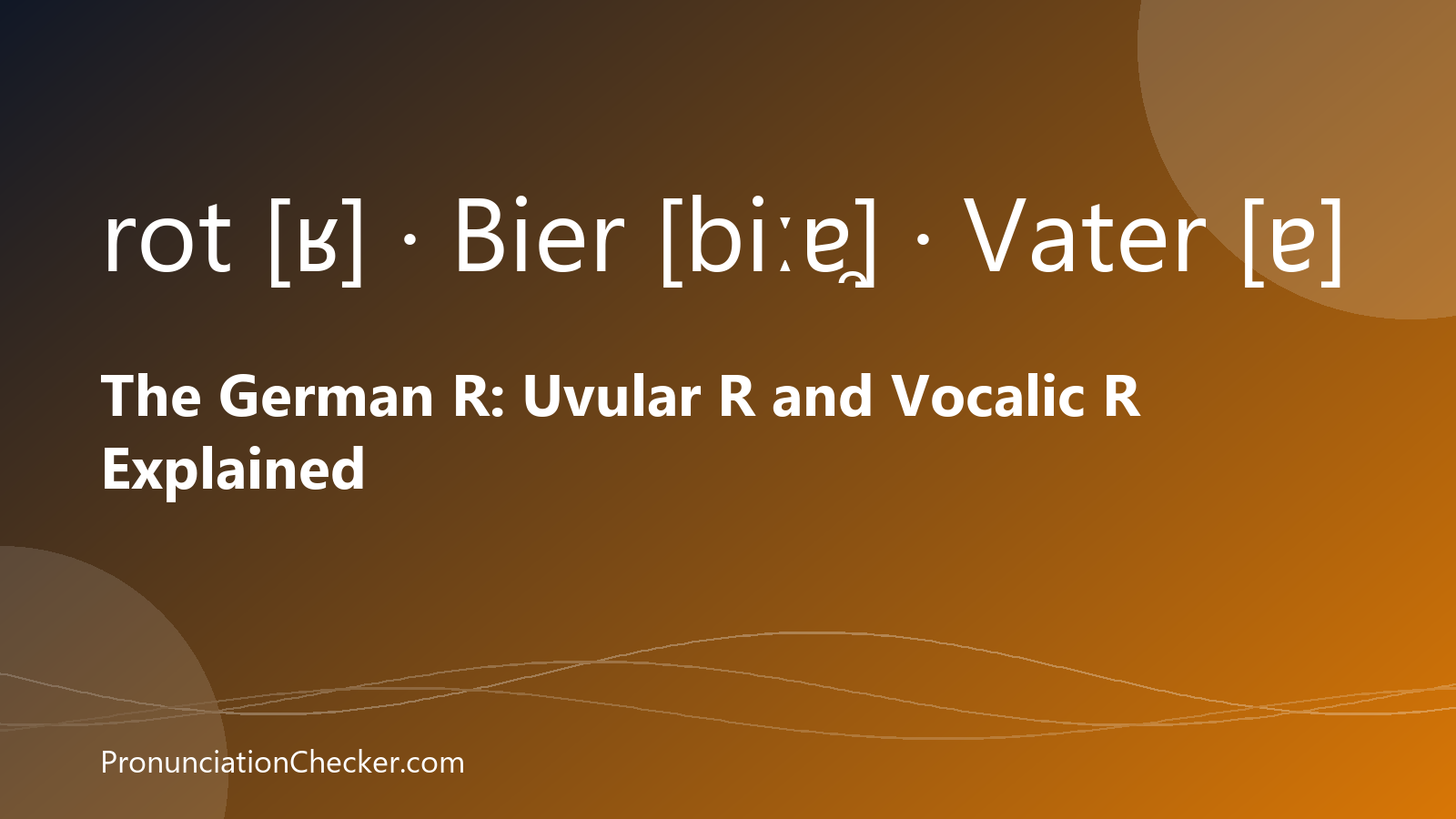
German has one R phoneme but two very different pronunciations. At the start of a syllable it is a consonant made at the back of the mouth, similar to the French R. After a vowel it often stops being a consonant at all and turns into a vowel, [ɐ]. English speakers usually get the first one wrong and do not know the second one exists.
Consonantal and vocalic R
| Position | Pronunciation | Examples |
|---|---|---|
| Start of a word or syllable | consonant [ʁ] (uvular), or [r] in some regions | |
| After a consonant | consonant [ʁ], often voiceless after p, t, k | |
| After a long vowel | vowel glide [ɐ̯] | |
| In the ending -er | vowel [ɐ] | |
| Prefixes er-, ver-, zer-, her- | vowel [ɐ] | |
| After a short vowel | varies: [ɐ̯] or weak [ʁ] |
The consonant: uvular [ʁ]
The standard R in most of Germany is made with the back of the tongue raised toward the uvula, as in French. It is usually a soft fricative or approximant, not a strong gargle. If you can make the German ach sound, [x], you are close: move it slightly further back and add voice. See the French R guide for step-by-step exercises, which work equally for German.
A tongue-tip R, trilled or tapped, is traditional in Bavaria, Austria and Switzerland, and it is fully accepted. What does not work is the English R, made by curling or bunching the tongue: to German ears it sounds unmistakably English.
The vowel: vocalic R
After a vowel, especially a long one, the German R is "vocalised". It becomes a weak, central vowel, [ɐ̯], that forms a diphthong with the preceding vowel:
- [hiːɐ̯] ("hee-uh")
- [tyːɐ̯]
- [oːɐ̯]
- [meːɐ̯]
- [uːɐ̯]
After long a, the [ɐ̯] often merges into the a completely: [jaːɐ̯] is frequently just [jaː], and sounds like [vaː].
Non-rhotic English helps. If you speak British, Australian or South African English, you already vocalise R after vowels: here is [hɪə], not [hɪr]. German works the same way. American English speakers need to consciously drop the R colouring.
The -er ending
Unstressed -er is the most frequent case, because it appears in so many nouns, comparatives and endings: , , , , . It is pronounced [ɐ], an open, central vowel close to the u of British cut or the a in sofa said with the mouth more open.
Contrast it with the ending -e, which is schwa [ə], a weaker, more closed sound. This difference distinguishes grammatical forms:
| -e [ə] | -er [ɐ] |
|---|---|
| (please) | (bitter) |
| (fair) | (knife) |
| (this, fem.) | (this, masc.) |
| (a, fem.) | (one) |
| (love) | (rather) |
Items in this drill: bitte / bitter; Messe / Messer; diese / dieser; eine / einer; Liebe / lieber; keine / keiner; gute / guter; neue / neuer.
Common mistakes
- English R at the start of words. Rot with an English R. Use the back of the tongue.
- American R after vowels. Bier as [bir] or Vater as "vahter". Vocalise it.
- Dropping it entirely after short vowels. In Wort, Karte and Berg, keep at least a hint of [ɐ̯] or a light [ʁ], or Karte (card) may sound like Katze.
- Confusing -er and -e, which changes grammar, as in the table above.
Phrases in this drill:
- Mein Bruder trinkt gern Bier.
- Der Lehrer ist hier.
- Wir fahren morgen früh nach Bremen.
- Das Wasser ist sehr kalt.
- Ich verstehe dich nicht.
Frequently asked questions
Can I use a rolled R in German?
Yes. A tongue-tip trill or tap is standard in parts of Bavaria, Austria and Switzerland, and it is accepted in Standard German, especially in singing and stage pronunciation. The uvular R is more common in Germany overall.
Is the German -er ending the same as English "uh"?
It is similar to the vowel of British English cut or but, [ɐ]. English speakers often use their own schwa or add an American R. Neither is right: -er is a clear, slightly open, unrounded vowel.
Why does German "Tür" sound like "Tü-uh"?
Because the r after a long vowel is vocalised: it turns into a short, weak [ɐ] glide. Tür is [tyːɐ̯], Uhr is [uːɐ̯].
Sources and further reading
- Wiese, R. (1996). The Phonology of German, chapter 8.4 on /r/. Oxford University Press.
- Kohler, K. (1990). German. Journal of the International Phonetic Association, 20(1), 48–50.
- Hall, C. (2003). Modern German Pronunciation (2nd ed.), chapter 6. Manchester University Press.
- Dudenredaktion (2015). Duden – Das Aussprachewörterbuch (7th ed.), introduction on r-vocalisation. Dudenverlag.
Disclosure: this page links to Preply, a tutoring marketplace. If you book a lesson through that link we may earn a commission, at no extra cost to you. It does not change what is recommended here. See our disclaimer and privacy policy.
Practise German out loud
Type any sentence, listen to a native voice, then record yourself and see which words a speech recogniser understood.
Open the practice page