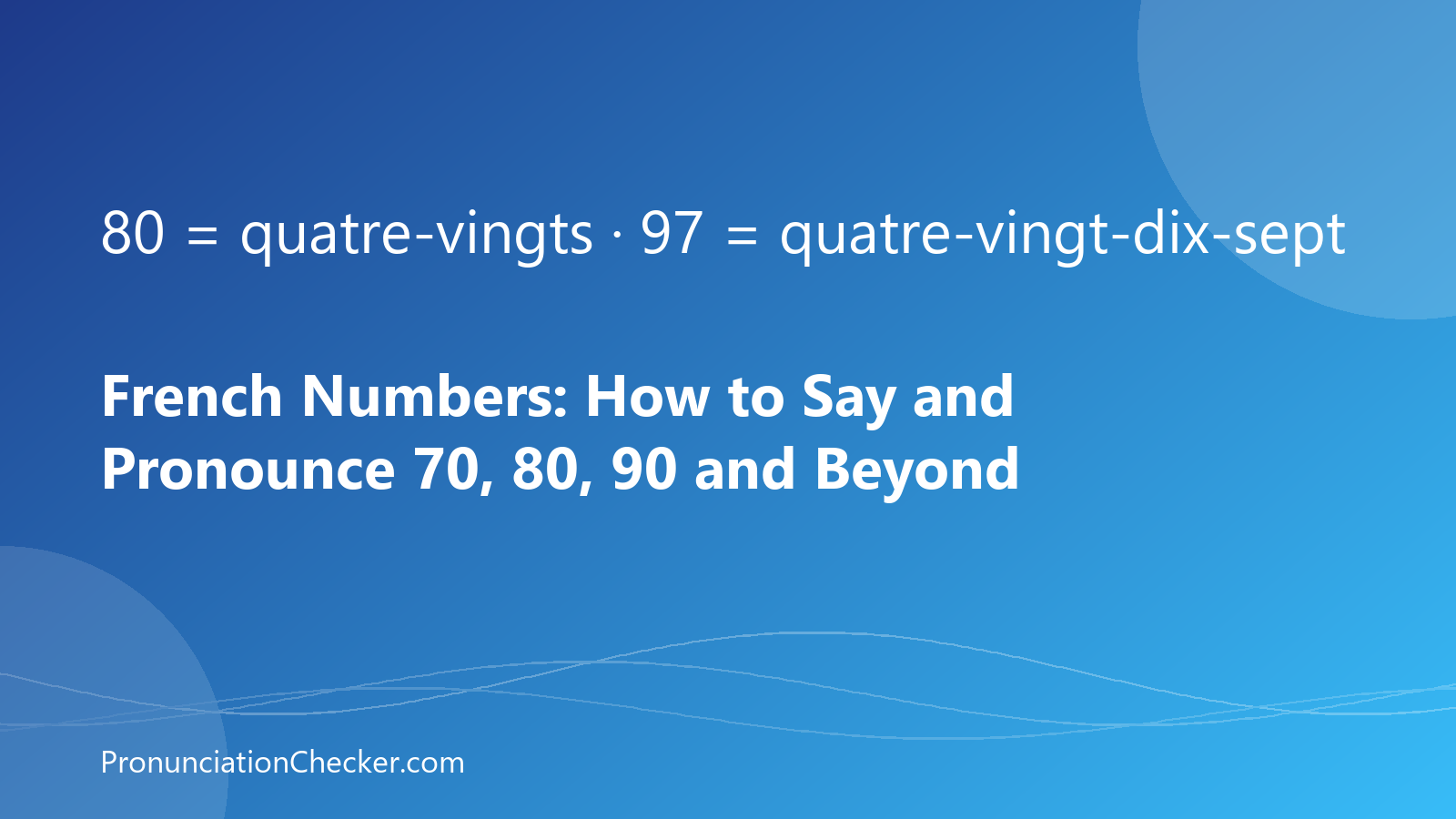
French numbers are straightforward up to 69, then suddenly turn into arithmetic: 70 is "sixty-ten", 80 is "four twenties" and 97 is "four twenties seventeen". Add a handful of numbers whose final consonant changes depending on the next word, and numbers become one of the most common sources of listening mistakes for learners.
0 to 20
| # | Word | IPA | # | Word | IPA |
|---|---|---|---|---|---|
| 0 | ze.ʁo | 11 | ɔ̃z | ||
| 1 | œ̃ / ɛ̃ | 12 | duz | ||
| 2 | dø | 13 | tʁɛz | ||
| 3 | tʁwa | 14 | ka.tɔʁz | ||
| 4 | katʁ | 15 | kɛ̃z | ||
| 5 | sɛ̃k | 16 | sɛz | ||
| 6 | sis | 17 | di.sɛt | ||
| 7 | sɛt | 18 | di.zɥit | ||
| 8 | ɥit | 19 | diz.nœf | ||
| 9 | nœf | 20 | vɛ̃ | ||
| 10 | dis |
Note the p of sept is silent, and the x of dix sounds like [z] in dix-huit and dix-neuf. Quatre is often reduced to [kat] in conversation.
The tens up to 69
(20), (30), (40), (50), (60). Units are joined with a hyphen, except that 1 is joined with et: , , but , . The t of vingt is pronounced from 21 to 29: vingt-deux is [vɛ̃t.dø], not [vɛ̃.dø].
70 to 99: the tricky part
| Number | French (France) | Literally |
|---|---|---|
| 70 | sixty-ten | |
| 71 | sixty and eleven | |
| 72 | sixty-twelve | |
| 77 | sixty-ten-seven | |
| 80 | four twenties | |
| 81 | four-twenty-one (no et) | |
| 85 | four-twenty-five | |
| 90 | four-twenty-ten | |
| 91 | four-twenty-eleven | |
| 97 | four-twenty-ten-seven | |
| 99 | four-twenty-ten-nine |
Pronunciation notes: the t of vingt is silent throughout the 80s and 90s: quatre-vingt-un is [ka.tʁə.vɛ̃.œ̃]. And quatre-vingts links to a following vowel with [z]: quatre-vingts ans [ka.tʁə.vɛ̃.zɑ̃].
The listening challenge is that the first part, soixante or quatre-vingt, arrives before you know the total. When you hear quatre-vingt-..., hold the 80 in your head and wait for the rest. French speakers themselves occasionally write down 4 before realising the number is 80-something.
Belgium and Switzerland
Belgian and Swiss French use more regular forms:
| Number | France | Belgium | Switzerland (most cantons) |
|---|---|---|---|
| 70 | soixante-dix | septante | |
| 71 | soixante et onze | septante et un | septante et un |
| 80 | quatre-vingts | quatre-vingts | |
| 90 | quatre-vingt-dix | nonante | |
| 99 | quatre-vingt-dix-neuf | nonante-neuf | nonante-neuf |
These are standard in their countries and understood in France, though French speakers from France rarely use them.
Hundreds and thousands
(100), (200), (201), (1,000), (2,000), (1,000,000). Note that cent and mille are never preceded by un: 100 is cent, not un cent. The plural s on cents and vingts appears only when the number ends there: deux cents but deux cent trois. Since the 1990 spelling reform, all parts of a compound number may be hyphenated (deux-cent-trois); both spellings are accepted.
Numbers whose sound changes
Several numbers change their final consonant depending on what follows. This is one of the most useful things to learn for listening:
| Number | Alone | Before a consonant | Before a vowel |
|---|---|---|---|
| six | [sis] | [si] | [siz] |
| dix | [dis] | [di] | [diz] |
| huit | [ɥit] | [ɥi] | [ɥit] |
| cinq | [sɛ̃k] | [sɛ̃k] or [sɛ̃] | [sɛ̃k] |
| neuf | [nœf] | [nœf] | [nœv] only in , |
| deux, trois | [dø], [tʁwa] | no change | liaison [z]: , |
Items in this drill: 60 / 70 / 80 / 90; 71 / 81 / 91; 16 / 17 / 66 / 76; 4 / 80 / 84; 96 / 76 / 86; 12 / 72 / 92; 13 / 73 / 93; 100 / 120 / 200.
The audio reads digits, so it uses your browser's standard French (France) forms.
Say it in French
Choose an answer to see the explanation.
1. 75 in standard French (France)
- septante-cinq
- soixante-quinze
- soixante-dix-cinq
Answer: soixante-quinze. 60 + 15: soixante-quinze. Septante-cinq is Belgian and Swiss.
2. 81
- quatre-vingt et un
- quatre-vingt-un
- quatre-vingts-un
Answer: quatre-vingt-un. No et in 81 or 91, and vingt has no s because a number follows.
3. 200
- deux cents
- deux cent
- deux centes
Answer: deux cents. Cent takes an s when multiplied and nothing follows it.
4. How is six pronounced in six livres?
- [sis]
- [si]
- [siz]
Answer: [si]. Before a consonant, the final consonant of six is silent.
Frequently asked questions
Why is 80 "quatre-vingts" in French?
It is a remnant of counting in twenties (vigesimal counting), which French shares with several European languages. Old French also had forms like "six-vingts" (120). The standard language kept the twenties only for 80 and, through 60 + 10–19, for 70–79 and 90–99.
Do all French speakers say soixante-dix?
No. Belgium and Switzerland use septante (70) and nonante (90). Most of French-speaking Switzerland also uses huitante (80), while Belgium keeps quatre-vingts. These forms are also heard in some eastern parts of France.
When does "vingt" and "cent" take an s?
When they are multiplied and end the number: quatre-vingts, deux cents. Not when another number follows: quatre-vingt-un, deux cent trois. Mille never takes an s.
Sources and further reading
- Grevisse, M. and Goosse, A. (2016). Le Bon Usage (16th ed.), sections on numerals (déterminants numéraux). De Boeck Supérieur.
- Académie française. Dictionnaire de l'Académie française, 9th edition, entries "vingt", "cent", "septante", "nonante".
- Conseil supérieur de la langue française (1990). Les rectifications de l'orthographe. Journal officiel de la République française, 6 December 1990.
Disclosure: this page links to Preply, a tutoring marketplace. If you book a lesson through that link we may earn a commission, at no extra cost to you. It does not change what is recommended here. See our disclaimer and privacy policy.
Hear any number in French
Type a number and hear it in French (France, Belgium or Switzerland), Spanish, German, Portuguese, Mandarin or Hindi, then test yourself with a listening quiz.
Open the number pronouncer