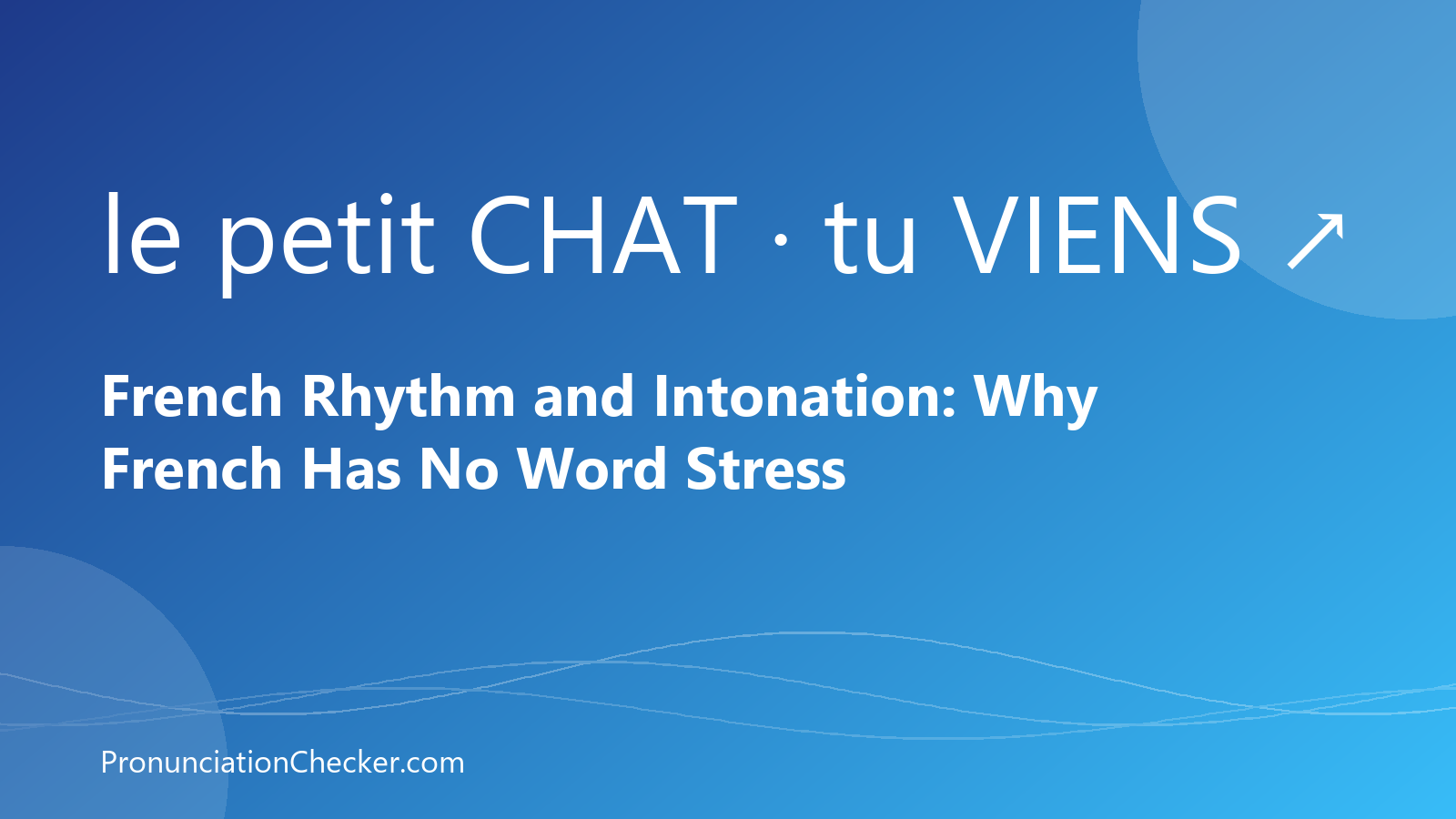
An English speaker can pronounce every French sound correctly and still sound unmistakably English, because of rhythm. English marks one stressed syllable in every word and squeezes the others. French does something completely different: it gives syllables roughly equal weight and saves its stress for the end of each group of words.
Rhythmic groups
French speech is divided into groupes rythmiques, short units of typically three to seven syllables that correspond to meaningful chunks: a noun with its article and adjectives, a verb with its pronouns, a prepositional phrase. Only the last full syllable of each group is stressed, meaning it is longer and usually higher or lower in pitch. The other syllables are roughly even.
Mon petit frère | habite à Marseille | depuis trois ans.
The consequence is that a word's stress moves as the phrase grows. The word petit is stressed on -tit said alone, but in petit chat the stress moves to chat, and in un petit chat noir it moves to noir:
- → petit
- → petit chat
- → un petit chat noir
What English speakers do wrong
English speakers carry over word stress, often on the first syllable, and reduce the others: restaurant becomes RES-tr'nt, important becomes im-POR-t'nt, and every word in a sentence gets its own little peak. To French ears this sounds jerky and can make words hard to recognise, because French listeners locate word boundaries partly by the stress at the end of groups.
| Word | English habit | French |
|---|---|---|
| RES-tau-rant | res-tau-rant, three even syllables with the last lengthened | |
| im-POR-tant | im-por-tant | |
| CA-na-da | ca-na-da | |
| pho-TO-gra-phy | pho-to-gra-phie |
A good exercise is to tap a finger for every syllable while reading a French sentence. The taps should be regular, with a slightly longer pause on the last syllable of each group.
Intonation patterns
Continuation rise
Inside a longer sentence, each group except the last usually ends with a rise, signalling "there is more to come". The final group falls. This gives French its characteristic up-up-up-down melody in lists and long sentences:
— rise on pain, fromage, pommes; fall on vin.
Statements
A simple statement ends with a fall:
Yes/no questions
French has three ways to ask a yes/no question, and intonation matters most in the first, which is the most common in conversation:
- Rising intonation on a statement: This is standard in everyday speech.
- Est-ce que: Neutral, common in all registers. The rise is optional.
- Inversion: Formal or written.
Question-word questions
Questions with où, quand, comment, pourquoi usually start high and fall: When the question word comes at the end, as in casual Tu vas où ?, the pitch often rises on it.
Emphatic stress
French does have a way to emphasise a single word: the accent d'insistance, a strong stress with a pitch peak, usually on the first syllable that begins with a consonant: C'est magnifique !, C'est incroyable !. It is optional and expressive, and it is common in the speech of politicians and news presenters. Do not confuse it with the regular phrase-final stress, which is always present.
Phrases in this drill:
- Mon petit frère habite à Marseille.
- Je voudrais réserver une table pour deux personnes.
- Tu viens avec nous ce soir ?
- C'est un restaurant très important.
- J'ai acheté du pain, du fromage et du vin.
Frequently asked questions
Does French have stress at all?
Yes, but at the level of the phrase, not the word. The last full syllable of each rhythmic group is longer and usually carries a pitch movement. Individual words do not have a fixed stressed syllable the way English words do.
What is the "accent d'insistance"?
It is an optional emphatic stress, often on the first syllable of a word, used to highlight it: c'est IN-croyable, c'est ab-so-LU-ment faux. It is common in speeches, journalism and emotional speech.
How do you ask a question with intonation in French?
In everyday French, the most common way to ask a yes/no question is simply to raise your pitch at the end of a statement: Tu viens ? This is fully standard in conversation.
Sources and further reading
- Di Cristo, A. (1998). Intonation in French. In D. Hirst and A. Di Cristo (eds.), Intonation Systems: A Survey of Twenty Languages, 195–218. Cambridge University Press.
- Jun, S.-A. and Fougeron, C. (2000). A phonological model of French intonation. In A. Botinis (ed.), Intonation: Analysis, Modelling and Technology, 209–242. Kluwer.
- Post, B. (2000). Tonal and Phrasal Structures in French Intonation. Holland Academic Graphics.
Disclosure: this page links to Preply, a tutoring marketplace. If you book a lesson through that link we may earn a commission, at no extra cost to you. It does not change what is recommended here. See our disclaimer and privacy policy.
Practise French out loud
Type any sentence, listen to a native voice, then record yourself and see which words a speech recogniser understood.
Open the practice page