American vs. British IPA: The ultimate online phonetic converter tool
Have you ever stumbled over the pronunciation of a word like "schedule," "aluminum," or "herb" when talking to someone from the other side of the Atlantic? You’re not alone. The divide between American and British English is one of the most fascinating aspects of the language, and it goes far beyond simple spelling differences. It lives and breathes in the very sounds we make.
For language learners, actors, linguists, or simply the curious, mastering these subtle phonetic differences can be a daunting task. This is where the International Phonetic Alphabet (IPA) becomes an indispensable tool. But what if you could instantly see these differences laid out clearly and accurately?
In this ultimate guide, we’ll dive deep into the world of American and British IPA, and introduce you to a powerful online phonetic converter that makes understanding these accents easier than ever.
First things first: What is the IPA?
Before we compare the accents, let's establish a common understanding of our key tool. The International Phonetic Alphabet (IPA) is a standardized system of phonetic notation. Think of it as a universal dictionary for sounds. Unlike the regular English alphabet, where one letter can represent multiple sounds (think 'c' in 'cat' vs. 'city'), each symbol in the IPA corresponds to one, and only one, distinct sound used in human speech.For example, the English word "thought" is spelled with 7 letters, but it has only 3 distinct sounds. In IPA, it's transcribed as /θɔːt/. This system eliminates the guesswork and provides a precise blueprint for pronunciation, regardless of the word's confusing spelling.
The great divide: Key differences between American and British IPA
While American and British English share the vast majority of their vocabulary and grammar, the pronunciation differences are systematic and significant. When you look at an IPA transcription, these differences become crystal clear. Let's break down the most important ones.
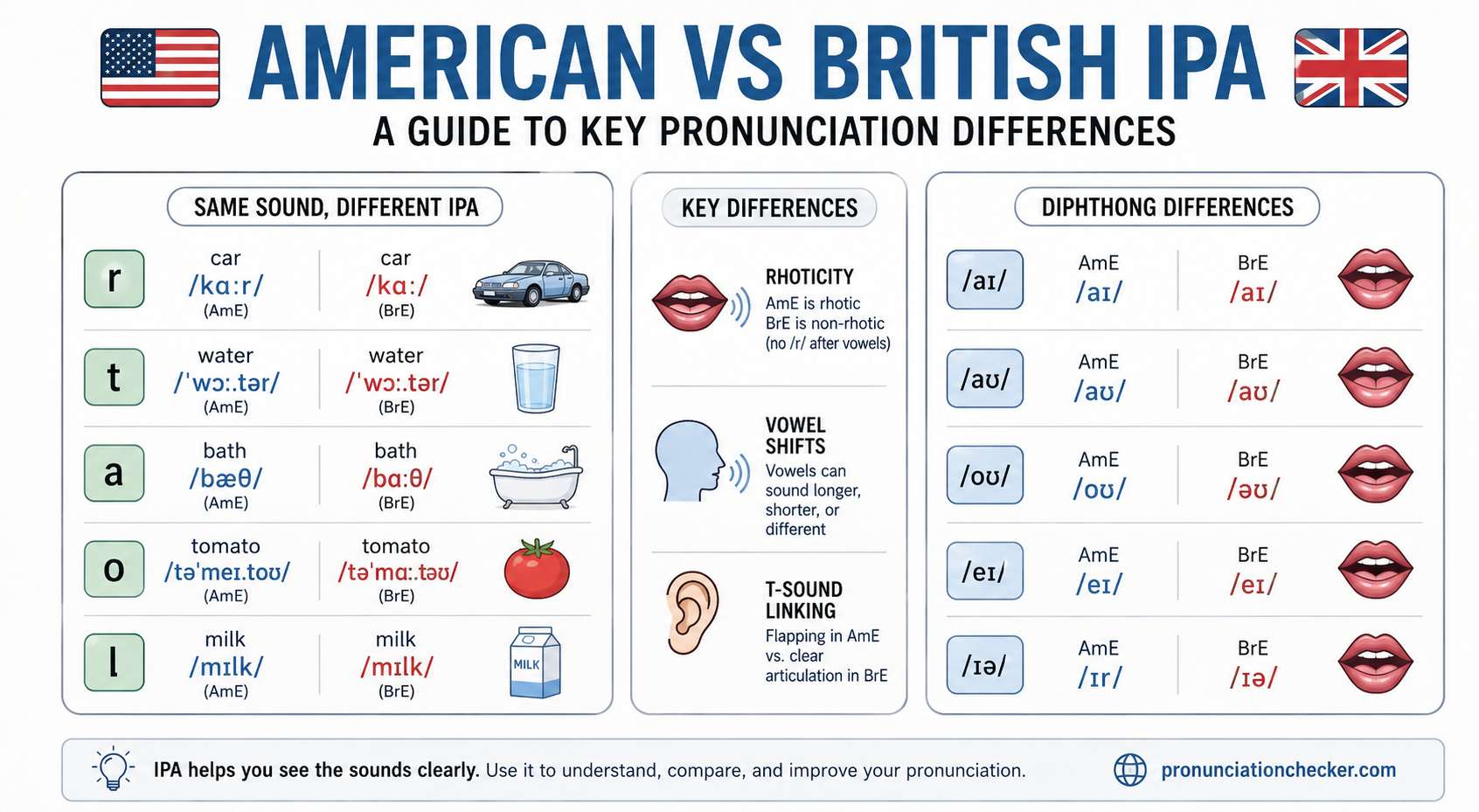
1. The rhotic 'R' (The most famous difference)
This is the single biggest differentiator between the two accents.
American English (GenAm): Rhotic. This means the /r/ sound is pronounced whenever it appears in the spelling. Whether it's at the start of a word like "red" /rɛd/, in the middle like "carrot" /ˈkærət/, or at the end like "car" /kɑːr/, you'll hear that distinct "r" sound.
British English (RP): Non-rhotic. In Received Pronunciation (the standard British accent), the /r/ sound is only pronounced when it is immediately followed by a vowel sound. So, you hear it in "red" /rɛd/ and "carrot" /ˈkærət/, but it disappears in "car" /kɑː/ and "hard" /hɑːd/. Instead, the vowel before the 'r' is often lengthened.
Example: "Water"
American IPA: /ˈwɔːtər/ (you hear the final 'r')
British IPA: /ˈwɔːtə/ (the final 'r' is silent, ending with a schwa /ə/)
2. The vowel in "bath," "dance," and "can't"
This is another classic distinction, often called the BATH-TRAP split.
American English: Uses a short front vowel /æ/ in these words. It's the same vowel sound as in "cat" or "trap."
bath: /bæθ/
dance: /dæns/
can't: /kænt/ (though the vowel can be lengthened before a nasal sound, it's
still the /æ/
quality)
British English (RP): Uses a long back vowel /ɑː/ in these words. It's the same sound as in "father" or "palm."
bath: /bɑːθ/
dance: /dɑːns/
can't: /kɑːnt/
3. The intrusive and linking 'R'
Because British English is non-rhotic, it has developed a feature to smooth out the transition between words. If a word ending in a vowel (or a silent 'r') is followed by a word beginning with a vowel, speakers often insert an /r/ sound to link them.
Example: "Law and order."
An American would say: /lɔː ænd ˈɔːrdər/ (no linking 'r' needed).
A British speaker might say: /lɔːr ən ˈɔːdə/ (inserting an 'r' between "law" and "and").
4. The 'T' sound: Tapping and glottal stops
The treatment of the /t/ phoneme is a major source of variation.
American English: Flap/Tap /ɾ/. When a /t/ sound appears between two vowels, Americans often pronounce it as a quick, soft "d" sound, known as a flap or tap.
"water": /ˈwɔːɾər/ (sounds like "wadder")
"butter": /ˈbʌɾər/ (sounds like "budder")
"city": /ˈsɪɾi/
British English: Glottal Stop /ʔ/. In many British accents (especially RP and Cockney), the /t/ sound is often replaced by a glottal stop when it appears at the end of a syllable. A glottal stop is the sound in the middle of "uh-oh."
"butter": /ˈbʌʔə/
"water": /ˈwɔːʔə/
"what": /wɒʔ/
5. Vowel quality in "lot," "God," and "stop"
American English: Uses an unrounded vowel /ɑ/ as in "spa" or "father."
lot: /lɑt/
god: /gɑd/
British English: Uses a rounded vowel /ɒ/.
lot: /lɒt/
god: /gɒd/
6. The yod-dropping
This refers to the omission of the /j/ (a "y") sound after certain consonants.
American English: Drops the /j/ sound after alveolar consonants like /t/, /d/, and /n/.
tune: /tuːn/ (not /tjuːn/)
duty: /ˈduːti/ (not /ˈdjuːti/)
new: /nuː/ (not /njuː/)
British English: Generally retains the /j/ sound in these words.
tune: /tjuːn/
duty: /ˈdjuːti/
new: /njuː/
Your secret weapon: The online phonetic converter tool
Manually learning all these IPA symbols and rules is a massive undertaking. This is where technology comes to the rescue. An online phonetic converter automates the entire process, giving you instant, accurate IPA transcriptions for any text you input.
The real power, however, lies in converters that offer side-by-side comparisons between American and British English. This feature is a game-changer for truly understanding the nuances we've just discussed.
One such powerful and user-friendly tool can be found at Pronunciation Checker. Their dedicated page for this specific purpose is an excellent resource: ToPhonetics: American and British English Converter.
Why this tool is a must-use
Let's see how using a tool like the one linked above transforms the learning process.
Step 1: Input your text. Simply type or paste the word or sentence you want to analyze. Let's use our earlier example: "I can't dance in the water."
Step 2: Select your accents. Choose both "American English" and "British English" (Received Pronunciation).
Step 3: Get instant, side-by-side IPA transcripts. The tool will generate two transcriptions, highlighting the differences. You would see something like:
American transcription: /aɪ kænt dæns ɪn ðə ˈwɔːtər/
British transcription: /aɪ kɑːnt dɑːns ɪn ðə ˈwɔːtə/
Instantly, you can spot:
- The different vowel in can't (/æ/ vs. /ɑː/).
- The different vowel in dance (/æ/ vs. /ɑː/).
- The presence of the rhotic /r/ at the end of water in American English and its absence in British English.
This visual, immediate comparison makes abstract phonetic concepts tangible and easy to grasp.
Practical applications: Who needs this tool?
This isn't just an academic exercise. A robust American vs. British IPA converter has real-world applications for a wide range of people.
1. For English language learners (ELL)
This is arguably the most important use case. If you are learning English, you must choose an accent target. This tool allows you to:
- Check pronunciation accurately without relying on unreliable spelling.
- Practice consistently in your chosen accent, avoiding a confusing mix of American and British sounds.
- Understand native speakers from different regions by seeing the phonetic patterns behind their speech.
2. For actors and voice-over artists
Accent work is a critical part of an actor's toolkit. Whether preparing for a role or a commercial, this tool provides a precise starting point.
- Script analysis: Convert your entire script into IPA to create a detailed pronunciation guide for yourself.
- Accent consistency: Ensure you maintain the same accent (e.g., British RP) throughout a performance by checking tricky words.
3. For teachers and linguists
- Lesson planning: Create clear, visual materials to teach pronunciation differences.
- Linguistic analysis: Quickly generate data for studying phonetic patterns and variations between the dialects.
4. For curious minds and travelers
If you simply love languages or are planning a trip, understanding these differences can enhance your appreciation of cultural nuances and help you be better understood.
Beyond the converter: Tips for mastering pronunciation
A converter gives you the map, but you still have to walk the path. Here’s how to use the IPA transcriptions effectively.
- Learn the key symbols: You don't need to memorize the entire IPA chart. Focus on the symbols that differ between the accents, like /ɑː/ vs. /æ/ and understanding the schwa /ə/.
- Listen and imitate: The IPA tells you what to say, but not exactly how to say it. Use the transcriptions in conjunction with listening to native speakers. YouTube, podcasts, and movies are great resources. Shadow their speech.
- Record yourself: Say the word, listen to the native pronunciation, and then compare it to a recording of yourself. This is the best way to identify areas for improvement.
- Start with Minimal Pairs: Practice pairs of words that only have one sound difference, like "cat" /kæt/ (American) and "cart" /kɑːt/ (British).
Conclusion: Bridge the accent gap with confidence
The journey into American and British pronunciation is a fascinating exploration of linguistic diversity. While the differences can seem complex, they are perfectly logical when viewed through the lens of the International Phonetic Alphabet. By leveraging a dedicated online tool like the American and British English IPA converter from Pronunciation Checker, you demystify these accents and gain a powerful, practical skill.
Whether your goal is fluency, a flawless performance, or simply deeper understanding, having the ability to see and compare the phonetic building blocks of speech is the ultimate advantage. Stop guessing how to pronounce words. Start knowing.
Ready to see the difference for yourself? Visit the Ultimate American vs. British IPA Converter Tool here!
Frequently asked questions
Why do British and American dictionaries transcribe the same word differently?
Because they describe different accents and follow different conventions. Go is /ɡəʊ/ in British and /ɡoʊ/ in American transcription, bird is /bɜːd/ against /bɝd/, hot is /hɒt/ against /hɑt/, and teacher is /ˈtiːtʃə/ against /ˈtitʃɚ/. Some American dictionaries also drop the length marks entirely. Neither system is more correct.
Which symbols differ most between the two systems?
The r-coloured vowels and the back vowels. American transcription uses /ɝ/ and /ɚ/ for the vowels of bird and teacher, where British uses /ɜː/ and /ə/ with no r. British /ɒ/ in hot corresponds to American /ɑ/, and British /əʊ/ in go corresponds to American /oʊ/. Front vowels such as /iː/, /ɪ/, /e/ and /æ/ are largely written the same in both.
Can I mix British and American pronunciations?
You can be understood, but consistency is worth aiming for. Mixing features — an American r with a British bath vowel, or British t with American stress patterns — is more noticeable to listeners than either accent used consistently, because they cannot form a stable expectation of how you speak. Choose one and let it settle before worrying about anything else.
Does a phonetic converter give British or American output?
It depends on the dictionary behind it, so check which variety a tool is set to before trusting its output. A converter configured for British English will not show the r in car or bird, and one configured for American English will show /ɑ/ rather than /ɒ/ in hot. Using a tool set to a different variety than you are learning produces confusing results.
Disclosure: this page links to Preply, a tutoring marketplace. If you book a lesson through that link we may earn a commission, at no extra cost to you. It does not change what is recommended here. See our disclaimer and privacy policy.
Convert a sentence both ways
Paste any English text and see its transcription in American and British IPA side by side.
Try the IPA converter