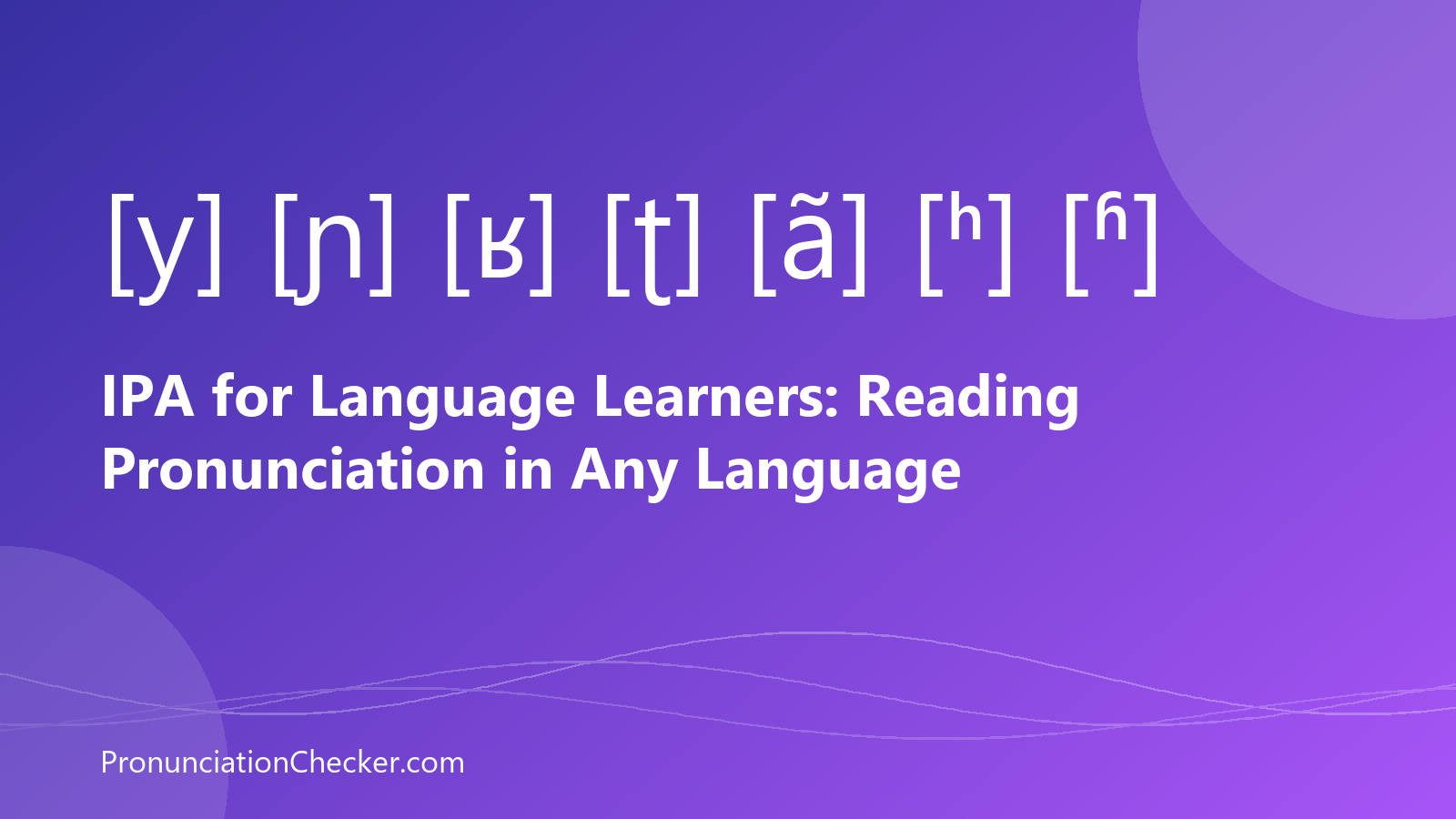
If you have used IPA to learn English, you already know most of the system. Other languages need a few extra symbols and diacritics, for sounds such as the French u, the Spanish ñ, Hindi retroflex and breathy consonants, and Mandarin tones. Once you can read them, every dictionary, textbook and Wikipedia pronunciation guide becomes usable, whatever the language.
Why IPA helps with other languages
Spelling systems mislead in different ways. Pinyin q is not a k sound, German w is [v], and Portuguese x has four values. IPA gives each sound one symbol, so q, ch and c across languages can be compared directly: pinyin q [tɕʰ], English ch [tʃ], Italian c before i [tʃ], Hindi छ [tʃʰ]. It also tells you what your ear might miss: length marks, nasal vowels and aspiration.
Vowel symbols you will need
| Symbol | Description | Examples |
|---|---|---|
| [y] | close front rounded: ee with rounded lips | French tu, German für, Mandarin lǜ |
| [ø] | close-mid front rounded | French deux, German schön |
| [œ] | open-mid front rounded | French peur, German können |
| [ɛ] / [e] | open-mid / close-mid front | Portuguese café / você |
| [ɔ] / [o] | open-mid / close-mid back rounded | Portuguese avó / avô |
| [ɐ] | near-open central | German Vater (-er), Portuguese unstressed a |
| [ɤ] | close-mid back unrounded | Mandarin è 饿 |
| [ɨ] | close central unrounded | European Portuguese unstressed e |
| [ə] | schwa, mid central | Hindi अ, French le, German bitte |
Consonant symbols
| Symbol | Description | Examples |
|---|---|---|
| [ɾ] / [r] | alveolar tap / trill | Spanish pero / perro |
| [ʁ] | voiced uvular fricative | French rouge, German rot |
| [x] / [ç] | velar / palatal voiceless fricative | German Bach / ich, Spanish jamón [x] |
| [ɲ] | palatal nasal | Spanish ñ, Portuguese nh, French gn |
| [ʎ] | palatal lateral | Portuguese lh |
| [β] [ð] [ɣ] | voiced bilabial, dental, velar fricatives/approximants | Spanish lobo, todo, lago |
| [ʈ] [ɖ] [ɳ] | retroflex stops and nasal | Hindi ट ड ण |
| [ɽ] | retroflex flap | Hindi ड़ in laṛkā |
| [ʂ] [ʈʂ] | retroflex fricative, affricate | Mandarin sh, zh |
| [ɕ] [tɕ] | alveolo-palatal fricative, affricate | Mandarin x, j |
| [ts] | alveolar affricate | German z, Mandarin z |
| [ʔ] | glottal stop | German be‿achten [bəˈʔaxtn̩] |
Diacritics that matter
- ː length: German [aː] in Staat vs [a] in Stadt; Hindi [iː] vs [ɪ].
- ◌̃ nasalisation: French [ɔ̃] bon, Portuguese [ɐ̃w̃] pão, Hindi [ãː] hā̃.
- ʰ aspiration: Hindi [kʰ] ख, Mandarin [pʰ] p. In English, aspiration is usually not written because it is predictable.
- ʱ breathy voice: Hindi [bʱ] भ, [ɡʱ] घ.
- ◌̪ dental: Hindi [t̪] त, Spanish [t̪]. Often omitted in broad transcriptions.
- ◌̯ non-syllabic (a glide in a diphthong): German [biːɐ̯] Bier.
- ˈ ˌ primary and secondary stress, placed before the stressed syllable.
- . syllable boundary: Spanish [pa.ˈis] país.
Writing tones
IPA has two ways to write tone. Tone letters draw the pitch contour on a five-level scale: Mandarin mā [ma˥], má [ma˧˥], mǎ [ma˨˩˦], mà [ma˥˩]. Chao's tone numbers express the same thing in digits: 55, 35, 214, 51. Most learner materials for Mandarin use pinyin tone marks instead, which are easier to read. See the four tones guide.
Traps when reading IPA across languages
- Broad vs narrow transcription. Dictionaries often write /r/ for any R sound. The French /r/ in a dictionary is actually [ʁ].
- Language-specific conventions. Some Mandarin materials write [i] for the buzzing vowel of sì and shì, which is misleading.
- Same symbol, slightly different sound. [e] in Spanish and [e] in German are close but not identical. IPA symbols define a region, not an exact point.
- English habits. [j] is the y of yes, not English j. [y] is a vowel.
Read the symbol
Choose an answer to see the explanation.
1. Which symbol represents the French u in tu?
- [u]
- [y]
- [ʊ]
Answer: [y]. [y] is the close front rounded vowel. [u] is the ou of tout.
2. What does ʰ after a consonant mean?
- Breathy voice
- Aspiration, a puff of air
- Length
Answer: Aspiration, a puff of air. Breathy voice is ʱ; length is ː.
3. What does [ɲ] sound like?
- ng in sing
- ny in canyon
- n + y separately
Answer: ny in canyon. [ɲ] is the palatal nasal: Spanish ñ, Portuguese nh.
4. In [pa.ˈis], where is the stress?
- pa
- is
- nowhere
Answer: is. The stress mark ˈ is placed before the stressed syllable.
Frequently asked questions
Is IPA the same in every language?
The symbols have the same meaning everywhere, but dictionaries for different languages make different choices about how much detail to show. A Spanish dictionary may write /b/ where a phonetician would write [β], and English dictionaries use conventions of their own.
What is the difference between slashes and square brackets?
Slashes /.../ show phonemes, the sounds that distinguish words in a language. Square brackets [...] show the actual pronunciation, including details that do not change meaning. Spanish dedo is /ˈdedo/ phonemically but [ˈde.ðo] phonetically.
How do I learn IPA symbols for sounds my language does not have?
Learn each symbol together with its articulatory description (for example, [y] is a close front rounded vowel) and an audio example. The descriptions tell you exactly what to do with your tongue and lips, which is more reliable than comparing to a sound in your own language.
Sources and further reading
- International Phonetic Association (1999). Handbook of the International Phonetic Association. Cambridge University Press.
- International Phonetic Association (2020). The International Phonetic Alphabet (revised to 2020). Chart available at internationalphoneticassociation.org.
- Ladefoged, P. and Johnson, K. (2014). A Course in Phonetics (7th ed.). Cengage Learning.
Disclosure: this page links to Preply, a tutoring marketplace. If you book a lesson through that link we may earn a commission, at no extra cost to you. It does not change what is recommended here. See our disclaimer and privacy policy.
Practise English out loud
Type any sentence, listen to a native voice, then record yourself and see which words a speech recogniser understood.
Open the practice page