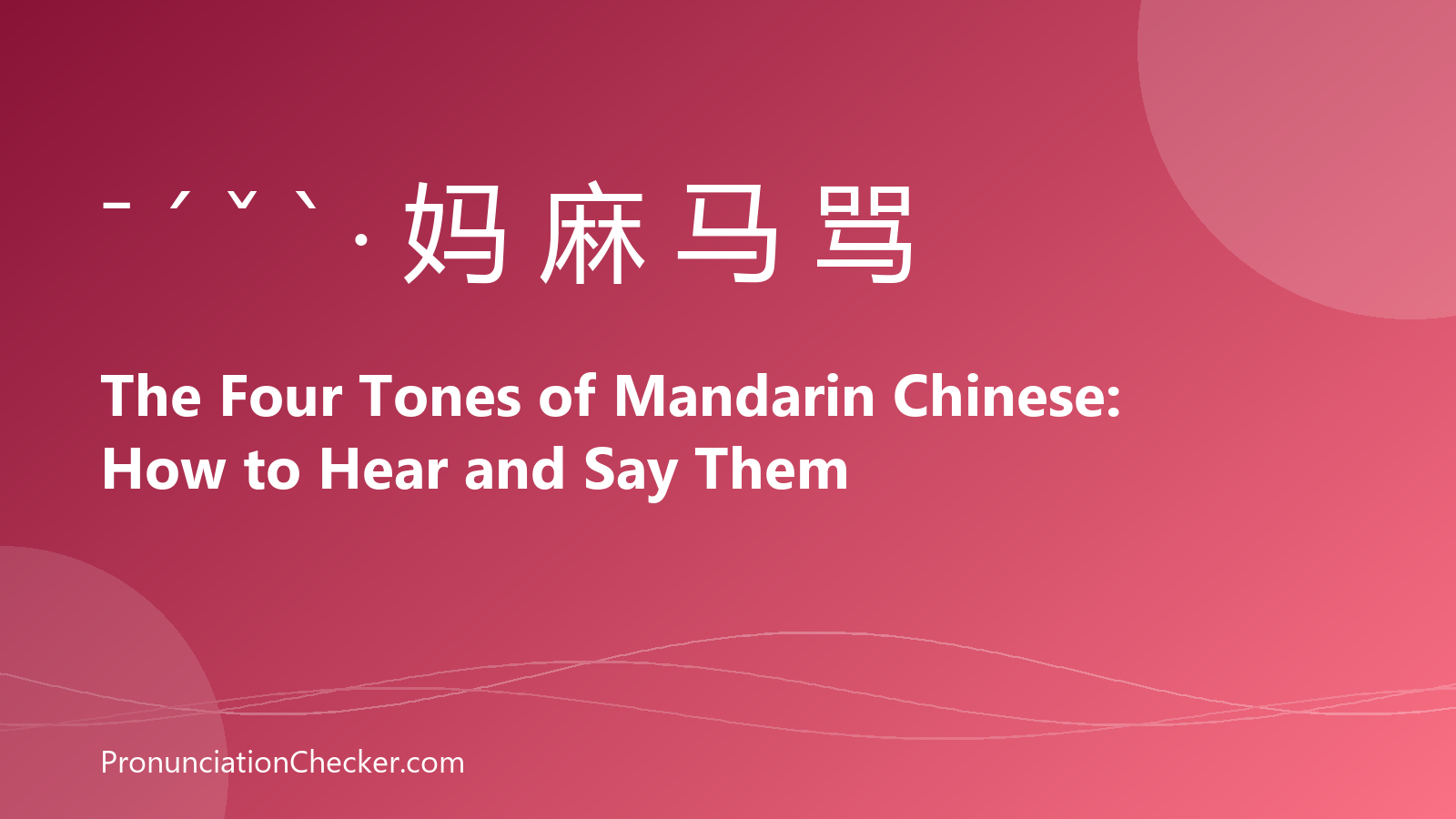
Every Mandarin syllable carries a tone, a pitch pattern that is as much a part of the word as its vowels and consonants. Mǎi means "buy" and mài means "sell". English uses pitch too, but for emotion and emphasis, never to change the dictionary meaning of a word. That is why tones feel strange at first, and why most English speakers can learn them once they stop treating pitch as expression.
The four tones
Chao's pitch numbers describe each tone on a five-point scale, 1 being the bottom of your comfortable range and 5 the top:
| Tone | Mark | Contour | Description | Try |
|---|---|---|---|---|
| 1 | ā | 55 | High and flat, held steady like a sung note | |
| 2 | á | 35 | Rising from middle to high, like a surprised English "What?" | |
| 3 | ǎ | 214 (21 in most contexts) | Low, often creaky; dips then rises only when said alone | |
| 4 | à | 51 | Sharp fall from high to low, like a firm "No!" |
Getting each tone right
First tone: high and level
Pitch it higher than you think, at the top of your normal speaking range, and keep it flat. English speakers tend to start it too low or let it fall at the end, which makes it sound like a fourth tone.
Second tone: rising
Start in the middle and rise clearly to the top. Imagine asking "Huh?" or "Really?". A common error is starting too high, so the rise is small and it sounds like a first tone.
Third tone: low
This is the most misunderstood tone. Textbooks show it as 214, a dip followed by a rise. But the full dip-and-rise only happens when the syllable is said alone or at the end of a phrase with emphasis. In running speech, before another syllable, it is simply a low tone, 21, often with a creaky voice quality. Learners who always produce the full dip sound slow and exaggerated. Before another third tone, it changes to a second tone: see tone sandhi.
Fourth tone: falling
Start high and fall fast and far. English speakers often do a soft, short fall that sounds like a first tone. Think of the way you might say "Go!" to a dog, or "Damn!".
Words that differ only in tone
- buy / sell
- soup / sugar / lie down / scalding
- poem / ten / to make / to be
- ask / kiss
- vs is useful to know at dinner.
Items in this drill: mā · 1 / má · 2 / mǎ · 3 / mà · 4; bā · 1 / bá · 2 / bǎ · 3 / bà · 4; tāng · 1 / táng · 2 / tǎng · 3 / tàng · 4; shī · 1 / shí · 2 / shǐ · 3 / shì · 4; wēn · 1 / wén · 2 / wěn · 3 / wèn · 4; qī · 1 / qí · 2 / qǐ · 3 / qì · 4; zhū · 1 / zhú · 2 / zhǔ · 3 / zhù · 4; fān · 1 / fán · 2 / fǎn · 3 / fàn · 4; guō · 1 / guó · 2 / guǒ · 3 / guò · 4; yī · 1 / yí · 2 / yǐ · 3 / yì · 4.
Single characters are read by your browser's Chinese voice. Some voices read isolated characters with a slightly exaggerated tone, which is actually helpful at this stage.
What English speakers do wrong
- Letting sentence intonation override tones. In English, a question rises at the end. In Mandarin, a fourth-tone word at the end of a question still falls: shì ma?
- Using too narrow a pitch range. Mandarin speakers use a wider range than English speakers do in neutral speech. Exaggerate at first.
- Making every third tone a full dip. Use a low tone in the middle of phrases.
- Learning words without their tones. Always learn the tone as part of the word, and say it aloud.
How to practise
- Hum it. Hum the pitch contour without the syllable, then add the syllable.
- Use your hand. Trace the tone in the air: flat, up, down-and-flat, down.
- Listen more than you speak at first. Perception training, like the drill above, improves production too.
- Practise pairs, not just single syllables. Tones interact; see tone pairs.
Frequently asked questions
Can I be understood without tones?
In context, sometimes, but it is hard work for the listener. Many words differ only in tone, and a sentence with wrong tones can be as confusing as an English sentence with the wrong vowels. Tones are worth learning properly.
Which tones are hardest to tell apart?
For most learners, the second and third tones. Both start fairly low and can rise, and a third tone before another third tone actually becomes a second tone. Listening for the low, creaky start of the third tone helps.
Can adults learn to hear tones?
Yes. In a well-known study by Wang and colleagues (1999), American adults improved their tone identification by about 21 percentage points after two weeks of listening training, and the improvement carried over to new words and voices.
Sources and further reading
- Chao, Y. R. (1968). A Grammar of Spoken Chinese. University of California Press.
- Xu, Y. (1997). Contextual tonal variations in Mandarin. Journal of Phonetics, 25(1), 61–83.
- Wang, Y., Spence, M. M., Jongman, A. and Sereno, J. A. (1999). Training American listeners to perceive Mandarin tones. Journal of the Acoustical Society of America, 106(6), 3649–3658.
- Duanmu, S. (2007). The Phonology of Standard Chinese (2nd ed.), chapter 11. Oxford University Press.
Disclosure: this page links to Preply, a tutoring marketplace. If you book a lesson through that link we may earn a commission, at no extra cost to you. It does not change what is recommended here. See our disclaimer and privacy policy.
Train your ear for tones
The tone trainer plays single syllables and two-syllable words and asks you to identify the tones, with instant feedback.
Open the tone trainer