Umlauts are the most distinctive letters in German, and they matter: schon (already) and schön (beautiful), Mutter (mother) and Mütter (mothers), zahlen (to pay) and zählen (to count) are different words. Two of the three umlaut vowels have no English equivalent, but they are made with a simple trick.
The principle: front tongue, round lips
English pairs front vowels with spread lips (see, say) and back vowels with rounded lips (too, go). German ü and ö break this pattern: the tongue is at the front, as for ee or ay, while the lips are rounded, as for oo or oh. Linguists call these front rounded vowels.
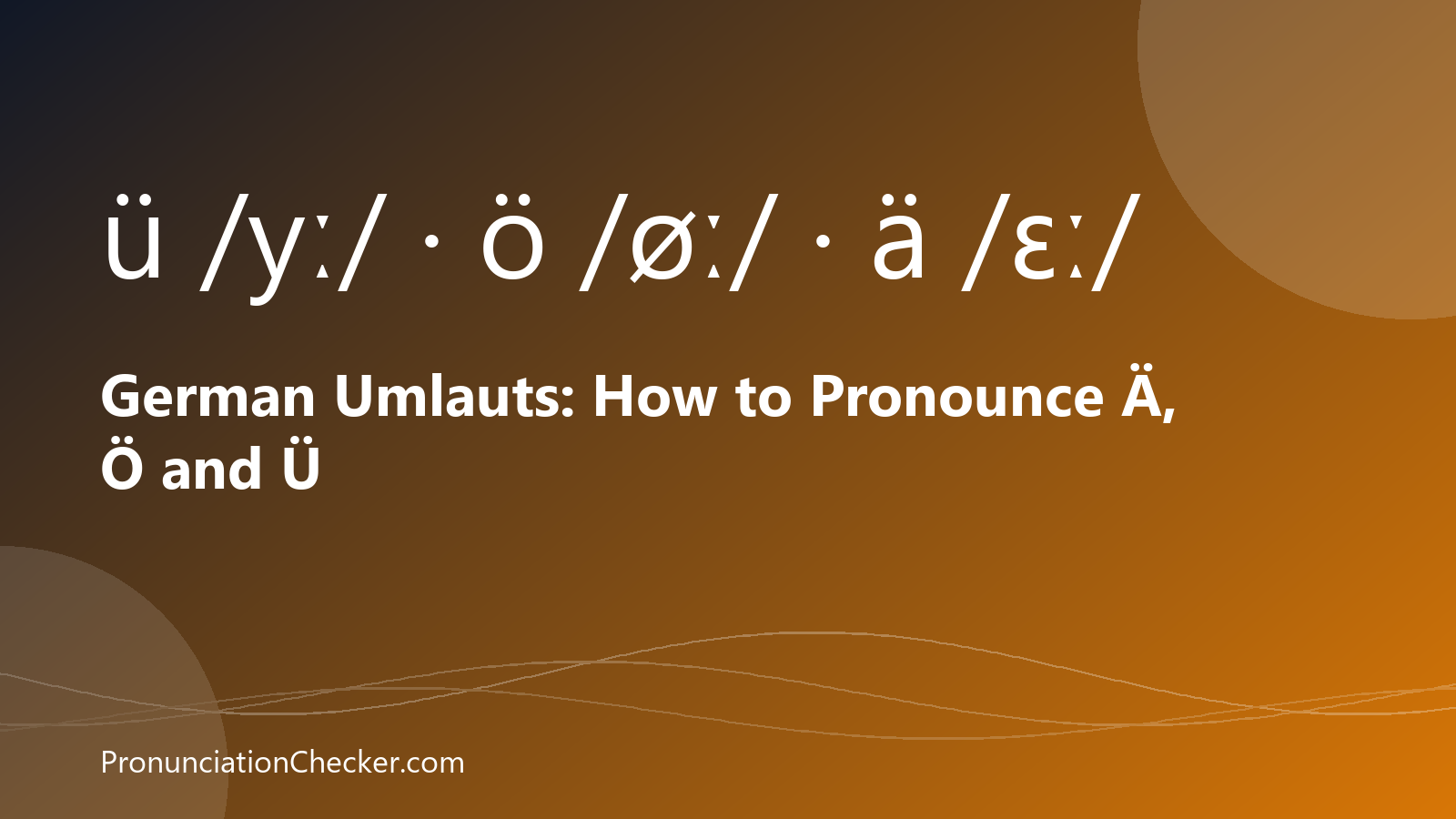
| Umlaut | Long | Short | Tongue as for | Lips as for |
|---|---|---|---|---|
| ü | [yː] , , | [ʏ] , , | ee (long) / i in sit (short) | oo |
| ö | [øː] , , | [œ] , , | ay without glide / e in bed | oh |
| ä | [ɛː] , , | [ɛ] , , | e in bed, held longer | spread, as normal |
Ä is the easy one: it is not a front rounded vowel at all, just an open e sound. Short ä is identical to short e.
How to say ü
- Say a long English eeee, as in see.
- Without moving your tongue, round your lips tightly, as if to whistle or say oo.
- The sound you hear is long ü: , , .
- For short ü, start from the i of sit instead and keep it short: , , .
A mirror helps: lips should be pushed forward and rounded, while the tongue tip stays behind the lower front teeth. If the sound becomes oo, your tongue has slipped back.
How to say ö
- Say a pure German long e, , with no glide.
- Keeping your tongue still, round your lips as for oh.
- That is long ö: , , .
- For short ö, start from the e of bed and round loosely: , , .
Common mistakes: English speakers often replace ü with oo or with you, and ö with the vowel of her or burn. The her vowel is closer than you might think to short ö, but it has no lip rounding. Round your lips firmly.
Minimal pairs
Umlauts mark plurals, comparatives, subjunctives and derived words, so pairs are everywhere:
| Without umlaut | With umlaut |
|---|---|
| (already) | (beautiful) |
| (mother) | (mothers) |
| (brother) | (brothers) |
| (drove) | (for) |
| (cake) | (kitchens) |
| (to pay) | (to count) |
| (bird) | (birds) |
| (to print) | (to press) |
| (had to) | (would have to) |
And ü contrasts with i, which is the mistake many learners make once they stop saying oo:
- (pillow) / (to kiss) · (animal) / (door) · (four) / (for)
Items in this drill: schon / schön; Mutter / Mütter; Bruder / Brüder; fuhr / für; Kuchen / Küchen; zahlen / zählen; Vogel / Vögel; drucken / drücken; musste / müsste; Kissen / küssen; Tier / Tür; lesen / lösen.
Why learning umlauts pays off
Because umlaut is grammatical, getting it right is not just about accent:
- Plurals: → , → , → .
- Comparatives: → , → , → .
- Verb forms: → , , , and the subjunctive , , .
In ich würde vs ich wurde ("I would" vs "I became") the umlaut is the only difference between conditional and past.
Phrases in this drill:
- Das Mädchen ist sehr schön.
- Ich würde gern fünf Brötchen kaufen.
- Die Tür ist schon offen.
- Meine Brüder sind älter als ich.
- Können Sie mir bitte helfen?
Frequently asked questions
How do you type umlauts if you do not have them on your keyboard?
The accepted substitutes are ae, oe and ue: Mueller for Müller, schoen for schön. They are used in email addresses, URLs and crossword puzzles.
Is "ä" pronounced the same as "e"?
Short ä is identical to short e: Äpfel and Eltern have the same first vowel. Long ä is traditionally [ɛː], more open than long e [eː], but many speakers, especially in northern Germany, pronounce it as [eː], so Ähre and Ehre sound the same.
Why do umlauts appear in plurals?
Umlaut originally was a sound change in which a vowel moved forward in anticipation of an i in the next syllable. Those i's have since disappeared, but the changed vowels remain as a grammatical marker: Mutter/Mütter, Buch/Bücher.
Sources and further reading
- Kohler, K. (1990). German. Journal of the International Phonetic Association, 20(1), 48–50.
- Hall, C. (2003). Modern German Pronunciation (2nd ed.), chapter 3. Manchester University Press.
- Wiese, R. (1996). The Phonology of German, chapter 7 on umlaut. Oxford University Press.
Disclosure: this page links to Preply, a tutoring marketplace. If you book a lesson through that link we may earn a commission, at no extra cost to you. It does not change what is recommended here. See our disclaimer and privacy policy.
Practise German out loud
Type any sentence, listen to a native voice, then record yourself and see which words a speech recogniser understood.
Open the practice page