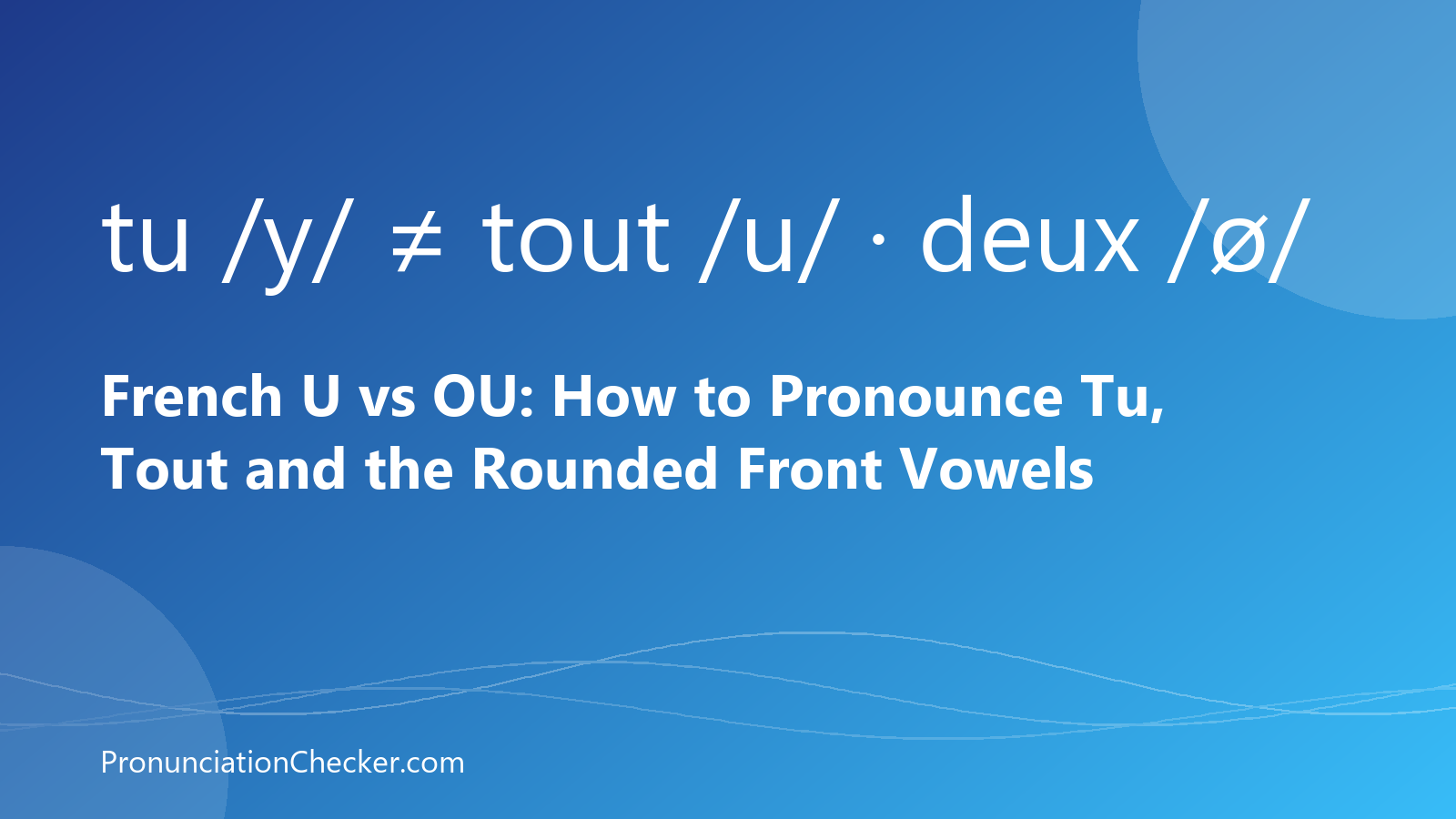
If you learn only one new vowel in French, make it the u of tu. It appears in some of the most frequent words in the language (tu, du, une, sur, plus, rue), and the English-speaker substitute, the ou of tout, produces a different word. Tu es sûr ? (Are you sure?) and Tout est sous... are not the same sentence.
Three vowels English does not have
French has three front rounded vowels: sounds made with the tongue at the front of the mouth, as for ee or ay, but with rounded lips. English only rounds its back vowels, as in food and go, so these combinations feel unnatural at first.
| IPA | Spelling | Examples | Tongue as for... | Lips as for... |
|---|---|---|---|---|
| /y/ | u, û | ee in see | oo in food | |
| /ø/ | eu, œu (end of syllable) | ay in say, without glide | o in go | |
| /œ/ | eu, œu (before a pronounced consonant) | e in bed | loosely rounded |
How to make /y/
- Say a long English eeee. Notice where your tongue is: high and forward, the tip behind the lower teeth.
- Keep saying eeee and slowly round your lips as if to whistle. Do not let your tongue move back.
- The sound changes from [i] to [y]. That is French .
- Check in a mirror: lips tightly rounded and pushed forward. Put a finger on your tongue tip if necessary: it should still be touching the back of your lower teeth.
The opposite exercise also helps: start with and, keeping your lips rounded, push your tongue forward. When the sound becomes brighter, you have [y].
Common mistake: saying u as English you, [juː]. French /y/ has no y glide in front of it. Tu is one steady vowel, not "t-you".
Minimal pairs: u vs ou
| /y/ | Meaning | /u/ | Meaning |
|---|---|---|---|
| you | all | ||
| seen | you (formal) | ||
| street | wheel | ||
| on top | underneath | ||
| been able | louse | ||
| drunk | end | ||
| known | under | ||
| read | wolf |
Dessus and dessous are the classic trap: mixing them up means saying the opposite of what you mean.
Items in this drill: tu / tout; vu / vous; rue / roue; dessus / dessous; pu / pou; bu / bout; su / sous; lu / loup; nu / nous; mule / moule; russe / rousse; pur / pour.
The eu vowels: /ø/ and /œ/
Once you can make /y/, the eu vowels follow the same principle, with the tongue a little lower. Start from a pure French (no glide) and round your lips: you get /ø/, as in . Open the mouth further, from the e of bed, and round loosely: /œ/, as in .
The choice between them is mostly predictable: /ø/ at the end of a syllable (, ) and before a /z/ sound (); /œ/ before any other pronounced consonant (, , ). A few words contrast them, the best known being (fasting, /ø/) and (young, /œ/), but many speakers do not distinguish these.
Do not confuse eu with the schwa in or : for most speakers the schwa is very close to /ø/ or /œ/ in quality, but it can be dropped, while eu never is.
Practice routine
- One minute of i → y → i → y, moving only your lips.
- Read the minimal pairs aloud, recording yourself, then compare with the audio.
- Do the listening drill until you score at least 9 out of 10.
- Practise the sentences below, which pack /y/ and /u/ close together.
Phrases in this drill:
- Tu as vu la rue ?
- Nous avons tous bu du jus.
- Le loup est sous la roue.
- Je suis sûr que tu es venu.
- Il a deux sœurs plus jeunes.
Frequently asked questions
Is French u the same as German ü?
They are essentially the same sound, the close front rounded vowel [y]. French eu in deux corresponds closely to German ö in schön.
Why do English speakers find the French u so hard?
English has no front rounded vowels, so at first the ear files [y] as a kind of [u]. The good news from research is that it can be learned: in Flege's 1987 study, experienced English-speaking learners produced French /y/ quite accurately, while the "similar" French /u/ stayed English-like for longer.
Is the u in "une" the same as in "tu"?
Yes. All of tu, du, une, sur, rue, plus, vu and bu have the same /y/ vowel.
Sources and further reading
- Fougeron, C. and Smith, C. L. (1993). French. Journal of the International Phonetic Association, 23(2), 73–76.
- Levy, E. S. and Strange, W. (2008). Perception of French vowels by American English adults with and without French language experience. Journal of Phonetics, 36(1), 141–157.
- Flege, J. E. (1987). The production of "new" and "similar" phones in a foreign language: evidence for the effect of equivalence classification. Journal of Phonetics, 15(1), 47–65.
Disclosure: this page links to Preply, a tutoring marketplace. If you book a lesson through that link we may earn a commission, at no extra cost to you. It does not change what is recommended here. See our disclaimer and privacy policy.
Practise French out loud
Type any sentence, listen to a native voice, then record yourself and see which words a speech recogniser understood.
Open the practice page