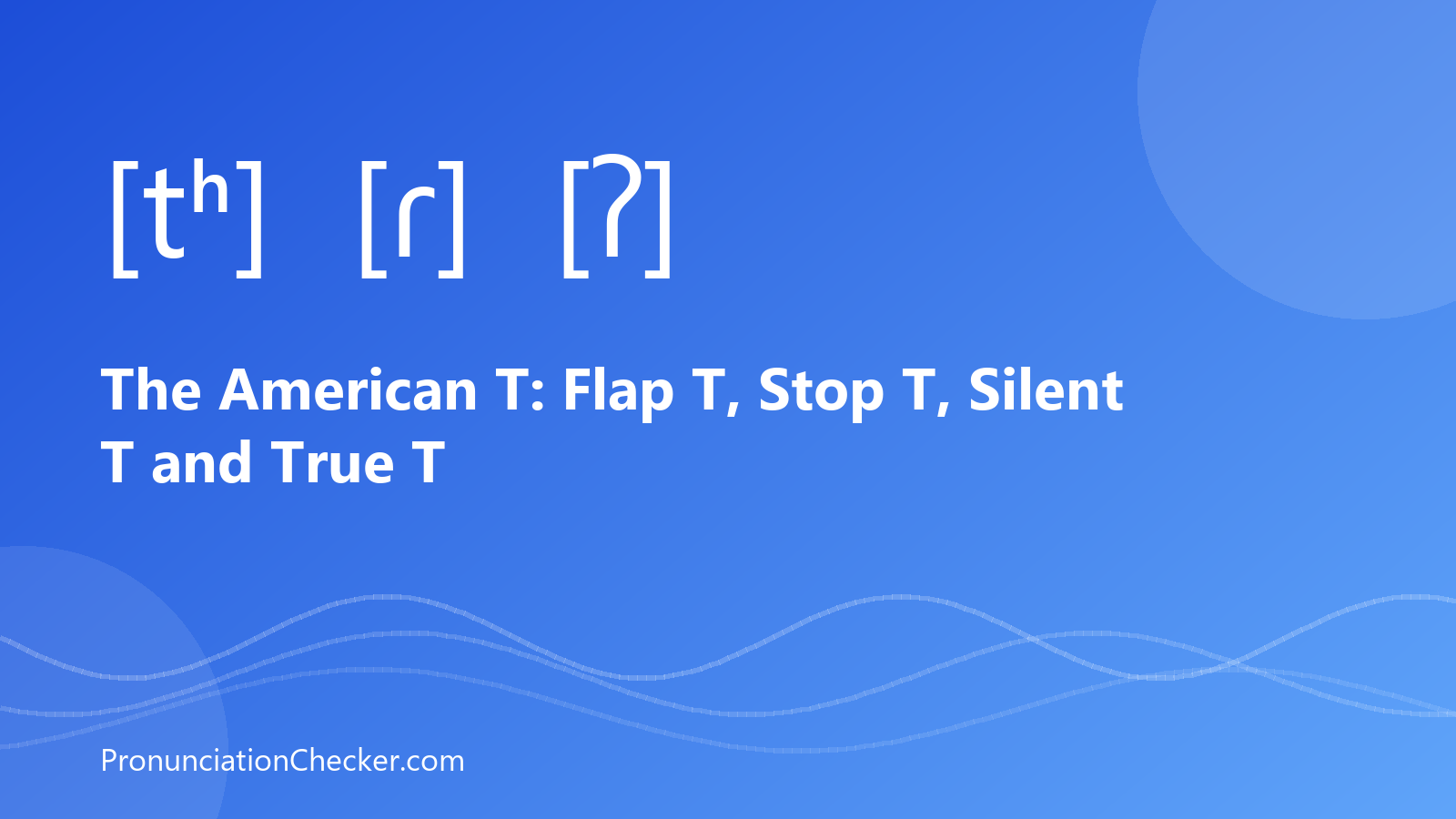
In American English, the letter t has at least five different pronunciations. Top has a strong /t/ with a puff of air. Water has a quick tap that sounds close to /d/. Button has a catch in the throat. Twenty often has no /t/ at all. And cat at the end of a sentence may stop without releasing any air.
Native speakers are usually unaware of the differences, yet they follow clear rules. Knowing them will help you understand American speech much better, and if you are aiming for an American accent, the flap T is the single change that makes the biggest difference.
The five T sounds at a glance
| Name | Symbol | Where it happens | Examples |
|---|---|---|---|
| True T (aspirated) | [tʰ] | At the start of a stressed syllable | top, time, attack, return, hotel |
| Flap T | [ɾ] | Between vowels when the next syllable is unstressed; also after r | water, better, city, party, a lot of |
| Stop T (glottal) | [ʔ] | Before a syllabic n, and often before another consonant | button, mountain, certain, that man |
| Silent T | (none) | After n, between vowels | twenty, internet, center, interview |
| Held T (unreleased) | [t̚] | At the end of a phrase | What? That's it. I forgot. |
A sixth pattern, T followed by you, merges into a /tʃ/ sound: don't you becomes "don-chu" and got you becomes "gotcha". That happens in British English too.
True T
At the start of a word or of any stressed syllable, American /t/ is aspirated: a small puff of air follows it. Hold your palm in front of your mouth and say top; you should feel the air. After /s/, the puff disappears, which is why the /t/ in stop sounds softer.
The important rule is about stress. In attack, hotel, Italian and return, the /t/ starts a stressed syllable, so it stays a true T even though it sits between vowels. Compare Italy /ˈɪɾəli/ with Italian /ɪˈtæljən/: the stress moves, and the T changes with it.
Flap T: the one that matters most
When /t/ comes between two vowels and the second one is unstressed, American speakers replace it with a flap: the tongue tip taps the ridge behind the upper teeth once, very quickly, with the vocal folds vibrating. The result sounds much like a quick /d/.
- Inside words: water, better, city, pretty, butter, matter, getting, beautiful, computer, little
- After r: party, forty, dirty, artist, shorter
- Across word boundaries: get it, what about, a lot of, not at all, put it on
The flap applies to /d/ as well, which is why latter and ladder, or metal and medal, sound almost identical in American speech. Many Americans still distinguish pairs like writer and rider by the vowel: the vowel before an underlying /d/ is a little longer.
If you speak Spanish or Portuguese, you already have this sound. It is the single r of Spanish pero or Portuguese caro. Many learners find it helpful to think of water as "wa-ro" with a Spanish tap. It is not perfectly accurate, but it is close enough to be heard as American.
Stop T before n
In words where /t/ is followed by an unstressed syllable containing /n/, American speakers usually replace the /t/ with a glottal stop, a brief closure in the throat, the same catch you hear in the middle of uh-oh. The /n/ that follows has no vowel before it.
Button is [ˈbʌʔn̩], mountain [ˈmaʊʔn̩], certain [ˈsɝʔn̩], written [ˈrɪʔn̩], cotton, Latin, important. A learner who says "but-ton" with a clear /t/ and a full vowel sounds careful rather than wrong, but a learner who says "buh-dun" with a flap sounds clearly wrong. If you are unsure, use a true T.
A glottal stop also often replaces /t/ at the end of a word before another consonant: that man [ðæʔ mæn], not now, get ready, it's in fast speech.
Silent T after n
After /n/ and before an unstressed vowel, many Americans drop the /t/ completely: twenty sounds like "twenny", internet like "innernet", center like "senner", and wanted like "wanned". Winter and winner can become homophones.
This is very common in relaxed speech but less so in careful or formal speech, and it is the least necessary pattern for a learner to produce. It is, however, essential to recognise. Many learners who understand American English well in class are lost in conversation partly because they are listening for a /t/ that is not there.
Held T at the end
At the end of a phrase, American speakers often make the tongue contact for /t/ but do not release it: no puff of air, no burst. What? ends abruptly. That's it. ends with the tongue held on the ridge. Listeners hear the /t/ from the way the vowel stops.
Learners from languages with no final consonants often go the other way and add a vowel: "what-o", "that's it-o". If you do this, the held T is the fix: put your tongue in place for /t/ and simply stop.
What British English does
Standard Southern British English uses a true T in water, better and city, and that clear T is one of the most recognisable differences between the accents. But many British speakers, especially younger ones and those from London and the south-east, use a glottal stop where Americans use a flap: wa'er, be'er, a lo' of. Glottal stops before consonants (ge' ready) are now normal in almost all British accents.
Flapping does occur in Australian, New Zealand and Irish English, so it is not a purely American feature, but it is most consistent in North America.
Should you use these sounds?
If you want an American accent, yes: learn the flap first. It is frequent, easy to produce, and immediately changes how you sound. The stop T before n is the next most useful. Silent T and held T will come naturally if you listen enough.
If you prefer a British accent, or no particular accent, a true T everywhere is perfectly clear and never misunderstood. What matters is consistency: switching between water with a flap and better with a true T in the same sentence sounds more unusual than either choice.
Frequently asked questions
Is the flap T the same as a D?
Almost. The flap is shorter than a normal /d/: the tongue taps the ridge once instead of pressing against it. In practice, American latter and ladder sound nearly identical, and many learners produce a good flap by thinking of a very quick, light d.
Why do Americans say "twenny" instead of twenty?
After /n/ and before an unstressed vowel, the /t/ is often dropped in relaxed American speech. It is common and normal, but not universal. In careful speech many Americans still say the /t/.
Does British English use the flap T?
Standard British English uses a clear T in words like water and better. Many British speakers use a glottal stop there instead. The flap is mainly North American, though it also occurs in Australian and Irish English.
Sources and further reading
- Ladefoged, P. and Johnson, K. (2015). A Course in Phonetics (7th ed.). Cengage Learning.
- Wells, J. C. (1982). Accents of English (3 vols.). Cambridge University Press.
- Kretzschmar, W. A. (2004). Standard American English pronunciation. In Schneider, E. W. et al. (eds.), A Handbook of Varieties of English. Mouton de Gruyter.
Disclosure: this page links to Preply, a tutoring marketplace. If you book a lesson through that link we may earn a commission, at no extra cost to you. It does not change what is recommended here. See our disclaimer and privacy policy.
Hear the T in both accents
Look up water, button and twenty and compare the American and British recordings.
Look up a word