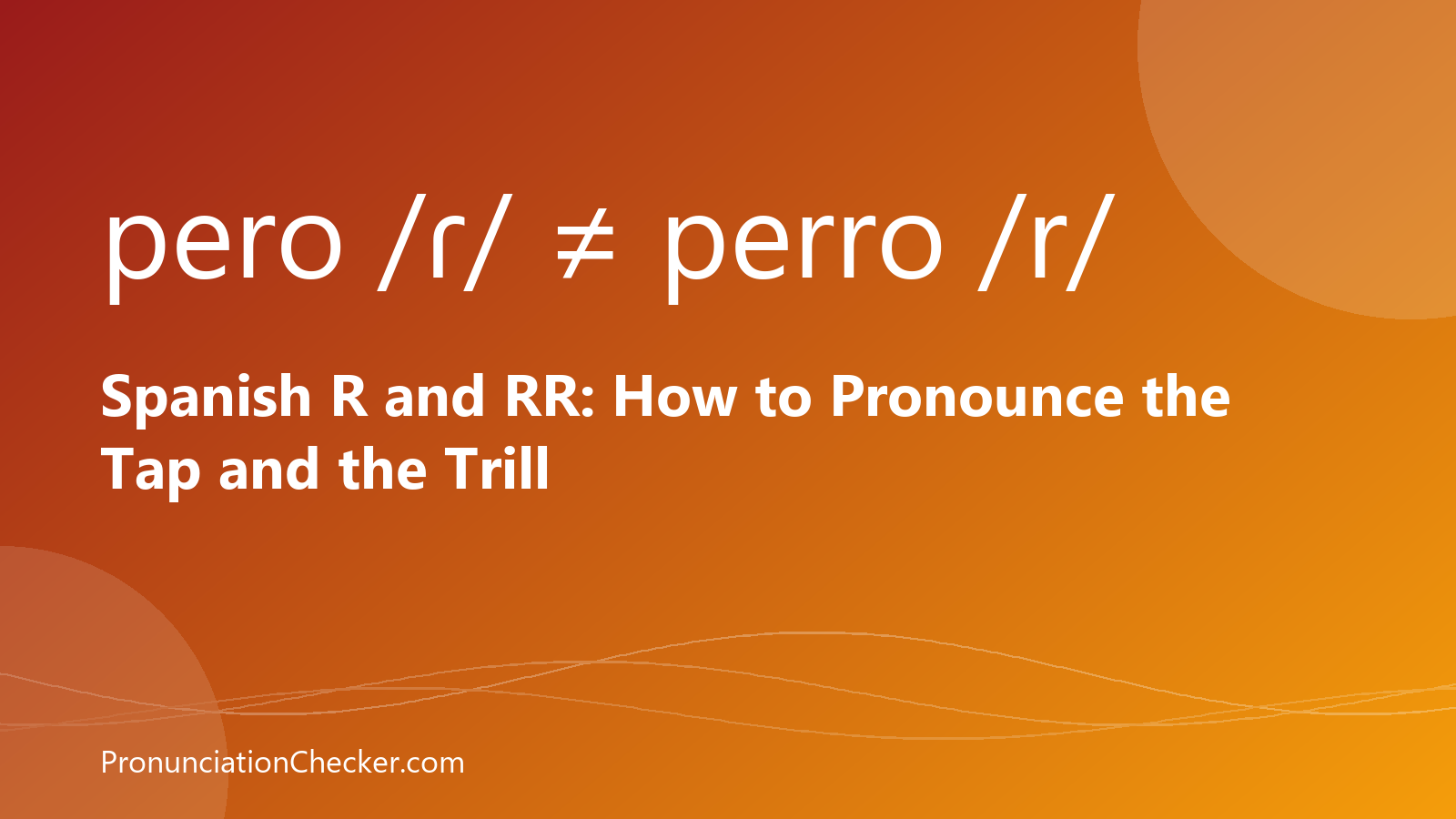
Spanish has two R sounds and English has neither of them. The good news is that the more common one, the tap, is a sound American English speakers already make dozens of times a day, just not when they see the letter R. The trill takes practice, but it is learnable at any age.
Two sounds, one contrast
The tap /ɾ/ is a single, very fast contact of the tongue tip against the ridge behind the upper front teeth. The trill /r/ is a series of two to five such contacts, produced by holding the tongue tip loosely in place and letting air make it vibrate. Between vowels, the difference changes meaning:
| Tap /ɾ/ | Meaning | Trill /r/ | Meaning |
|---|---|---|---|
| but | dog | ||
| expensive | car, cart | ||
| choir | I run | ||
| for | grapevine | ||
| Moorish | snout | ||
| zero | hill | ||
| now | he saves |
Items in this drill: pero / perro; caro / carro; coro / corro; para / parra; cero / cerro; moro / morro; ahora / ahorra; foro / forro; mira / mirra; vara / barra.
When to use each one
The spelling tells you exactly which sound to make:
- rr is always a trill. It only appears between vowels: , , .
- r at the start of a word is a trill: , , . Spanish never writes rr at the start of a word, so you have to remember this.
- r after n, l or s is a trill: , , , .
- Every other r is a tap: between vowels (), after a consonant in the same syllable (, , ), and before a consonant (, ).
- r at the end of a word is usually a tap, but speakers often strengthen it for emphasis: , . Either is acceptable.
How to make the tap
If you speak American or Australian English, you already produce this sound. Say these phrases quickly and casually:
- gotta, oughta, pot of tea, got it
- ladder, edited, Betty bought a bit of butter
The t or d in the middle is a tap, [ɾ]. Now say oughta and change the vowels: otta becomes Spanish , and pot of becomes . That single quick flick is the Spanish R. If you speak British English, where these are usually full [t] sounds, say pot of as fast as possible without releasing a puff of air; the tongue will start to tap.
Two mistakes to avoid: do not curl the tongue back as for English R, and do not let the tongue stay on the ridge. The contact should last only a few hundredths of a second.
Taps after a consonant, as in and , are harder because English speakers expect an English R there. A useful trick is to insert a tiny vowel: say te-res quickly until the vowel disappears into [tɾes].
How to learn the trill
The trill is not made by pushing the tongue harder. It works like a flag in the wind: the tongue tip is held loosely near the ridge, and a steady stream of air makes it flap repeatedly. Tension kills it. Try these steps, a few minutes a day:
- Find the spot. Say d-d-d-d quickly and notice where the tongue tip touches: just behind the upper teeth. That is where the trill happens.
- Relax and blow. Place the tongue there, very loosely, and blow air over it, as if cooling soup. You are looking for a single flutter, even a brief one.
- Use a launch consonant. Sequences like tr and dr help, because the stop builds up air pressure. Say trrrr, drrrr, then with an exaggerated trill.
- Use the "butter" trick. Say butter or ladder over and over, faster and faster: bottabottabotta. The repeated taps eventually merge into a short trill.
- Move it into words. Start with words where the trill follows a vowel you can prolong: , , . Word-initial trills, as in , are hardest; leave them for last.
Realistic expectation: most adult learners need somewhere between a few days and a few weeks to produce a reliable trill. Two minutes of daily practice works better than one long session. Meanwhile, use a strong, slightly lengthened tap for rr; it will be understood.
Regional variation
Not every native speaker trills in the same way. In Puerto Rico, a uvular or velar R, similar to French, is common for rr. In parts of Costa Rica, Guatemala and the Andes, the trill is often an assibilated sound, like a buzzing [ʐ]. In the Caribbean and Andalusia, syllable-final r may become l or disappear. These are normal features of those accents, but the tap and trill described here are understood everywhere and are the standard in teaching materials.
Phrases in this drill:
- El perro corre por la carretera.
- Pero el carro es muy caro.
- Rosa quiere arroz con leche.
- Tres tristes tigres tragaban trigo.
- Enrique tiene una guitarra roja.
If the speech recogniser writes pero when you meant perro, your trill was too short. Hold it for two or three vibrations and try again.
Frequently asked questions
Can I be understood if I cannot roll my R?
Mostly, yes. A long tap or a slightly buzzed R is usually understood from context. The contrast only matters in pairs like pero and perro, and even there context helps. Get the tap right first, because it is far more frequent.
Why can some people never roll their R?
Almost everyone can learn it; it is a matter of tongue tension and airflow rather than anatomy. A very short lingual frenulum (tongue-tie) can make it harder, but that is rare. Most adults get it after a few weeks of short daily practice.
Is the Spanish tap the same as the American T in water?
Very close. The American flap in water, better and ladder is the same tongue movement as the Spanish tap in pero, para and caro. Using it is the fastest way to learn the Spanish sound.
Sources and further reading
- Hualde, J. I. (2005). The Sounds of Spanish, chapter 10: Rhotics. Cambridge University Press.
- Blecua, B. (2001). Las vibrantes del español: manifestaciones acústicas y procesos fonéticos. Doctoral thesis, Universitat Autònoma de Barcelona.
- Face, T. L. (2006). Intervocalic rhotic pronunciation by adult learners of Spanish as a second language. In C. A. Klee and T. L. Face (eds.), Selected Proceedings of the 7th Conference on the Acquisition of Spanish and Portuguese as First and Second Languages, 47–58. Cascadilla.
Disclosure: this page links to Preply, a tutoring marketplace. If you book a lesson through that link we may earn a commission, at no extra cost to you. It does not change what is recommended here. See our disclaimer and privacy policy.
Practise Spanish out loud
Type any sentence, listen to a native voice, then record yourself and see which words a speech recogniser understood.
Open the practice page