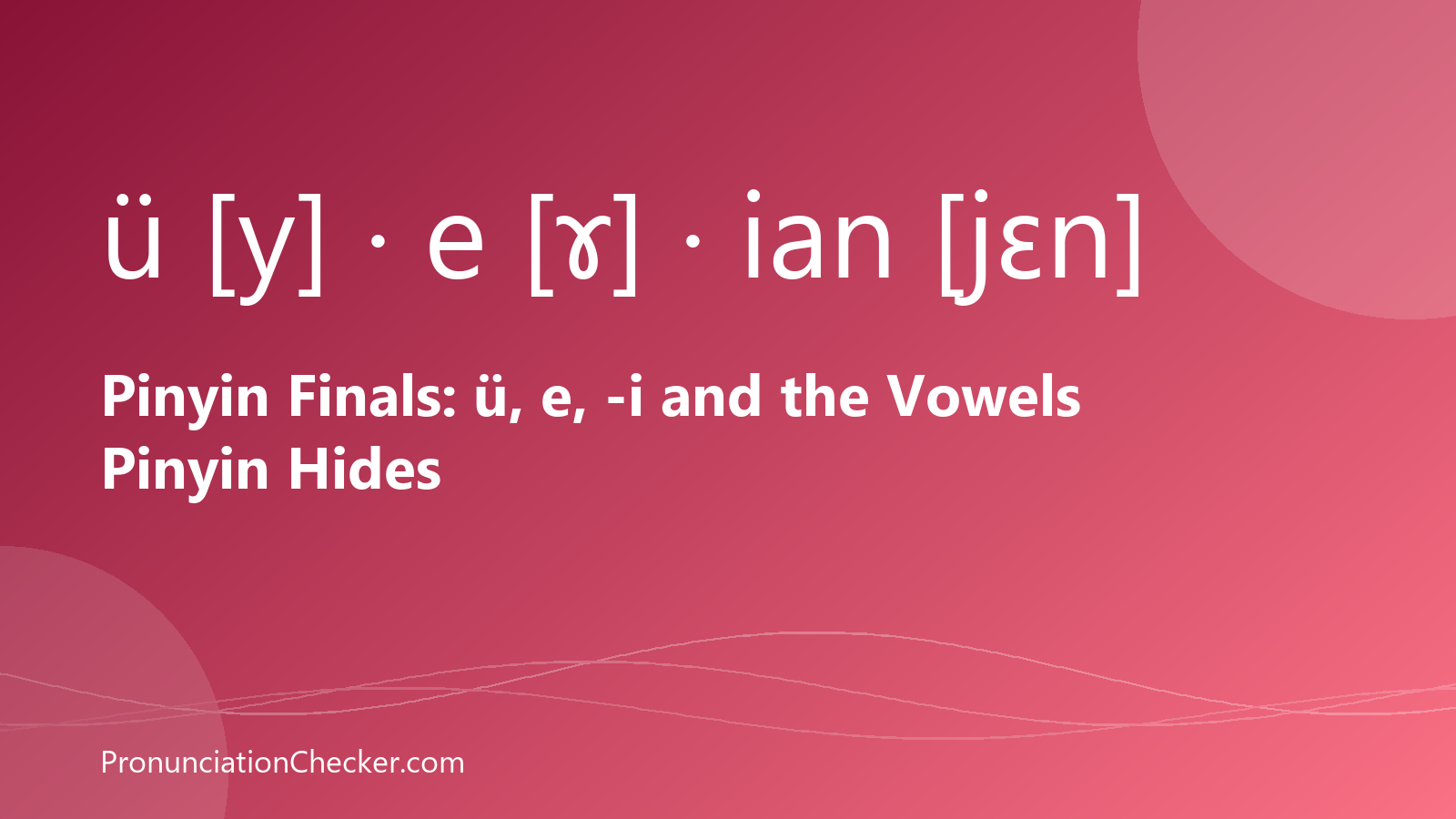
Pinyin uses only six vowel letters, a, o, e, i, u and ü, to represent a much larger range of sounds. The same letter can stand for very different vowels depending on its neighbours, and some finals are written in abbreviated form. Knowing the handful of traps below will fix most vowel errors in beginner Mandarin.
ü: the rounded ee
Pinyin ü is [y], the same sound as German ü or French u: the tongue position of ee with the lips rounded as for oo. Say a long eeee, then round your lips without moving your tongue.
- woman vs effort
- green vs road
- donkey vs (surname)
- to go, fish, to study, army
The hidden ü. After j, q, x and y, pinyin drops the dots: ju, qu, xu, yu, jue, que, xue, yue, jun, qun, xun, yun, juan, quan, xuan, yuan all contain ü, not u. English speakers who read qu as "choo" or yu as "you" produce the wrong vowel.
Items in this drill: nǚ / nǔ; lǜ / lù; lǘ / lú; lǚ / lǔ; lǜ / lù.
The many faces of e
| Context | Sound | Examples |
|---|---|---|
| e alone or after a consonant | [ɤ], an unrounded back vowel | |
| ie, üe | [ɛ], as in yes | |
| ei | [ei], as in day | |
| en, eng | schwa [ə] | |
| er | [ɚ], an r-coloured vowel |
To make [ɤ], start with oo [u], then unround your lips (spread them slightly) while keeping your tongue back. The result sounds a little like a throaty "uh". In many syllables it starts slightly higher and glides down, [ɯʌ].
The buzzing -i
After z, c, s, zh, ch, sh and r, the letter i stands for a vowel that continues the consonant's buzz rather than [i]. After z, c and s it is often written [ɹ̩] or [ɨ]; after zh, ch, sh and r, [ɻ̩]:
- , , : hold the z, ts or s position and add voice.
- , , , : hold the curled-tongue position and add voice. It sounds rather like "shr".
Compare and : the first has the buzzing vowel, the second a real [i].
ian and yan: "yen", not "yan"
The final ian (and yan) is pronounced [jɛn], rhyming with English yen, not with Ann: , , , , . By contrast, üan (written uan after j, q, x, y) varies between [yɛn] and [yæn]: , .
Abbreviated finals: iu, ui, un
Pinyin shortens three finals when they follow a consonant:
| Written | Full form | Sound | Examples |
|---|---|---|---|
| -iu | iou | [jou] | |
| -ui | uei | [wei] | |
| -un | uen | [wən] |
So jiǔ (nine, wine) is roughly "jyo-u", not "joo"; guì (expensive) is "gway", not "gwee"; dùn is "dwun", not "doon". After j, q, x and y, un means ün: , .
-n vs -ng
Mandarin distinguishes final [n] and [ŋ], and the vowel before them also differs. English speakers usually hear this well, but be careful not to add a hard g after ng:
- / · / · / · /
Items in this drill: jīn / jīng; shān / shāng; mén / méng; xīn / xīng; pán / páng; gēn / gēng.
Frequently asked questions
Why is ü sometimes written u in pinyin?
After j, q, x and y, pinyin writes ü as plain u, because those initials never combine with the u [u] sound. So ju, qu, xu and yu all contain ü. After n and l, the dots are kept because nu and nü are different syllables.
How is pinyin "e" pronounced?
On its own or after a consonant (e, he, ke, de), it is [ɤ], an unrounded back vowel, similar to the vowel in English "uh" but with the tongue further back. Next to i or ü (ie, üe) it is [ɛ], like English "yes". In ei it is [e], and in en and eng it is a schwa.
Is "iu" pronounced like English "you"?
Not exactly. Iu is short for iou, [jou], so liu sounds like "lyo-u" and jiu like "jyo-u". In third and fourth tones the o is clearly audible; in first and second tones it is weaker.
Sources and further reading
- Lee, W.-S. and Zee, E. (2003). Standard Chinese (Beijing). Journal of the International Phonetic Association, 33(1), 109–112.
- Duanmu, S. (2007). The Phonology of Standard Chinese (2nd ed.), chapter 3 on vowels. Oxford University Press.
- Lin, Y.-H. (2007). The Sounds of Chinese, chapter 4. Cambridge University Press.
Disclosure: this page links to Preply, a tutoring marketplace. If you book a lesson through that link we may earn a commission, at no extra cost to you. It does not change what is recommended here. See our disclaimer and privacy policy.
Practise Mandarin Chinese out loud
Type any sentence, listen to a native voice, then record yourself and see which words a speech recogniser understood.
Open the practice page