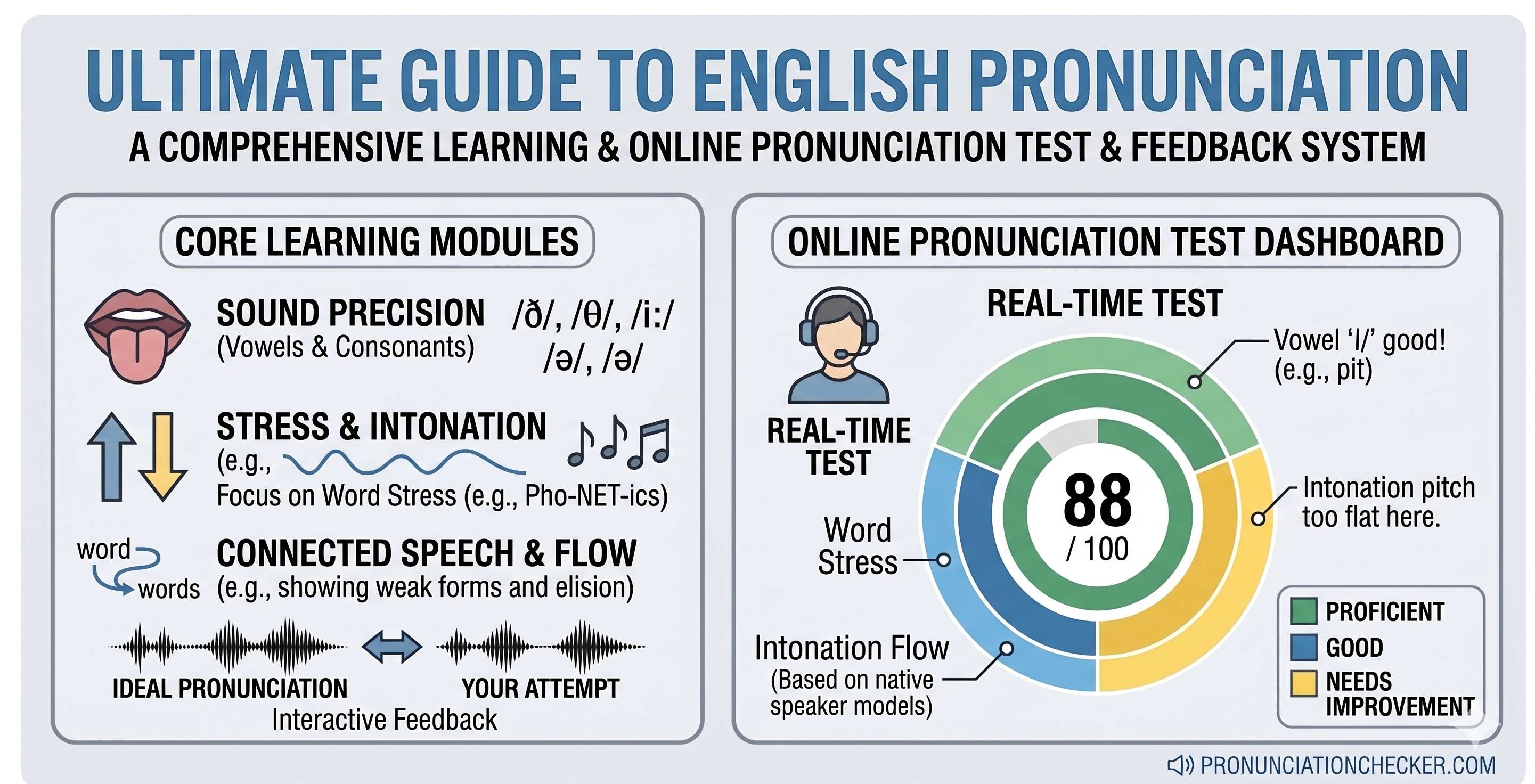
Say it right: the ultimate guide to English Pronunciation with an online test App
Have you ever had to repeat yourself in English? That moment of hesitation, the polite smile from the listener, the slight frustration—it’s a feeling known to millions of learners. You know the words, you understand the grammar, but the pronunciation just doesn’t land as it should.
What if you had a personal coach available 24/7 to give you instant, accurate feedback on your accent? This isn't a fantasy; it's the power of modern technology. The key to unlocking clear, confident English might just be sitting in your web browser.
In this ultimate guide, we will show you exactly how to use an online pronunciation test app to diagnose your problem areas, practice with precision, and finally say it right.
Why pronunciation is the key to being understood
Before we dive into the "how," let's solidify the "why." You can have a vocabulary that rivals a dictionary and a perfect grasp of tenses, but if your pronunciation is off, communication breaks down.
- Builds unshakeable confidence: You speak more freely in meetings and conversations.
- Reduces listener effort: Your message becomes easier to understand.
- Creates a professional image: Clear pronunciation builds credibility.
- Opens social doors: Everyday interactions become smoother and more enjoyable.
The goal isn't to erase your accent entirely. The goal is clarity.
What is an online pronunciation test app?
An online pronunciation test app uses advanced speech recognition technology to analyze your spoken English and provide immediate, objective feedback.
- Instant scoring
- Visual feedback
- Phonetic breakdown
- Native speaker audio models
Phase 1: The diagnosis - using the app to find your weak spots
The first step to improvement is knowing what to improve. Use a baseline test to identify patterns in your pronunciation challenges, such as specific sounds, stress placement, or intonation.
Phase 2: Targeted practice - drilling down to the details
Practice minimal pairs, focus on syllable stress, and refine sentence-level intonation. Use instant feedback to adjust and repeat until your accuracy improves consistently.
Phase 3: Integration - taking your skills into the real world
Apply your training in real conversations. Use shadowing, record spontaneous speech, and become an active listener to reinforce what you've learned.
Creating a sustainable practice habit
- Practice 10–15 minutes daily.
- Rotate focus between sounds, stress, and intonation.
- Track progress and retest regularly.
Conclusion: Your journey to saying it right starts now
With the right tools and consistent practice, you can transform your pronunciation. Stop wondering if you're being understood—start speaking with clarity and confidence today.
The order that actually matters
English pronunciation has many components, and treating them as equally important is the fastest route to slow progress. Research on intelligibility gives a fairly consistent ranking of what affects a listener's ability to understand you.
| Priority | Feature | Why it ranks here |
|---|---|---|
| 1 | Word stress | Listeners retrieve words from memory using the stressed syllable; a misplaced stress can prevent recognition entirely |
| 2 | Merged vowel contrasts in common words | Creates genuine ambiguity between frequent words |
| 3 | Sentence rhythm and reduction | Listeners use prominence to locate the content words |
| 4 | Consonant clusters | Deletion removes grammatical endings; insertion adds syllables that confuse stress |
| 5 | Individual consonant substitutions | Usually recoverable from context |
| 6 | Allophonic detail and intonation nuance | Affects impression rather than comprehension |
Most self-study starts at level five, with th and r, because those are the errors learners are told about most often. Starting at level one produces faster improvement in how easily people understand you.
A self-assessment you can run today
Record yourself reading the following aloud, then check the six points below. Each targets one of the priorities above.
Last Wednesday the photographer asked me a comfortable question about my vegetable garden. I walked through the streets and thought about it, though I had already decided that three different answers were possible.
- Wednesday — two syllables, WENZ-day? Three syllables signals reading rather than listening.
- photographer — stress on the second syllable, pho-TOG-ra-pher?
- comfortable, vegetable — three syllables each, or four?
- walked — one syllable, or did you add a vowel?
- streets, asked — did every consonant survive, and did you add a vowel before streets?
- through, thought, though — three different vowels, and though with
/ð/rather than/θ/?
Listen to that recording tomorrow, not now. Immediately after speaking, you hear what you intended, because it is still in working memory. A day later you hear what is actually there. The same file produces a noticeably more accurate list of problems on the second day.
Using online tests sensibly
Automated tests are useful for finding consistent segment errors and useless for prosody. Four rules make the results worth something:
- Test single words, not sentences — context lets a recogniser guess past your errors.
- Test minimal pairs, so that a merger shows up as both words returning the same result.
- Repeat each item five times; recognition is probabilistic.
- Take the test three times on different days, and treat only consistent failures as findings.
Then read the failures as a pattern rather than a score. Failures sharing a vowel indicate one merged contrast. Failures concentrated in long words indicate stress. Scattered failures with no pattern usually indicate a recording or accent-setting problem rather than a pronunciation one.
Turning results into a plan
- Pick one target, ranked by frequency in English rather than by how wrong it sounds. A small imprecision in schwa affects more speech than a large error in a rare sound.
- Test whether it is perception or production. Have someone read twenty items from a pair set while you write what you hear. Below 70%, train listening first; above 90%, the work is motor.
- Run a four-week cycle: perception, isolated production, sentences, spontaneous speech.
- Retest the same items under the same conditions and compare item by item, not by overall score.
- Move to the next target. Roughly a dozen targets a year is enough to change an accent substantially.
What to expect
Being realistic about timelines prevents the disappointment that ends most self-study. Producing a new sound in isolation can take a single session with clear articulatory instructions. Reliable perception of a new contrast takes two to four weeks of daily listening. Consistent production in connected speech takes one to three months per contrast. A broadly noticeable change in overall intelligibility takes six to twelve months.
Being mistaken for a native speaker is rarely achieved after childhood, and it is worth saying plainly that this is not the goal. Research on international communication finds that a clear non-native accent does not impede understanding, while misplaced word stress and merged vowel contrasts do. The target is being understood without effort, and that is reliably achievable.
Frequently asked questions
What should I work on first if I want to be understood better?
Word stress. Intelligibility research consistently ranks it above individual sounds, because English listeners use the stressed syllable to retrieve a word from memory, so a misplaced stress can prevent recognition entirely while a substituted consonant usually leaves enough information for context to recover the word. Merged vowel contrasts in common words come second, and sentence rhythm third.
How can I assess my own pronunciation without a teacher?
Record yourself reading a passage that targets known trouble spots, then listen the following day rather than immediately, since straight afterwards you hear what you intended rather than what you produced. Check specific points rather than listening generally: syllable count in comfortable and vegetable, stress in photographer, whether walked is one syllable, and whether consonant clusters survived.
How should I use an online pronunciation test?
Test single words rather than sentences, since context lets a recogniser guess past your errors, and test minimal pairs so a merger shows up as both words returning the same result. Repeat each item five times because recognition is probabilistic, and take the test three times on different days, treating only consistent failures as real findings. Then read the failures as a pattern rather than as a score.
How long does it take to improve English pronunciation?
Producing a new sound in isolation can take a single session with clear instructions. Reliable perception of a new contrast takes two to four weeks of daily listening, and consistent production in connected speech takes one to three months per contrast. A broadly noticeable change in overall intelligibility takes six to twelve months of consistent work.
Disclosure: this page links to Preply, a tutoring marketplace. If you book a lesson through that link we may earn a commission, at no extra cost to you. It does not change what is recommended here. See our disclaimer and privacy policy.
Get your baseline score
Read the passage once and keep the result to compare with in a month.
Take the voice test