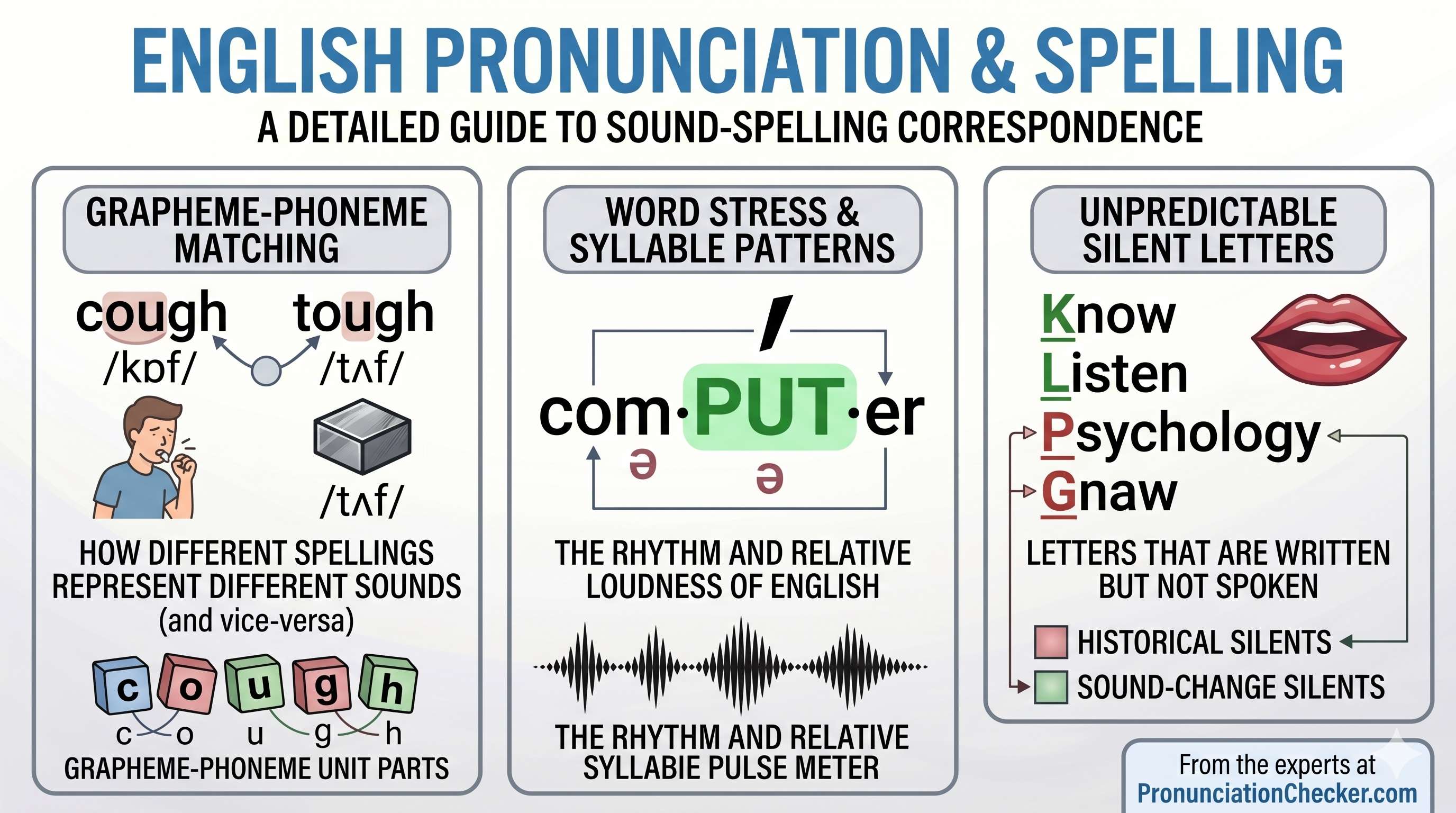
Stop guessing: how to spell and pronounce any English word correctly
Have you ever felt that moment of panic? You’re typing an important email or speaking up in a meeting, and you hit a word you’re not 100% sure about. Your fingers hover over the keyboard. Your voice wavers. Should it be “accommodate” or “acommodate”? Do you pronounce “niche” as nitch or neesh?
You’re not alone. English is a notoriously tricky language, a melting pot of Germanic, Latin, and French influences with spelling rules that seem to have more exceptions than applications. This uncertainty can dent your confidence, both in writing and in speech.
But what if you could replace that guesswork with confidence? This guide is your roadmap to mastering English spelling and pronunciation, turning you from a hesitant guesser into a confident communicator. We’ll explore practical strategies, uncover the logic behind the chaos, and introduce powerful tools—like the comprehensive resource hub at Pronunciation Checker—that make accuracy easier than ever.
Why English spelling and pronunciation are so difficult
Before we dive into the solutions, it helps to understand the problem. English isn’t difficult to be spiteful; its complexity is a product of history.
The great vowel shift: Between the 14th and 18th centuries, the pronunciation of English long vowels changed dramatically, but the spelling, which had already been standardized with the invention of the printing press, did not. This is why words like "knight" were once pronounced with all the consonants heard but are now silent.
A language of borrowers: English has enthusiastically borrowed words from other languages, often keeping their original spelling. For example, “ballet” (French), “pizza” (Italian), “tsunami” (Japanese), and “chutney” (Hindi) all bring their native spelling and pronunciation rules with them.
Silent letters: Why do we have a ‘b’ in ‘doubt’? It was added to reflect the Latin root dubitare, even though no one ever pronounced it. Silent letters (like the ‘k’ in ‘knight’ or the ‘p’ in ‘psychology’) are often historical artifacts.
The result? A single combination of letters can be pronounced in multiple ways. Consider “ough”:
tough (sounds like ‘uff’)
though (sounds like ‘oh’)
through (sounds like ‘oo’)
cough (sounds like ‘off’)
bough (sounds like ‘ow’)
It’s enough to make anyone’s head spin! But don’t despair—there is a method to the madness.
Part 1: conquering spelling once and for all
Spelling correctly is the foundation of clear written communication. Here are proven techniques to improve your spelling.
1. Embrace phonetics (but don't fully trust them)
Phonetics is the study of speech sounds. While English is not phonetic, many words are. Break words down into their sound components. For example, “cat” is /k/ /a/ /t/. This works well for simpler words. However, as we saw with “ough,” this strategy has limits. Use it as a starting point, not a definitive rule.
2. Learn the rules (and the key exceptions)
While famously inconsistent, some English spelling rules do hold true most of the time.
"I before E except after C": This old adage works for words like "believe" and "receive." The full rule is more nuanced: "I before E, except after C, or when sounded as 'A' as in 'neighbor' and 'weigh.'" This covers more ground but still has exceptions like "weird" and "seize."
Dropping the silent ‘E’: When adding a vowel suffix (like -ing, -able, -ed), you usually drop the silent ‘e’: make → making, hope → hoping. Exception: Keep the ‘e’ if it's needed to soften a ‘c’ or ‘g’ sound: change → changeable, courage → courageous.
Doubling the final consonant: In a one-syllable word ending with a single vowel followed by a single consonant (CVC), double the final consonant before adding a vowel suffix: run → running, big → bigger.
3. Use mnemonics (memory aids)
Create silly sentences or phrases to remember tricky spellings.
Necessary: One collar and two socks (one ‘c’, two ‘s’s).
Because: big elephants can always understand small elephants.
Rhythm: Rhythm Helps Your Two Hips Move.
4. Practice active recall and muscle memory
Don’t just passively read words. Write them down. The physical act of writing engages your muscle memory. Use flashcards or apps to test yourself. Look at a word, cover it up, write it down, and then check your spelling.
5. Harness the power of technology (wisely)
Spell-checkers in word processors are a great first line of defense, but they are not infallible. They might not catch homophones (words that sound the same but are spelled differently), like their/there/they’re or your/you’re. Always proofread manually.
Part 2: mastering pronunciation with confidence
Mispronouncing a word can be embarrassing, but it’s a hurdle you can easily overcome.
1. Listen and imitate the experts
Audiobooks and podcasts: Listen to skilled narrators and
speakers. Pay close
attention to how they articulate unfamiliar words.
Movies and TV shows: Watch content with subtitles on. This
creates a direct
link between the written word and its spoken form.
Ted talks: These are excellent because they often provide
interactive
transcripts, allowing you to follow along word-for-word.
2. Learn the International Phonetic Alphabet (IPA)
The IPA is a game-changer. It’s a standardized system of symbols that represents every sound in a language. Once you learn the basic symbols for English sounds, you can pronounce any word correctly by looking it up in a dictionary that uses IPA.
For example, the word “pronunciation” is transcribed as /prəˌnʌn.siˈeɪ.ʃən/. This tells you exactly how to say it, leaving no room for doubt. It might seem technical at first, but learning even a handful of key symbols is incredibly empowering.
3. Break words into syllables
Long words are less intimidating when you break them down.
In-ter-mi-na-ble
Re-spon-si-bi-li-ty
Say each syllable slowly, then gradually speed up until the word flows naturally. Most dictionaries indicate syllable breaks.
4. Focus on word stress
In English, one syllable in a multi-syllable word is stressed—meaning it’s said louder, longer, and at a higher pitch. Incorrect stress is a major cause of misunderstood pronunciation.
PRO-ject (noun) vs. pro-JECT (verb)
PRE-sent (noun) vs. pre-SENT (verb)
Dictionaries indicate stress with an apostrophe (') before the primary stressed syllable: /prə’nʌn.si.eɪ.ʃən/.
Your secret weapon: leveraging digital tools
While the strategies above are essential, we live in an age of incredible technology. Why not use it to your advantage? This is where specialized online tools become indispensable.
Instead of just hoping you’re right, you can know you’re right in seconds.
A fantastic centralized resource for this is Pronunciation Checker's guide to English pronunciation tools. This page is a goldmine, cataloging a wide array of tools that can help you spell and pronounce words accurately. These tools typically offer:
Instant audio pronunciations: Simply type in a word and hear it
spoken by a
high-quality, synthetic or human voice. You can often hear both British and
American English
variations.
Phonetic transcriptions: See the word spelled out using the
IPA, so you
understand the exact sounds you need to make.
Word definitions and usage: Context is key. Many tools
provide definitions
and example sentences, ensuring you’re using the word correctly.
Spell-checking and suggestions: Advanced tools can analyze
your text and
flag potentially misspelled words, offering correct suggestions.
How to integrate these tools into your daily life:
While reading: Keep a tab open to a pronunciation tool. When you
encounter a
new word, don’t just skip over it. Pause, look it up, and say it out loud
yourself.
While writing: If you’re unsure of a spelling, use the tool
to verify it
immediately. This reinforces the correct spelling in your memory.
Preparing for a speech or presentation: Practice saying any
challenging
words aloud. Use the audio pronunciation as a model and record yourself to
compare.
By making these tools a habitual part of your learning process, you actively build your vocabulary and confidence simultaneously.
Putting it all together: a practical action plan
Mastering spelling and pronunciation is a journey, not a destination. Here’s a simple, actionable plan you can start today:
Commit to learning one new word a day: Choose a word you often
encounter but
are unsure about. Use the techniques in this article: check its spelling, look
up its IPA
transcription, listen to its pronunciation and practice saying it.
Curate your resources: Bookmark a reliable online dictionary
(like
Cambridge or Merriam-Webster) and a dedicated pronunciation tool hub like the
one at
Pronunciation Checker. Having these at your fingertips removes friction.
Read aloud: Spend 10 minutes each day reading a book,
article, or report
out loud. This forces you to engage with both spelling and pronunciation in
real-time. When
you stumble, stop and look the word up.
Don’t fear being wrong: Everyone mispronounces and misspells
words. The
goal is not to be perfect but to be a lifelong learner. When someone corrects
you, thank
them! It’s a free lesson.
Conclusion: from guessing to knowing
English may be a complex language, but you are more than capable of mastering its intricacies. By combining a basic understanding of its rules, active learning strategies, and the powerful digital tools available today, you can eliminate the guesswork.
Stop wondering and start knowing. Visit resources like Pronunciation Checker's English Pronunciation Tools page to explore the tools that will empower your communication. Take control of your language skills today. Your future self, confidently typing that email or delivering that presentation, will thank you for it.
Frequently asked questions
Why is English spelling such a poor guide to pronunciation?
Because spelling was largely fixed by printers in the fifteenth and sixteenth centuries and the Great Vowel Shift moved the long vowels afterwards, so the spelling records an older pronunciation. English has also borrowed heavily from French, Latin and Greek while keeping the source spelling, which is why ch is different in church, chemistry and machine.
Which spelling patterns are actually reliable?
The r-controlled vowels are the most regular part of the system: ar gives /ɑːr/, or gives /ɔːr/, and er, ir and ur all merge into one vowel, so her, sir, fur, word and heard share a sound across five spellings. The silent E rule is the next most productive, turning hat into hate and bit into bite.
How do I work out the pronunciation of a word I have only read?
Look up the transcription rather than guessing, and check the stress mark first, since stress determines which vowels reduce. Guessing from spelling is where fossilised errors come from, and a single lookup at the point of learning is far cheaper than correcting an entrenched error years later.
Is it worth learning spelling rules at all?
Selectively. Learn the r-controlled group and the silent E rule, since both cover large numbers of common words. Beyond that, effort is better spent on word stress, because roughly one vowel in nine in running English is a schwa and every unstressed vowel reduces regardless of how it is spelled.
Disclosure: this page links to Preply, a tutoring marketplace. If you book a lesson through that link we may earn a commission, at no extra cost to you. It does not change what is recommended here. See our disclaimer and privacy policy.
Practise spelling and sound together
Hear how any word or name is pronounced, with phonetic guidance.
Open the word trainer