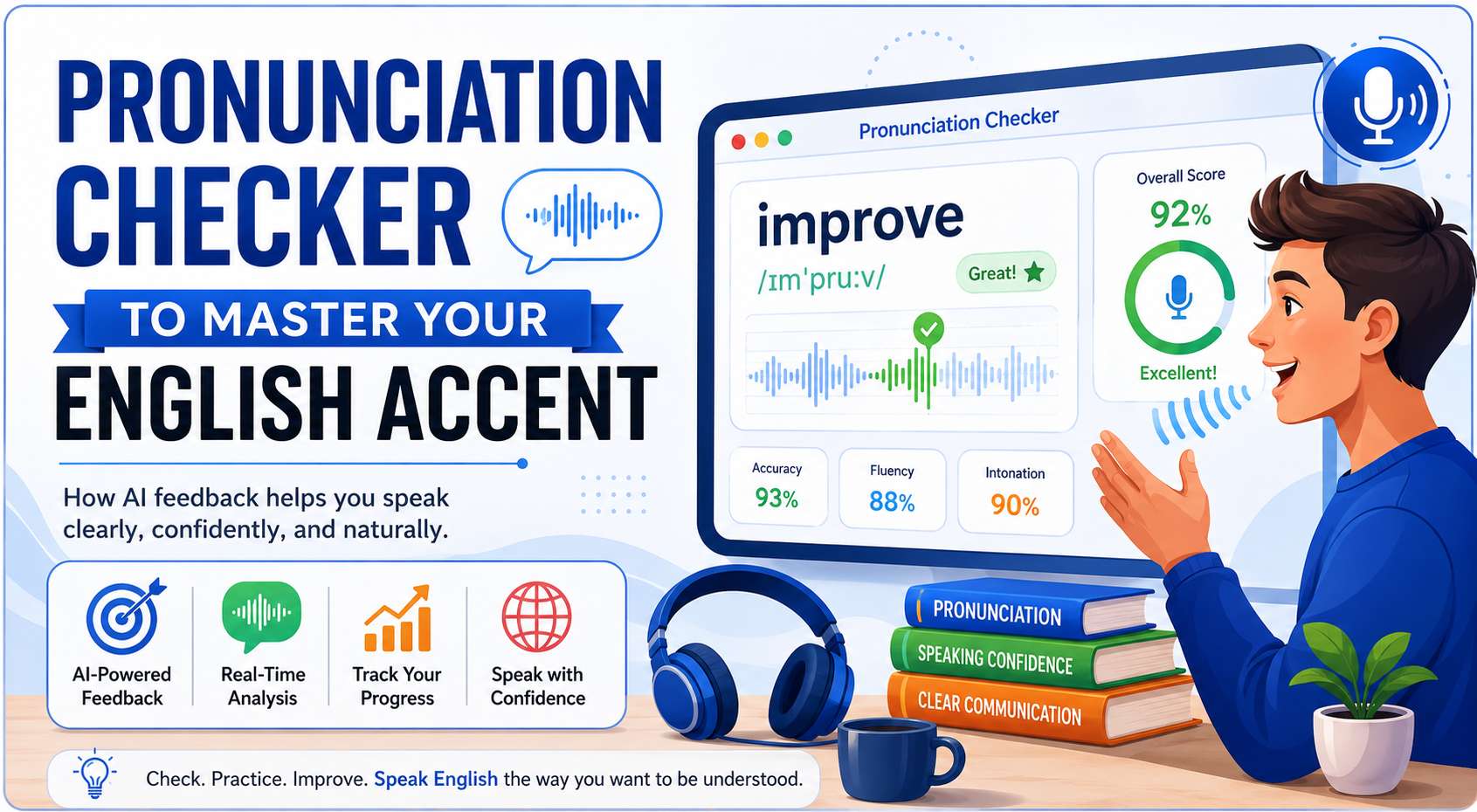
How to use an online Pronunciation Checker to master your English Accent
Have you ever felt a flicker of hesitation before speaking English? Maybe you’ve practiced a sentence in your head, only to stumble over the words when you say them aloud. You’re not alone. For millions of English learners, mastering pronunciation is the final frontier to achieving true fluency and confidence.
The good news? The days of relying solely on a teacher or a dictionary’s confusing phonetic symbols are over. Today, technology offers a powerful ally: the online pronunciation checker. This isn't just a fancy gadget; it's a personal, patient, and always-available pronunciation coach.
In this comprehensive guide, we’ll walk you through exactly how to use an online pronunciation checker to transform your English accent, boost your confidence, and make yourself understood anywhere in the world. We'll also take a closer look at a tool like the one found at Pronunciation Checker to see how it works in practice.
Why pronunciation matters more than you think
Before we dive into the "how," let's understand the "why." Perfect grammar and an extensive vocabulary are crucial, but without clear pronunciation, communication can break down instantly. Strong pronunciation helps you:
Be understood clearly: The ultimate goal of any language is
communication.
Correct pronunciation ensures your message lands as intended.
Gain confidence: When you know you sound clear, you speak
more freely and
participate more actively in conversations, meetings, and presentations.
Reduce listener fatigue: If a listener has to constantly
decipher your
words, they expend more mental energy. Clear pronunciation makes the
conversation smooth and
enjoyable for everyone.
Make a professional impression: In global business, clear
English
pronunciation is often associated with professionalism and competence.
What is an online Pronunciation Checker?
An online pronunciation checker is a web-based or app-based tool that uses speech recognition technology to analyze your spoken English. You say a word or sentence into your microphone, and the tool provides instant feedback on your accuracy.
Think of it as a GPS for your mouth. It doesn't just tell you you're off track; it shows you exactly how to reach the right destination.
A robust tool, like the English Pronunciation Test App & Voice Online tool, goes beyond simple right-or-wrong feedback. It typically offers:
Visual feedback: Waveforms or soundwaves that compare your
speech to a
native speaker’s.
Phonetic breakdown: Showing you the individual sounds
(phonemes) that make
up a word.
Scoring system: A quantitative measure (e.g., 85%) to track
your progress
over time.
Native speaker audio: High-quality recordings for you to
listen to and
mimic.
Your step-by-step guide to using a Pronunciation Checker effectively
Simply repeating words into a tool isn’t enough. To truly master your accent, you need a strategic approach. Follow these steps to get the maximum benefit.
Step 1: Find a high-quality tool and set up your
environment
Choose a reliable pronunciation checker that offers detailed feedback. Use a
good
microphone, find a quiet place, and access the tool through browsers like
Chrome or Firefox
for better speech recognition support.
Step 2: Start with the basics – Individual sounds
(phonemes)
English has 44 unique sounds, and many don’t exist in other languages. Target
problem sounds
like “th,” “r,” or the short “i.” Use minimal pairs (ship/sheep, bed/bad) and
carefully
analyze the visual and scoring feedback provided.
Step 3: Move on to words and syllable stress
Practice multisyllabic words like “photograph” or “communication.” Pay
attention to which
syllable is stressed. Record yourself and compare your pronunciation to the
native model
until your stress patterns are accurate.
Step 4: Conquer sentences and intonation
Fluent speech depends on rhythm, linking, and intonation. Practice full
sentences such as,
“Could you please send me the report?” Focus on melody and how words connect
naturally in
spoken English.
Step 5: Be consistent and track your progress
Schedule short daily sessions of 15–20 minutes. Keep a pronunciation journal
and use the
scoring system to measure improvement over time. Celebrate small wins as your
accuracy
increases.
A closer look: using the Pronunciation Checker tool
Imagine you want to practice the word “entrepreneur.” It’s common in business but notoriously difficult to pronounce.
You navigate to the tool and listen to the native speaker model. You notice the stress is on the last syllable and pay attention to the vowel sounds.
You record your attempt and receive detailed feedback. Instead of a simple “correct” or “incorrect,” the tool provides a score and visual comparison. You may discover that your stress wasn’t strong enough or that a vowel sound needs adjustment.
You repeat the process, refining your pronunciation with each attempt. This cycle of listening, recording, analyzing, and improving is what makes pronunciation checkers so effective.
Beyond the checker: integrating your skills into real life
The pronunciation checker is your training ground. Real conversations are your playing field.
Shadowing: Listen to a podcast or TV clip and imitate the
speaker’s
pronunciation, speed, and emotion. Then test yourself in the checker.
Record freestyle speech: Speak for a minute about your day,
transcribe part
of it, and analyze those sentences in the tool.
Be an active listener: Pay attention to rhythm and intonation
patterns when
interacting with native speakers.
Conclusion: your path to accent mastery starts now
Mastering your English accent is an achievable goal. An online pronunciation checker is a modern, efficient, and highly effective tool that guides you from individual sounds to full, natural speech.
The goal isn’t to erase your accent—your accent is part of your identity. The goal is clarity and confidence. By practicing consistently and using detailed feedback wisely, you can build a clearer, stronger, and more professional English voice.
Ready to test your pronunciation? Visit Pronunciation Checker’s English Pronunciation Test App and start your journey to clearer, more confident English today.
Frequently asked questions
How does a pronunciation checker decide whether I am correct?
Most use automatic speech recognition: your audio is converted to text and compared against the target. It is therefore measuring whether a recogniser trained largely on native speech produced the expected transcription, which correlates with but is not the same as how native you sound.
Why does it accept pronunciations I know are wrong?
Because recognisers use context to guess. In a sentence the surrounding words can make the target the most probable option even when your pronunciation was poor. Testing single words removes that help, and testing minimal pairs is better still — check whether the tool distinguishes ship from sheep rather than whether it recognises either.
How many attempts should I make before trusting a result?
Five per word, and look at the pattern rather than any single outcome. Four failures out of five is a finding; one is noise. Across items, failures that share a vowel indicate one merged contrast rather than several separate problems, and that inference is worth far more than a percentage score.
Can a checker help with my accent, or only with individual words?
Mainly with individual words and consistent segment substitutions. Accent in the broader sense — rhythm, reduction, pitch range, intonation — is largely invisible to recognition-based tools. Pair the checker with monthly self-recordings of a fixed passage, reviewed specifically for rhythm and pitch, to cover what it cannot see.
Disclosure: this page links to Preply, a tutoring marketplace. If you book a lesson through that link we may earn a commission, at no extra cost to you. It does not change what is recommended here. See our disclaimer and privacy policy.
Check your hardest word
Look up the word you avoid most, listen, and say it to the recogniser.
Open the checker