What's a morpheme? Your beginner's guide to linguistic terminology
If you've ever wondered how words like "unbelievable" or "reactivation" are built, you've already started thinking like a linguist. The secret lies in understanding morphemes—the smallest meaningful units of language that form the building blocks of every word you speak.
Whether you're learning English as a second language or simply curious about how language works, understanding basic linguistic terminology can transform your approach to language learning. This guide will demystify essential terms starting with morphemes and show you how this knowledge connects to practical pronunciation skills.
Part 1: The building blocks of meaning
What exactly is a morpheme?
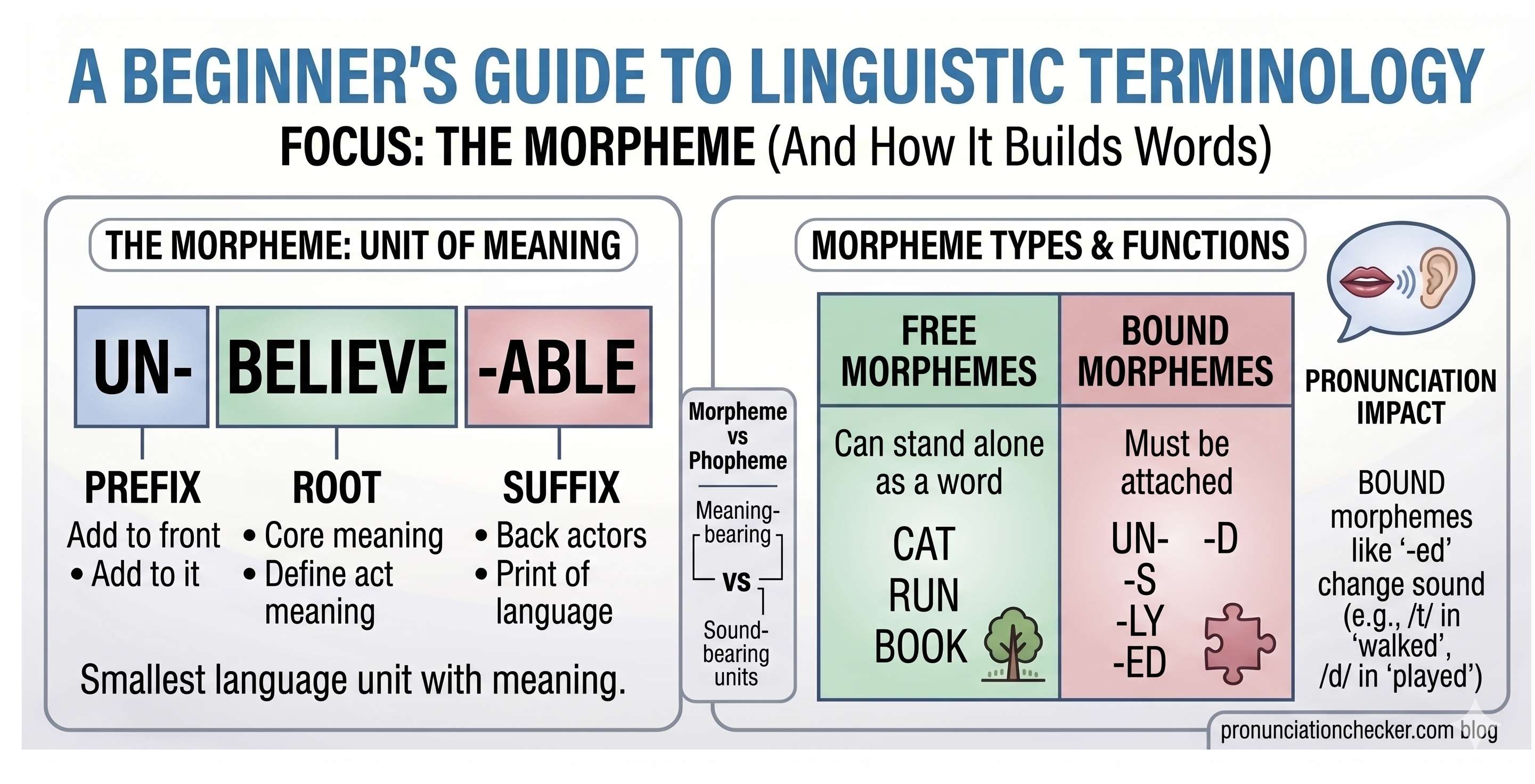
A morpheme is the smallest grammatical unit in a language that carries meaning. Unlike syllables, which are about sound, morphemes are about meaning. You can't break a morpheme down further without losing its essential meaning.
Let's look at the word "unhappiness":
"un-" means "not"
"happy" is the root word meaning "joyful"
"-ness" turns the adjective into a noun meaning "the state of"
Each of these three components is a morpheme. They're the LEGO bricks of language that we combine to create complex meanings.
Types of morphemes
Free morphemes can stand alone as independent words. Examples include "book," "run," "happy," and "fast." These are complete words on their own.
Bound morphemes cannot function independently and must attach to other morphemes. These include:
Prefixes: "un-", "re-", "pre-"
Suffixes: "-able", "-ness", "-ly"
Inflectional endings: "-s" (plural), "-ed" (past tense), "-ing" (continuous)
Understanding this distinction helps you see how words relate to each other. When you recognize that "uncomfortable" contains the free morpheme "comfort," you can better understand and remember its meaning.
Beyond morphemes: Other essential linguistic terms
Now that we've mastered morphemes, let's explore other key concepts that will enhance your language understanding.
Phonemes: The sound building blocks
While morphemes are meaning units, phonemes are the smallest units of sound that can distinguish meaning. Changing a phoneme changes the word:
"Bat" vs. "cat" (/b/ vs. /k/)
"Ship" vs. "sheep" (/ɪ/ vs. /i:/)
English has approximately 44 phonemes, depending on dialect. Mastering these sounds is crucial for clear pronunciation.
Syntax: The architecture of sentences
Syntax refers to the rules governing how words combine to form phrases and sentences. It's why "The cat chased the mouse" makes sense while "Chased cat the mouse the" doesn't. Understanding syntax helps you construct grammatically correct sentences automatically.
Morphology: The study of word structure
Morphology is the study of morphemes and how they combine. When you analyze how "re-" + "do" creates "redo," you're practicing morphology. This knowledge helps you decode unfamiliar words by recognizing their components.
Pragmatics: Meaning in context
Pragmatics examines how context influences meaning. The question "Can you pass the salt?" isn't really about your ability—it's a polite request. Understanding pragmatics helps you use language appropriately in social situations.
Why linguistic terminology matters for language learners
You might wonder why these technical terms matter for everyday language learning. Here's how this knowledge gives you a significant advantage:
1. Vocabulary expansion strategy
Understanding morphemes is like having a vocabulary multiplier. Once you know common prefixes and suffixes, you can:
Decode unfamiliar words by breaking them down
Create new words correctly
Understand word families (help, helpful, helpless, unhelpful)
For example, knowing that "-able" means "capable of" helps you understand that "readable" means "capable of being read."
Part 2: The building blocks of sound
2. Pronunciation precision
Knowing about phonemes helps you identify specific pronunciation challenges. If you struggle with distinguishing "ship" and "sheep," you can focus specifically on the /ɪ/ and /i:/ phonemes rather than vaguely trying to "improve pronunciation."
3. Grammar mastery
Understanding syntax helps you internalize sentence patterns rather than memorizing rules. You start feeling what "sounds right" because you understand the underlying structure.
4. Cultural competence
Pragmatics knowledge helps you avoid social misunderstandings. You learn not just what to say, but when and how to say it appropriately in different contexts.
Bridging the gap: From knowledge to practice
Understanding linguistic concepts is one thing—applying them to improve your speaking skills is another. This is where many learners hit a barrier. You might know what a phoneme is theoretically, but how do you know if you're producing it correctly?
This challenge is especially pronounced with pronunciation. You can study phoneme charts and understand the difference between /θ/ (as in "think") and /s/ (as in "sink"), but without feedback, you might not hear your own errors. This phenomenon, where you perceive your pronunciation differently from how it actually sounds, is common among language learners.
The feedback gap in language learning
Traditional language learning methods often create what we might call a "feedback gap":
Textbooks provide knowledge but no interactive feedback
Language apps might test vocabulary but rarely provide detailed pronunciation analysis
Conversation partners might understand you despite errors, missing opportunities for correction
This gap is particularly problematic for pronunciation because what you hear when you speak isn't what others hear. Bone conduction and familiarity with your own speech patterns can trick you into thinking your pronunciation is clearer than it actually is.
Bridging the gap with technology
This is where modern pronunciation tools become invaluable. While understanding morphemes helps with vocabulary, and syntax helps with grammar, pronunciation requires specific, immediate feedback that traditional methods often can't provide.
Your personal pronunciation coach
How pronunciation technology complements linguistic knowledge
Pronunciation apps that use speech recognition technology act as your personal pronunciation coach. Here's how they connect to the linguistic concepts we've discussed:
Phoneme-level feedback Advanced pronunciation tools can analyze your production of individual phonemes. If you're struggling with the /v/ and /w/ distinction (a common challenge for speakers of many languages), these tools can detect whether you're producing the sounds correctly and give you specific feedback.
Word stress analysis Many tools can analyze your word stress patterns—crucial for intelligibility in English. They can tell you if you're stressing the correct syllable in words like "PHOtograph" versus "phoTOGraphy."
Intonation practice Some applications provide visual feedback on your intonation patterns, helping you master the musical aspects of English that are so important for conveying meaning and emotion.
Immediate correction Unlike a human teacher who might let occasional errors slide to maintain conversation flow, pronunciation tools give you instant, objective feedback on every attempt.
Practical application: Using your new knowledge
Now that you understand both the linguistic theory and the tools available, here's how to create an effective learning practice:
1. Morphology-based vocabulary building
Keep a journal of word families (act, action, active, activate)
Practice adding prefixes and suffixes to root words
When you encounter a new word, break it into morphemes
2. Phoneme-focused pronunciation practice
Identify 2-3 phonemes that challenge you
Use minimal pairs (ship/sheep, bat/pat) for practice
Record yourself and compare to native speakers
3. Syntax awareness
Analyze sentence structures in texts you read
Practice transforming sentences (active to passive, statements to questions)
Pay attention to word order patterns in conversations
4. Pragmatics observation
Notice how native speakers make requests or express politeness
Pay attention to body language and tone in different contexts
Practice appropriate responses for common situations
Conclusion: Your journey to linguistic awareness
Putting it all together: Your linguistic toolkit
Understanding morphemes and other linguistic concepts gives you a framework for understanding how English works. But knowledge alone isn't enough—you need practice and feedback.
This is where specialized tools like the English Pronunciation Test App become valuable. By combining your theoretical knowledge with practical, technology-driven feedback, you create a powerful learning system. The app helps you bridge the gap between knowing about phonemes and actually producing them correctly.
If you're ready to apply your new linguistic knowledge to improve your pronunciation, consider trying a specialized tool. For example, you can test your skills with the English Pronunciation Test App Voice Online, which provides the detailed feedback necessary to turn theoretical knowledge into practical speaking ability.
Learning about morphemes and other linguistic concepts isn't just academic—it's practical. This knowledge helps you see patterns in the language, understand how words relate to each other, and identify specific areas for improvement.
Remember that language learning is a journey. Start with one concept at a time, practice consistently, and use tools that give you the feedback you need to progress. Whether you're focused on vocabulary building through morphology or pronunciation improvement through phoneme practice, each step brings you closer to fluency.
The key is combining theoretical knowledge with practical application. Now that you understand what morphemes are and how they fit into the larger picture of language learning, you're equipped with valuable tools for your English learning journey.
Ready to perfect your pronunciation?
Type any word into our free tool to hear exactly how it sounds in American, British, Australian, and Indian English.
Try PronunciationChecker Now