10 tricky Minimal Pairs that confuse English learners (and How to fix them)
Imagine confidently ordering a "bowl of rice" at a restaurant, only to have the waiter look at you in confusion. You might be saying "lice" instead. Or perhaps you've tried to compliment someone's "sheep" (meaning their animal) but accidentally said they have a nice "ship" (meaning a large boat). These simple misunderstandings are the result of mixing up what are known as minimal pairs.
A minimal pair is a pair of words that are exactly the same except for one single sound. For native speakers, the difference between these sounds is automatic and clear, but for English learners, they can be a minefield. The reason is simple: many of these sounds do not exist in other languages, or they are not used in a way that changes a word’s meaning. Learning to hear and produce these subtle distinctions is the single most effective way to improve your accent and ensure your message is understood.
This guide will break down ten of the trickiest minimal pairs that consistently confuse English learners. More importantly, we'll give you a clear, actionable plan—complete with exercises and tips—to master each one. While this article provides a solid starting point, for an exhaustive list of thousands of pairs, we highly recommend checking out the extensive resource at https://pronunciationchecker.com/tools/minimal-pair/english-minimal-pair-list.html. This site is an invaluable tool for any serious English student.
Tricky Pair 1: L vs. R (light vs. right)
This is perhaps the most famous and frustrating minimal pair for many learners, particularly those from Asian language backgrounds where the sounds are either interchangeable or one does not exist. The difference is all in the tongue position.
L sound: To make the L sound, the tip of your tongue touches the ridge behind your upper front teeth. The air flows around the sides of your tongue.
R sound: For the R sound, your tongue curls back slightly and does not touch the roof of your mouth. The air flows over the top of your tongue. Your lips may also round slightly.
How to Fix It:
- Focus on tongue placement. Say the word "light" while consciously touching your tongue to the roof of your mouth. Then, say the word "right" while pulling your tongue back so it doesn't touch.
- Exaggerate the movements. Practice saying "light, right, light, right" slowly, feeling the distinct position of your tongue for each sound.
- Tongue Twister: "A red lorry, a yellow lorry." This will help you switch between the sounds quickly.
Tricky Pair 2: TH (unvoiced) vs. T (thin vs. tin)
The unvoiced th sound (as in 'thin') doesn't exist in many languages, causing learners to substitute it with a t or an s sound. This can completely change the meaning of a sentence.
TH (unvoiced): To make this sound, place the tip of your tongue gently between your front teeth. Push air out, and you should feel it on your tongue without making a vibration in your throat.
T sound: For the t sound, the tip of your tongue touches the ridge behind your upper teeth. The sound is made by a quick burst of air, a plosive.
How to Fix It:
- Feel the vibration (or lack thereof). Place your fingers on your throat. When you say "tin," you should feel a slight vibration. When you say "thin," you should feel nothing.
- Practice in front of a mirror. Watch your tongue as you say "thin," making sure it is between your teeth.
- Tongue Twister: "I thought a thought, but the thought I thought wasn't the thought I thought I thought."
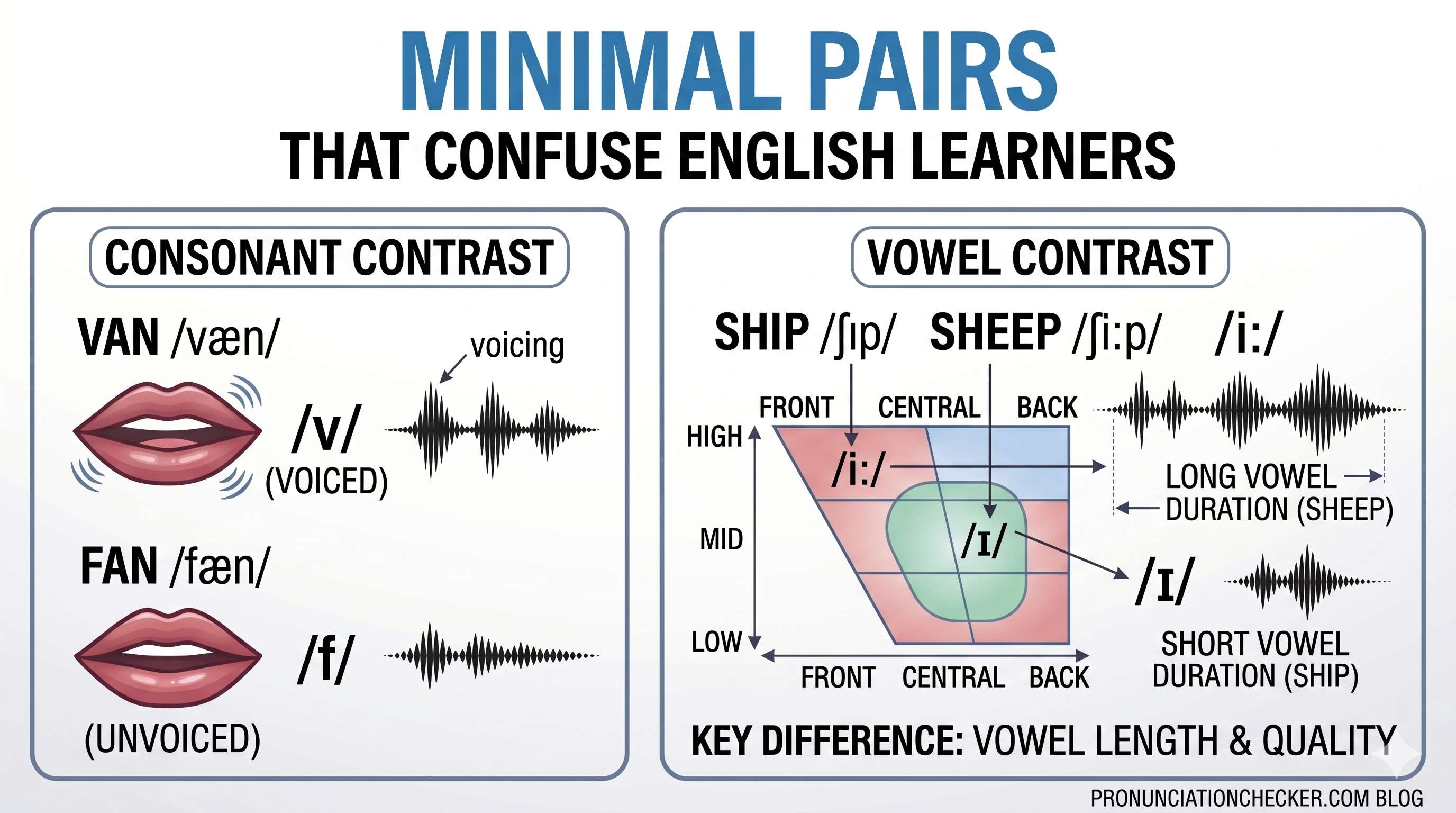
Tricky Pair 3: I vs. I: (ship vs. sheep)
This vowel pair is challenging because the sounds are so similar, and many languages only have a single 'i' sound. The difference is the length and tension of the sound.
I sound (short): This is the vowel in "ship." Your mouth is slightly open, and the sound is short and relaxed.
I: sound (long): This is the vowel in "sheep." Your lips are slightly spread as if you are smiling, and the sound is longer and more tense.
How to Fix It:
- Exaggerate the smile. When you say "sheep," smile widely. When you say "ship," let your face relax. This will help you feel the difference in muscle tension.
- Use a visual aid. Think of the long sound as a "long smile." Say "ship" then "sheeeep" and stretch out the long sound.
- Phrase Practice: "The ship is on the sea," vs. "The sheep are in the field."
Tricky Pair 4: V vs. W (vine vs. wine)
This pair is a classic source of confusion, especially for Spanish and German speakers. The key difference lies in how you use your lips and teeth.
V sound: To make the v sound, your upper teeth touch your lower lip. You then force air out, creating a buzzing vibration.
W sound: For the w sound, your lips are rounded into a small circle, as if you're about to whistle. There is no contact between your teeth and lips.
How to Fix It:
- Look in a mirror. Say "vine" and watch your upper teeth touch your lower lip. Say "wine" and watch your lips round.
- Feel the vibration. Place a finger on your throat. You should feel a strong vibration for both sounds. The difference is in the lip/teeth contact.
- Tongue Twister: "Walter and Victor went to the village to buy vegetables and wine."
Tricky Pair 5: E vs. Æ (bed vs. bad)
This is a subtle but critical distinction. Mispronouncing these can lead to awkward misunderstandings.
E sound: The vowel in "bed" is a relaxed, slightly open mouth sound. The corners of your lips are neutral.
Æ sound: The vowel in "bad" is made by opening your mouth wider, as if you are saying "ah," and spreading your lips slightly. The jaw drops more.
How to Fix It:
- Use a mirror. Notice how your jaw drops more for "bad" than for "bed."
- Practice contrasting words: "The man has a bad back," vs. "I went to bed."
- Visualize the sound: Imagine the e sound as "eh" and the æ sound as "aah." This exaggerated difference will help you train your mouth.
Tricky Pair 6: S vs. SH (sea vs. she)
This pair can be a problem for speakers of languages where the sh sound is not common, or where it's a variation of the s sound.
S sound: The s sound is a high-pitched hiss. Your tongue is flat and behind your teeth, and the air flows through a narrow gap in the middle.
SH sound: For the sh sound, your lips are rounded, and your tongue is further back in your mouth. The sound is much quieter and less hissing.
How to Fix It:
- Feel the air. Place the back of your hand in front of your mouth. When you say "she," you should feel a wider burst of air. When you say "sea," it will be a more concentrated, sharper flow.
- Practice rounding your lips. Consciously round your lips when you say words like "she," "shoe," and "wash."
- Tongue Twister: "She sells seashells by the seashore."
Tricky Pair 7: TH (voiced) vs. D (this vs. dis)
This is the second th sound, and it's voiced. For many learners, this can sound just like a d sound.
TH (voiced): To make this sound, place your tongue between your teeth, just like the unvoiced th, but this time, vibrate your vocal cords. You should feel a buzz.
D sound: For the d sound, your tongue touches the ridge behind your upper teeth. The sound is a quick burst of air with vocal cord vibration.
How to Fix It:
- Feel the vibration (and position). Place your fingers on your throat to feel the buzz for "this." Then feel the pop of air for "dis."
- Practice with minimal phrases: "This is a cat," vs. "He is displeased."
- Exaggerate the tongue. Really stick your tongue out a little when you say words like "that," "the," and "they."
Tricky Pair 8: P vs. B (pat vs. bat)
This pair can be tricky because the difference between the sounds is in a small puff of air called "aspiration."
P sound: The p sound is aspirated. This means a puff of air is released. Hold your hand in front of your mouth. When you say "pat," you should feel a strong puff of air.
B sound: The b sound is not aspirated. There is very little to no puff of air. The sound is also voiced (your vocal cords vibrate). You can feel this on your throat.
How to Fix It:
- The "Paper" Trick. Hold a small piece of paper in front of your mouth. When you say "pat," the paper should move. When you say "bat," it should not.
- Feel your vocal cords. Place your fingers on your throat. Say "pat" and feel no vibration. Say "bat" and feel a vibration.
- Record yourself. Listen back to your words. Do they sound sharp and clear (p) or softer and more voiced (b)?
Tricky Pair 9: A vs. U (æ vs. ʌ) (hat vs. hut)
Another classic vowel confusion. These two sounds are often indistinguishable for non-native speakers, but they are completely different.
A (æ) sound: The vowel in "hat" is an open-mouth sound, similar to the a in "cat." Your mouth is wide and flat.
U (ʌ) sound: The vowel in "hut" is a more relaxed, central vowel sound. Your mouth is less open and your lips are in a neutral position.
How to Fix It:
- Exaggerate mouth shape. Say "hat" and widen your mouth. Say "hut" and keep your mouth more relaxed.
- Record yourself. Try saying a sentence with both words and listen back: "The hat is on the hut."
- Practice in a group. Have a friend say one of the words and you guess which one it is. This tests your listening skills as well.
Tricky Pair 10: F vs. V (fan vs. van)
While similar to the V vs. W pair, the key here is voicing. The lip-to-teeth position is the same for both f and v.
F sound: This is an unvoiced sound. Your upper teeth touch your lower lip, and you push air out. No vocal cord vibration.
V sound: This is a voiced sound. The mouth position is the same as for f, but your vocal cords vibrate.
How to Fix It:
- Feel the vibration. Place your fingers on your throat. Say "fan" and you'll feel nothing. Say "van" and you'll feel a clear buzz.
- Practice with other words. Practice "fine" vs. "vine," "safe" vs. "save," etc.
- Create Sentences: "I saw a fan in the van."
A Call to Action: Your Pronunciation Journey Starts Now
Mastering these minimal pairs is not about achieving a "perfect" accent, but about gaining clarity and confidence in your communication. By training your ear to hear these subtle differences and your mouth to produce them correctly, you're taking a monumental step toward fluency.
Remember, consistency is key. Set aside just 10-15 minutes a day to practice one or two of these pairs. Use the Pronunciation Checker website as your personal library for finding the exact sounds you need to work on. Record yourself, use a mirror, and practice with a friend. It may feel strange at first, but with persistence, you will build the muscle memory you need to communicate effortlessly and effectively. Your path to a clearer, more confident English accent is just a few minimal pairs away.
Ready to perfect your pronunciation?
Type any word into our free tool to hear exactly how it sounds in American, British, Australian, and Indian English.
Try PronunciationChecker Now