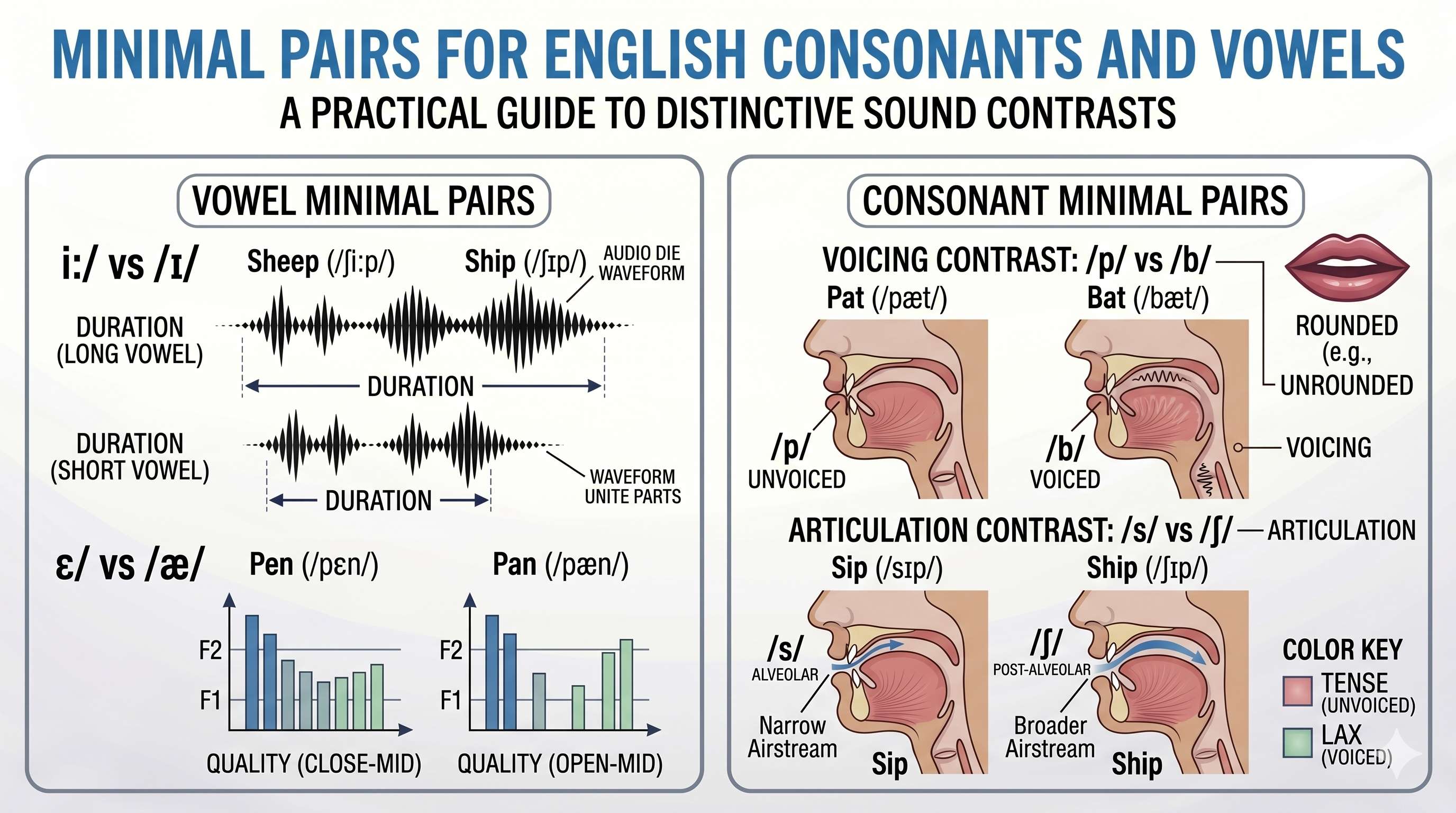
The ultimate list of Minimal Pairs for English consonants and vowels
Have you ever been confused when someone said they need to "collect a ship" when you thought they were talking about a "sheep"? Or perhaps you’ve struggled to hear the difference between saying you feel "full" versus "fool"? If so, you've encountered the powerful world of minimal pairs.
Minimal pairs are the secret weapon for mastering English pronunciation, whether you're a non-native speaker aiming for clarity or a native speaker honing your elocution. They are the key to unlocking sounds that might not exist in your native language and training your ear to hear the subtle distinctions that define meaning in English.
In this comprehensive guide, we present the ultimate list of minimal pairs for English consonants and vowels. We’ll break down exactly what minimal pairs are, why they are so effective, and provide extensive, categorized lists to practice with. For an interactive way to practice these pairs, be sure to check out the excellent resources at Pronunciation Checker's Minimal Pair Page (https://pronunciationchecker.com/tools/minimal-pair/english-minimal-pair-list.html).
What are Minimal Pairs? The foundation of clear speech
A minimal pair is a set of two words that are identical in every way except for one sound. This single sound difference occurs in the same position in each word and changes the word's entire meaning.
Let's take the classic example:
Ship /ʃɪp/
Sheep /ʃiːp/
Both words begin with the "sh" sound (/ʃ/) and end with the "p" sound (/p/). The only difference is the vowel sound in the middle: the short, quick /ɪ/ in "ship" and the longer, higher /iː/ in "sheep." This tiny phonetic change creates two completely different words.
Why practicing Minimal Pairs is a game-changer
You might wonder, "Why focus on such small differences?" The answer is simple: intelligibility. Being understood is the primary goal of communication. Mispronouncing a sound can lead to confusion, misunderstandings, and even awkward situations.
1. Trains your ear (perception): Before you can produce a sound correctly, you
must be able to hear it. Minimal pair practice sharpens your listening skills,
helping you discern nuances you might have previously missed.
2. Trains your mouth (production): By switching between two similar sounds,
you develop the fine muscle control needed in your tongue, lips, and jaw to
articulate each sound distinctly.
3. Builds phonemic awareness: You become more aware of the individual sound
units (phonemes) that make up English words. This awareness is crucial for
both pronunciation and spelling.
4. Prevents common errors: Many common pronunciation mistakes, like mixing up
"r" and "l" sounds or long and short vowels, are directly addressed by minimal
pair practice.
How to use these Minimal Pair lists effectively
Don't just read the lists—practice them actively. Here’s a proven method:
1. Listen first: Find audio examples for the pairs. The list on Pronunciation
Checker
(https://pronunciationchecker.com/tools/minimal-pair/english-minimal-pair-list.html)
is a great starting point as it provides audio for many common pairs. Close
your eyes and focus on hearing the difference.
2. Repeat aloud: After hearing the correct pronunciation, repeat each word
slowly and deliberately. Feel the position of your articulators (tongue, lips,
etc.).
3. Record yourself: Use your phone's voice recorder. Say both words in a pair,
then play it back. Compare your pronunciation to the native speaker audio.
This is incredibly revealing.
4. Use in sentences: Practice the words in context. For example, "The ship is
large. The sheep is white." This bridges the gap between isolated sounds and
natural speech.
Part 1: Consonant Minimal Pairs
Consonant sounds are produced with some form of obstruction of the airflow. These pairs often challenge speakers whose native languages lack certain English consonants.
1. Voiced vs. voiceless consonants
The main difference here is the vibration of your vocal cords. Place your
fingers on your throat; you should feel a buzz for voiced sounds and no buzz
for voiceless ones.
/b/ (voiced) vs. /p/ (voiceless)
Bin - Pin
Buy - Pie
Cab - Cap
Rob - Rope
/d/ (voiced) vs. /t/ (voiceless)
Die - Tie
Dough - Toe
Bad - Bat
Bed - Bet
/g/ (voiced) vs. /k/ (voiceless)
Goat - Coat
Girl - Curl
Bag - Back
Log - Lock
/v/ (voiced) vs. /f/ (voiceless)
Vest - Fest
Vine - Fine
Save - Safe
Leave - Leaf
/z/ (voiced) vs. /s/ (voiceless)
Zip - Sip
Zero - Sero
Buzz - Bus
Prize - Price
/ð/ (voiced 'th') vs. /θ/ (voiceless 'th')
Thy - Thigh
Then - Thin
Breathe - Breath
Clothe - Loth (as in "unwilling")
2. Challenging consonant sistinctions
/r/ vs. /l/ (Common for East Asian speakers)
Right - Light
Road - Load
Fry - Fly
Prize - Plies
/w/ vs. /v/ (Common for German, Slavic, and Indian language speakers)
West - Vest
Wine - Vine
Wet - Vet
Why - Vie
/ʃ/ ('sh') vs. /s/
Ship - Sip
She - See
Mash - Mass
Preshure - Pressure (Note the different spellings!)
/ʧ/ ('ch') vs. /ʃ/ ('sh')
Cheap - Sheep
Chip - Ship
Rich - Rish (a surname)
Watch - Wash
/n/ vs. /ŋ/ ('ng')
N - Thin - Thing
Run - Rung
Sin - Sing
Win - Wing
Part 2: Vowel Minimal Pairs
Vowel sounds are produced with an open vocal tract. English has a complex vowel system with many subtle distinctions between long/short and tense/lax vowels.
1. Long vs. short vowels
/iː/ (long E) vs. /ɪ/ (short I) - The "Ship-Sheep" Pair
Sheep - Ship
Beat - Bit
Feel - Fill
Seat - Sit
/ɑː/ (long A as in "father") vs. /ʌ/ (short U as in "cup")
Hard - Hud (a surname)
Park - Puck
Dark - Duck
Hart - Hut
/ɜː/ (long U as in "fur") vs. /ɔː/ (long O as in "born") - Requires careful lip
rounding for /ɔː/
Fur - For
Her - Whore
Turn - Torn
2. The tricky "short e" vs. "short a"
/e/ (short E) vs. /æ/ (short A)
Bed - Bad
Men - Man
Pen - Pan
Lend - Land
3. Diphthongs vs. pure vowels
/eɪ/ (long A as in "face") vs. /e/ (short E as in "dress")
Face - Fess (a geological term)
Wait - Wet
Late - Let
Great - Gret (a rare word, but useful for the sound)
/aɪ/ (long I as in "price") vs. /eɪ/ (long A as in "face")
Bite - Bait
Ride - Rade
Lie - Lay
Night - Nate (a name)
/aʊ/ (as in "mouth") vs. /oʊ/ (as in "goat")
Now - Know
House - Hose
Loud - Load
Cloud - Clode (a name)
4. The schwa /ə/
The schwa is the most common vowel sound in English—a quick, neutral, unstressed sound found in many function words (a, the, of) and unstressed syllables.
/ə/ in unstressed syllables
about, alone, agree, sofa, pencil
Contrast: photograph (stress on 'pho') vs. photography (stress on 'to', 'pho'
becomes /fə/)
The ten pairs that cause the most trouble
If you only have time for a few contrasts, start with these. Each is common in everyday words, and each has a dedicated guide with articulation tips and drills.
| Pair | Contrast | Why it is hard | Full guide |
|---|---|---|---|
| light, right | /l/ – /r/ | One liquid sound in Japanese, Korean and many Chinese languages | R vs L |
| thin, tin | /θ/ – /t/ | TH is rare among the world's languages | TH vs S vs T |
| ship, sheep | /ɪ/ – /iː/ | Most languages have one vowel in this space | Short vowels |
| vine, wine | /v/ – /w/ | One sound in German, Russian, Hindi, Turkish | V vs W |
| bed, bad | /e/ – /æ/ | /æ/ is missing from most languages | Short vowels |
| sea, she | /s/ – /ʃ/ | Missing /ʃ/ in many Spanish varieties, Greek, Korean | SH, CH and J |
| this, dis | /ð/ – /d/ | Voiced TH is usually replaced by /d/ or /z/ | TH vs S vs T |
| pat, bat | /p/ – /b/ | No /p/ in Arabic; aspiration differs elsewhere | P vs B |
| hat, hut | /æ/ – /ʌ/ | Both heard as /a/ by speakers of many languages | Short vowels |
| fan, van | /f/ – /v/ | Final devoicing in German, Dutch, Russian | F vs V |
Taking it further: Minimal sets and sentences
Once you're comfortable with pairs, challenge yourself with minimal sets (groups of 3 or more words that differ by one sound) and minimal pair sentences.
Minimal sets
/b/, /p/, /t/, /d/ - Bee, Pee, Tee, Dee
/ɪ/, /iː/, /eɪ/, /aɪ/ - Bit, Beat, Bait, Bite
/æ/, /ɛ/, /ɪ/, /ʌ/ - Bad, Bed, Bid, Bud
Tongue twister sentences (practice with care!)
/s/ vs. /ʃ/: She sells seashells by the seashore.
/ɪ/ vs. /iː/: The cheap ship trip made the tourists feel sick.
/θ/ vs. /s/: I thought I saw thirty-three thirsty thieves on Thursday.
/r/ vs. /l/: Red lorry, yellow lorry, red lorry, yellow lorry.
Your path to pronunciation mastery
Mastering minimal pairs is not an overnight task, but it is one of the most rewarding investments you can make in your English communication skills. By consistently practicing the lists provided here, you will build the muscle memory and auditory discrimination needed for clear, confident speech.
Remember, the goal is not to achieve a "perfect" native-like accent, but to be easily understood by everyone you speak with. For ongoing practice and to hear many of these words pronounced by native speakers, bookmark this page and explore the extensive tools available at Pronunciation Checker(https://pronunciationchecker.com/tools/minimal-pair/english-minimal-pair-list.html).
Start today. Pick one or two pairs that are particularly challenging for you. Spend just five minutes a day listening, repeating, and recording. With patience and persistence, you will hear the difference—and so will everyone else.
Frequently asked questions
Are consonant or vowel contrasts harder for learners?
Vowels, generally, for two reasons. English has many more vowel contrasts than most languages, so more of them collapse into a single native category. And vowels have no contact point you can feel, whereas a consonant can be corrected by placing the tongue somewhere specific. Consonant errors are usually more noticeable but easier to fix.
Which contrasts should I prioritise from a long list?
Rank by how frequent the sounds are in English rather than by how different they sound. The /iː/ and /ɪ/ contrast affects hundreds of common words; the /ʒ/ and /dʒ/ contrast affects a few dozen. A small imprecision in a frequent sound costs more than a large error in a rare one, so frequency should decide where a month of practice goes.
How many pairs should I practise in one session?
Around twenty items on a single contrast, rather than fifty items spread across several. Fifty words covering fifteen sounds gives fifteen shallow exposures; twenty words on one target gives one deep exposure, and depth is what consolidates. Depth also lets you notice patterns in your own errors within the session.
Do I need to practise pairs in sentences too?
Yes, and earlier than feels comfortable. Word-level accuracy is a poor predictor of conversational accuracy, because the contrast has to survive while your attention is on grammar and meaning. Use sentence frames where the wrong sound changes the sentence, such as I need a sheet of paper against I need a ship of paper.
Disclosure: this page links to Preply, a tutoring marketplace. If you book a lesson through that link we may earn a commission, at no extra cost to you. It does not change what is recommended here. See our disclaimer and privacy policy.
Practise any pair from the list
Pick a contrast, listen, answer, and repeat until you hit ten in a row.
Practise minimal pairs