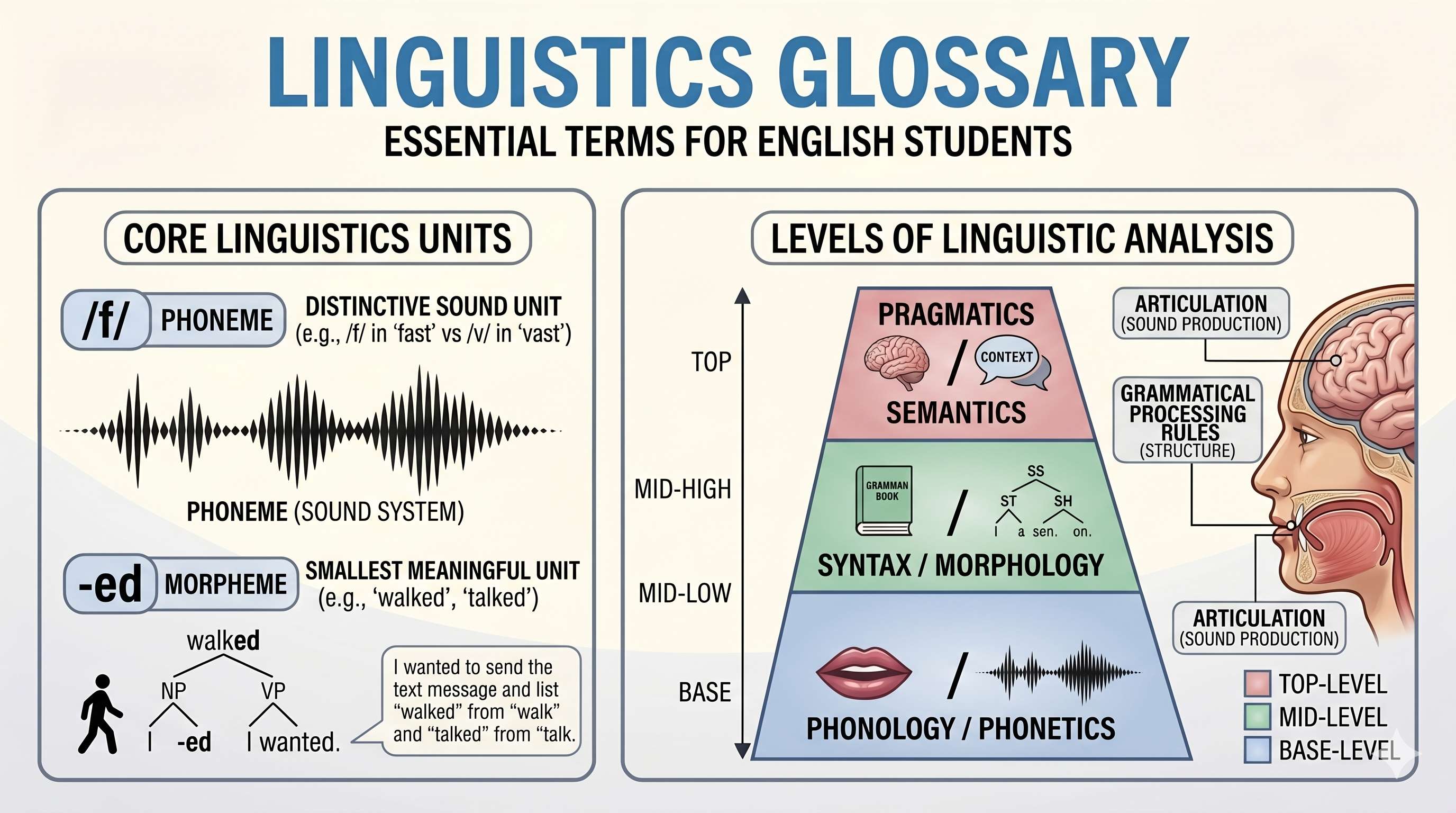
Demystifying linguistics: A simple glossary for English students
Have you ever felt like your English teacher or language app is speaking a different language? Words like "phoneme," "intonation," and "morphology" get thrown around, leaving you more confused than when you started. You're not alone. The field of linguistics—the scientific study of language—has its own vocabulary, but you don't need a PhD to understand it.
For any English student, knowing these terms is like getting a behind-the-scenes tour of how the language works. It demystifies why you make certain mistakes and, more importantly, shows you exactly how to fix them. This simple glossary is designed to cut through the jargon and give you the key linguistic concepts that will turbocharge your learning journey.
Think of this as your friendly guide to the language of language learning. Let's dive in!
Why bother with linguistic terms?
Before we get to the definitions, let's address the "why." Isn't it enough to just practice speaking and listening?
In short, no. Imagine trying to assemble a complicated piece of furniture without the instruction manual. You might eventually figure it out through trial and error, but it will take much longer and the result might be wobbly. Linguistic terms are your instruction manual for English. They help you:
Diagnose problems precisely: Instead of thinking "my pronunciation is bad," you can identify the specific issue: "I struggle with the /θ/ phoneme" or "I'm not using the correct intonation for questions."
Find the right solutions: Knowing the correct term helps you search for effective exercises. Searching for "how to make the th sound" is more effective than searching for "how to sound better."
Understand native speakers: Linguistics explains why native speakers sound the way they do—why they squash words together, drop sounds, and sing-song their sentences. Understanding these patterns is the key to moving from textbook English to natural, conversational English.
Your A-Z glossary of essential terms
Here are the most important linguistic terms, explained in plain English with clear examples.
1. Accent
What it means: The distinctive way a person or group pronounces words, usually influenced by their native language or region. In plain English: Everyone has an accent! It's the unique melody and sound of your speech. The goal for most learners isn't to eliminate their accent entirely, but to achieve clarity so they can be easily understood. Example: The difference between an American accent saying "water" (/ˈwɔːtər/) and a British accent saying "water" (/ˈwɔːtə/).
2. Articulation
What it means: The physical movement of your tongue, lips, teeth, and jaw to produce speech sounds. In plain English: It's how you shape your mouth to make a sound. Precise articulation is the secret to clear pronunciation.
3. Consonant
What it means: A speech sound made by partially or completely blocking the airflow from your lungs. In plain English: These are the sounds that are not vowels. They often appear at the beginnings and ends of syllables. English has consonants like /p/, /b/, /t/, /d/, /k/, /g/, /f/, /v/, /s/, /z/, and the tricky /θ/ (as in "think"). Example: The word "cat" has three consonants: /k/, /t/, and the closing sound of the vowel.
4. Diphthong
What it means: A complex vowel sound that glides from one vowel position to another within the same syllable. In plain English: It's a vowel that moves in your mouth. English is full of them! Example: The sound in "light" (/aɪ/) starts with an "ah" and glides to an "ee." The sound in "house" (/aʊ/) starts with an "ah" and glides to an "oo."
5. Intonation
What it means: The rise and fall of the pitch of your voice when you speak. In plain English: This is the "music" or "melody" of your speech. It's not about the words you say, but how you say them. Intonation expresses meaning and emotion. Example: A rising intonation at the end of a sentence often indicates a question ("You're coming? ↗"). A falling intonation indicates a statement ("You're coming. ↘").
6. IPA (International Phonetic Alphabet)
What it means: A special alphabet designed to represent every sound in every human language with one symbol for each sound. In plain English: English spelling is crazy! The "ough" in "though," "through," and "tough" are all pronounced differently. The IPA cuts through this confusion. Each word has a unique IPA spelling that shows you exactly how to pronounce it. Example:
though is pronounced /ðoʊ/
through is pronounced /θruː/
tough is pronounced /tʌf/
Learning the IPA is a superpower for language learners because it removes the guesswork from spelling.
7. Morphology
What it means: The study of the structure of words and their parts. In plain English: How words are built using smaller units of meaning called morphemes. A morpheme is the smallest meaningful unit. Example: The word "unbelievable" has three morphemes: un- (a prefix meaning "not"), believe (the root word), and -able (a suffix meaning "can be done").
8. Phoneme
What it means: The smallest unit of sound in a language that can change the meaning of a word. In plain English: It’s a distinct sound that makes a word different from another. If you swap one phoneme for another, you get a new word. Example: The words pat, bat, cat, and hat are only different because of their first phoneme: /p/, /b/, /k/, and /h/. The /p/ and /b/ sounds are distinct phonemes in English.
9. Pragmatics
What it means: The study of how context influences how we interpret meaning. In plain English: It's about using language appropriately in social situations. It’s the difference between what you say and what you mean. Example: If someone says, "It's cold in here," the literal meaning is about the temperature. But pragmatically, they might be hinting that they want you to close the window. Understanding pragmatics is key to avoiding social misunderstandings.
10. Rhythm
What it means: The pattern of stressed and unstressed syllables in speech. In plain English: English has a stress-timed rhythm. This means the beats (the stressed syllables) happen at roughly regular intervals, and the unstressed syllables are squeezed in between. This creates a characteristic "da-DUM da-DUM" pattern. Example: The sentence "The big dog chased the cat." The rhythm falls on the bold words.
11. Schwa (/ə/)
What it means: The most common vowel sound in English. It's a quick, relaxed, neutral "uh" sound. In plain English: In unstressed syllables, vowels often become a schwa. It’s the key to sounding natural and not robotic. Example: The 'a' in "about," the 'e' in "system," and the 'o' in "harmony" are all pronounced as a schwa (/ə/).
12. Syntax
What it means: The set of rules that governs the structure of sentences—the order of words and phrases. In plain English: This is what most people think of as "grammar." It's the rule that you say "I see the big dog" instead of "I the big dog see." Example: Syntax rules dictate that in English, adjectives usually come before nouns ("a red car"), whereas in other languages, they might come after.
13. Stress (word stress)
What it means: The emphasis placed on a particular syllable within a word. In plain English: In every multi-syllable English word, one syllable is said louder, longer, and with a higher pitch. Getting this wrong is a major reason why people might not understand you. Example:
Noun: "I have a RE-cord." (Stress on first syllable)
Verb: "Please re-CORD the song." (Stress on second syllable)
14. Vowel
What it means: A speech sound produced without any significant blockage of airflow. In plain English: These are the "open" sounds that form the core of every syllable (a, e, i, o, u). English has a complex vowel system with many more vowel sounds than the five or six letters suggest. Example: The words "beat" (/i:/) and "bit" (/ɪ/) have different vowel sounds, even though they are both represented by the letter 'i'.
Bringing the glossary to life: From theory to practice
Knowing what "intonation" means is one thing. Hearing it in your own voice and correcting it is another. This is the biggest challenge for students: the feedback gap. You might think you're using the correct rhythm or pronouncing a vowel correctly, but without an objective ear, it's hard to be sure.
This is where modern technology becomes your most valuable study partner.
How a pronunciation checker bridges the gap
A specialized tool, like the English Pronunciation Test App from Pronunciation Checker, is designed to give you the immediate, precise feedback that a textbook or even a busy teacher cannot always provide. It acts as your personal linguistics coach.
Here’s how it connects directly to the terms in this glossary:
Phoneme practice: The app's advanced speech recognition can analyze your production of individual phonemes. It can tell you if your /v/ sound is clear or if it's sounding too much like a /w/. This turns the abstract concept of a phoneme into a tangible, improvable skill.
Suprasegmental feedback: The best tools go beyond single sounds. They can analyze the suprasegmentals—the music of your speech. The app can provide visual feedback on your intonation (showing a pitch graph for a question vs. a statement) and your word stress (indicating if you emphasized the correct syllable in "RE-cord" vs. "re-CORD").
Objective measurement: It provides data, not just opinion. You can see a score or a visual representation of your pronunciation, which allows you to track your progress over time as you practice specific sounds and patterns.
Think of it as a practical lab for the theory you've just learned. You can test your understanding of these linguistic concepts and get instant results. Ready to demystify your own pronunciation? You can test your skills with the English Pronunciation Test App Voice Online.
Conclusion: You're now in the know
Linguistics doesn't have to be intimidating. By understanding these key terms, you've given yourself a powerful framework for understanding English. You're no longer just memorizing rules; you're understanding the system behind them.
Use this glossary as a reference. When you notice a recurring problem in your speaking, come back and find the term that describes it. Then, seek out targeted practice, and use tools like pronunciation checkers to close the feedback loop.
Remember, mastering a language is a journey. But with this new map in hand, you're well-equipped to navigate the path to fluent, confident, and clear English.
Ready to perfect your pronunciation?
Type any word into our free tool to hear exactly how it sounds in American, British, Australian, and Indian English.
Try PronunciationChecker Now