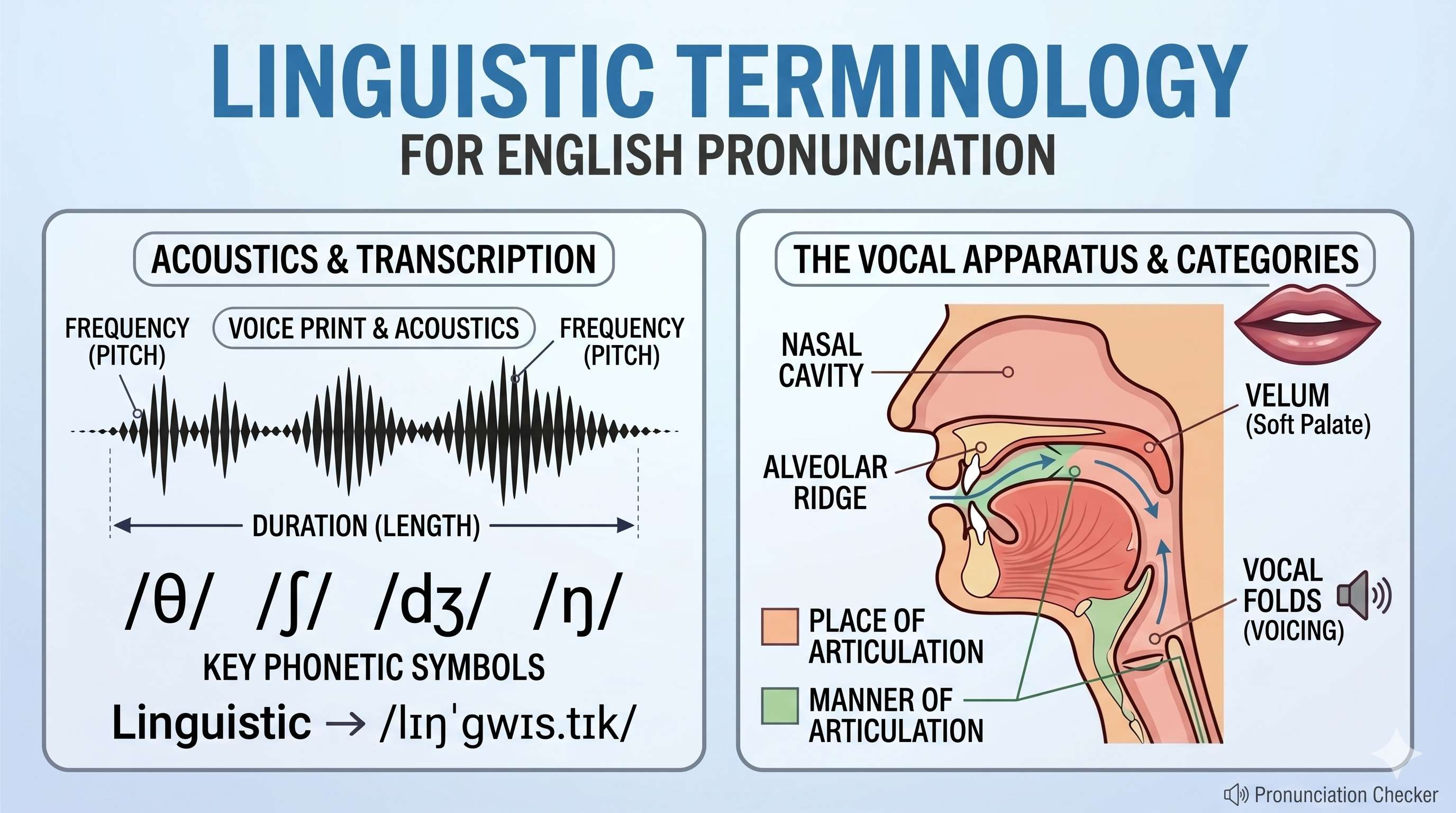
Beyond grammar: Essential linguistic terminology for English pronunciation
You’ve mastered the past perfect tense. You have a solid vocabulary. You can construct complex sentences on paper. But when you speak, people still ask you to repeat yourself. If this sounds familiar, you’ve encountered the critical truth of language learning: grammar and vocabulary are only half the battle.
The other, often-neglected half is the sound system of the language—the domain of pronunciation. To truly improve your spoken English, you need to move beyond grammar and delve into the world of linguistics. Understanding the specific terminology that describes how sounds are produced is the first step toward gaining control over your accent and achieving clear, confident speech.
This guide will introduce you to the essential linguistic terms that are the keys to unlocking English pronunciation. These are not just abstract academic concepts; they are practical tools for diagnosing problems and finding solutions.
Why grammar isn't enough: The sound system barrier
Think of language as a car. Grammar is the engine and the chassis—it’s the fundamental structure that makes the car work. Vocabulary is the fuel. But pronunciation? Pronunciation is the steering wheel, the brakes, and the accelerator. Without precise control over these elements, even the most powerful engine won’t get you where you want to go smoothly.
Many learners focus solely on the "engine" (grammar) and the "fuel" (vocabulary), hoping that speaking more will naturally improve their pronunciation. While practice is vital, practicing without awareness often leads to fossilization—the permanent entrenchment of errors. To correct a sound, you first need to understand what it is you’re doing wrong. That’s where linguistic terminology becomes your most valuable diagnostic tool.
The buildingblocks: Phonetics and Phonology
Before we dive into specific terms, let's define the two fields that study speech sounds:
Phonetics is the study of the physical production, transmission, and perception of speech sounds. It’s about the mechanics: how your tongue, lips, and vocal cords move.
Phonology is the study of how sounds function within a particular language. It’s about the patterns and systems of sounds. For example, why does the "p" in "pin" sound different from the "p" in "spin" to a native English speaker?
Understanding both the physical (phonetic) and systematic (phonological) aspects is crucial for effective pronunciation.
Part 1: The sounds themselves - Phonemes and the IPA
1. Phoneme: The sound that changes meaning
A phoneme is the smallest unit of sound in a language that can distinguish meaning. Changing a phoneme changes the word.
Example: The words bat, cat, hat, and fat are distinguished by their initial phonemes: /b/, /k/, /h/, and /f/. In English, /b/ and /v/ are distinct phonemes, as in "berry" vs. "very." However, in Spanish, that distinction doesn't exist, which is why Spanish speakers might struggle with it.
Why it matters for you: If you substitute one phoneme for another that is not distinct in your native language, you might accidentally say a completely different word. Mastering English pronunciation means learning to hear and produce all of its unique phonemes.
2. International Phonetic Alphabet (IPA): Your unbiased guide
The International Phonetic Alphabet (IPA) is a standardized system of symbols that represents every sound in human language. It is your best friend in pronunciation.
English spelling is notoriously unreliable. Consider the "o" in "do," "go," and "not"—it represents three different sounds! The IPA cuts through this confusion.
Example: The word "though" is pronounced /ðoʊ/. The word "through" is pronounced /θruː/. The word "tough" is pronounced /tʌf/. The IPA shows you the exact sounds, regardless of the chaotic spelling.
Why it matters for you: Learning the basic IPA symbols for English sounds allows you to look up any word in a dictionary and know its exact pronunciation, freeing you from the traps of English spelling.
3. Vowel: The core of your syllable
A vowel is a speech sound produced with an open vocal tract, without any significant obstruction of airflow. Vowels are the nucleus of every syllable. English has a particularly large and complex vowel system (around 14-20 vowels, depending on the dialect), which is a major challenge for learners.
Key vowel concepts include:
Tense vs. Lax: Tense vowels (like the /i:/ in "beat") are longer and require more muscle tension than lax vowels (like the /ɪ/ in "bit").
Diphthong: A complex vowel sound that glides from one vowel position to another within a single syllable (e.g., the /aɪ/ sound in "my" glides from "ah" to "ee").
Why it matters for you: Mispronouncing vowels is a primary source of a "strong accent." Confusing "ship" (/ʃɪp/) and "sheep" (/ʃiːp/) is a classic vowel error.
4. Consonant: Shaping the airflow
A consonant is a speech sound produced by partially or completely blocking the airflow. Consonants are defined by their place and manner of articulation.
Place of articulation: Where in the vocal tract is the airflow obstructed? (e.g., lips for /p/, teeth for /θ/, alveolar ridge for /t/).
Manner of articulation: How is the airflow obstructed?
Plosives/stops: Complete blockage then release (/p/, /b/, /t/, /d/, /k/, /g/).
Fricatives: Partial blockage creating a friction sound (/f/, /v/, /s/, /z/, /θ/ as in "think," /ð/ as in "this").
Affricates: A stop followed immediately by a fricative (/tʃ/ as in "chip," /dʒ/ as in "judge").
Why it matters for you: Understanding, for example, that /θ/ is a dental fricative (tongue against teeth) tells you exactly what to do physically, unlike just vaguely trying to imitate a "th" sound.
Part 2: The music of speech - suprasegmentals
This is where we go beyond individual sounds. Suprasegmentals are features of speech that extend over more than one sound, such as stress, rhythm, and intonation. They are the "music" of the language and are often more critical for intelligibility than perfect individual sounds.
5. Stress: The beat of a word
Word stress refers to the emphasis placed on a particular syllable within a word. In English, stressed syllables are longer, louder, and higher in pitch.
Example: In the word "record" (noun), the stress is on the first syllable. In "record" (verb), the stress is on the second syllable. Getting this wrong can make a word unrecognizable.
Why it matters for you: Incorrect word stress is a major barrier to being understood. Native listeners often rely on stress patterns to decode speech.
6. Rhythm: The flow of a sentence
English has a stress-timed rhythm. This means that the stressed syllables in a sentence tend to occur at regular intervals, while unstressed syllables are squeezed in between. This creates a characteristic "beat" (da-DUM da-DUM da-DUM). Unstressed vowels often reduce to a schwa (/ə/), the neutral "uh" sound.
Example: The sentence "The big dog chased the cat." The rhythm hinges on the stressed words.
Why it matters for you: Languages like Spanish or French are syllable-timed (each syllable gets roughly equal time). Applying a syllable-timed rhythm to English is a key reason why speech can sound "flat" or "mechanical" to a native ear.
7. Intonation: The melody of meaning
Intonation is the rise and fall of the pitch of your voice across a phrase or sentence. It conveys attitude, emotion, and grammatical structure.
Falling intonation: Used for statements and commands (e.g., "It's raining.↘").
Rising intonation: Used for yes/no questions (e.g., "Is it raining?↗").
Rise-fall intonation: Can express surprise or sarcasm.
Why it matters for you: Using flat or inappropriate intonation can make you sound bored, rude, or uncertain, even if your grammar is perfect.
Part 3: Connecting sounds - The secrets of natural speech
8. Assimilation: When sounds influence each other
Assimilation is when a sound changes to become more like a neighboring sound for ease of pronunciation.
Example: "ten pounds" is often pronounced "tem pounds" – the /n/ sound assimilates to the /p/ sound and becomes /m/.
9. Elision: The disappearing sound
Elision is the omission of a sound or syllable.
Example: Saying "fam'ly" instead of "family," or "choc'late" instead of "chocolate."
10. Linking: Smoothing the edges
Linking is the smooth connection of words together.
Example: Linking a final consonant to a following vowel: "an_apple," "turn_off."
Why it matters for you: If you try to pronounce every word separately and perfectly, your speech will sound stilted and unnatural. Understanding these connected speech phenomena is essential for both speaking fluently and comprehending native speakers.
From theory to practice: How to apply this knowledge
Knowing the term "diphthong" is one thing; producing it correctly is another. The biggest challenge learners face is the feedback gap. You can't correct what you can't hear. You might think you're saying "ship" correctly, but without an objective reference, it's nearly impossible to know if you're actually producing the lax vowel /ɪ/ or the tense vowel /i:/.
This is where technology bridges the gap between linguistic theory and practical improvement.
How a pronunciation checker app acts as your personal linguist
A specialized tool, like the English Pronunciation Test App from Pronunciation Checker, is designed to provide the precise, instant feedback that traditional methods lack. Here’s how it relates directly to the terminology we’ve covered:
Phoneme accuracy: The app's speech recognition technology is fine-tuned to analyze your production of specific phonemes. It can tell you if your /θ/ sound in "think" is clear or if it's sounding too much like /s/ or /t/.
Suprasegmental analysis: Advanced tools don't just check sounds; they analyze stress, rhythm, and intonation. The app can show you a pitch graph, allowing you to see if your intonation is rising for a question or if you're placing the word stress on the correct syllable.
Objective feedback: It provides an unbiased assessment, free from the politeness or subjectivity of a human listener. It gives you data, not just an impression.
You can think of it as a practical lab where you can test your understanding of phonetics and phonology. You can experiment with different tongue placements for a fricative and get immediate results. You can practice a sentence and see a visual representation of its rhythm.
Ready to put these linguistic terms into practice? You can test your pronunciation and receive instant, detailed feedback using the English Pronunciation Test App Voice Online. It’s the perfect partner for turning theoretical knowledge into tangible speaking skills.
Conclusion: Your pronunciation journey, demystified
Improving your English pronunciation is not a mysterious art; it's a science. By understanding the essential linguistic terminology—from phonemes and the IPA to stress and intonation—you equip yourself with a powerful map. You can now identify your specific challenges with precision.
Move beyond just learning words and rules. Start listening to the music of English. Pay attention to the rhythm of conversations and the melody of questions. Use the IPA to take control of chaotic spelling. And most importantly, use modern tools to close the feedback loop and practice with purpose.
Your journey to clear, confident English pronunciation starts with understanding the system. You now have the keys.
Ready to perfect your pronunciation?
Type any word into our free tool to hear exactly how it sounds in American, British, Australian, and Indian English.
Try PronunciationChecker Now