Master the IPA: Your complete guide to using a phonetic transcription dictionary
Have you ever looked up a word in the dictionary, only to be completely baffled by the strange symbols in the parentheses next to it? You’re not alone. Those symbols—like /ˈfəʊnɛtɪks/ for "phonetics"—are your secret key to unlocking perfect pronunciation. They are part of the International Phonetic Alphabet (IPA), a universal code that accurately represents the sounds of any language.
For language learners, actors, singers, and anyone passionate about clear communication, mastering the IPA is a game-changer. It frees you from relying on unreliable English spelling and allows you to see the exact sounds of a word. In this complete guide, we will demystify the IPA and show you exactly how to use a powerful tool: the phonetic transcription dictionary.
What is the IPA? Your passport to precise pronunciation
The International Phonetic Alphabet (IPA) is a standardized system of phonetic notation created by linguists. Its goal is simple but profound: to provide a one-to-one correspondence between a sound and a symbol. Unlike the English alphabet, where one letter can make multiple sounds (think 'c' in 'cat' vs. 'ice'), each IPA symbol consistently represents one specific sound.
Why is this so important? Consider these well-known problem words:
Tough (/tʌf/), though (/ðəʊ/), through (/θruː/), thought (/θɔːt/)
Read (present tense: /riːd/) vs. read (past tense: /rɛd/)
The spelling is similar, but the pronunciations are wildly different. The IPA cuts through the confusion, showing you the precise vowel and consonant sounds required.
Breaking down the IPA: Consonants, vowels, and diacritics
Before you can use a phonetic transcription dictionary, you need to understand its basic components. Don't worry; you don't need to memorize everything at once. Start with the sounds of English.
1. English consonant sounds
Many English consonants look like their Roman alphabet counterparts, such as /p/, /b/, /t/, /d/. The real power comes from symbols for sounds that don't have a single letter.
/θ/ and /ð/ (the "th" sounds): /θ/ is voiceless (as in thin, think). /ð/ is
voiced (as in
this, that).
/ʃ/ and /ʒ/ (the "sh" and "zh" sounds): /ʃ/ is common (as in ship, wash). /ʒ/
is less common
(as in measure, vision).
/tʃ/ and /dʒ/ (the "ch" and "j" sounds): These are actually two sounds
combined (as in
church and judge).
/ŋ/ (the "ng" sound): This is a single sound, not /n/ + /g/ (as in sing,
walking).
2. English vowel sounds (this is where the magic happens)
Vowels are the trickiest part of English pronunciation because there are so many of them (around 14-20, depending on the dialect). The IPA has a unique symbol for each one.
Short vowels:
/ɪ/ as in kit, bid
/ɛ/ as in desk, bed
/æ/ as in trap, bad
/ʌ/ as in cut, sun
/ʊ/ as in put, book
/ɒ/ as in lot, rob (common in British English)
/ə/ (The Schwa) - This is the most common vowel in English! It's a lazy,
neutral sound found
in unstressed syllables, like the 'a' in about or the 'e' in synthesis.
Long vowels & diphthongs (gliding vowels):
/iː/ as in fleece, see
/uː/ as in goose, blue
/ɑː/ as in father, calm
/ɔː/ as in thought, law
/ɜː/ as in nurse, bird
/eɪ/ as in face, day
/aɪ/ as in price, my
/ɔɪ/ as in choice, boy
/aʊ/ as in mouth, now
/əʊ/ (British) or /oʊ/ (American) as in goat, show
3. Understanding diacritics and stress markers
You'll also notice small marks around the symbols. The two most critical ones are:
Stress markers ( ˈ and ˌ ): The apostrophe-like symbol /ˈ/ before a syllable shows it carries the primary stress—the syllable you say with the most emphasis. The secondary stress marker /ˌ/ is used for a slightly weaker emphasis in longer words.
Pronunciation (/prəˌnʌn.siˈeɪ.ʃən/): Notice the primary stress on "-a-" and the
secondary
stress on "-nun-".
Understanding (/ˌʌn.dəˈstæn.dɪŋ/): The secondary stress is on "un-" and the
primary stress
is on "-stand-".
How to use a phonetic transcription dictionary: A step-by-step guide
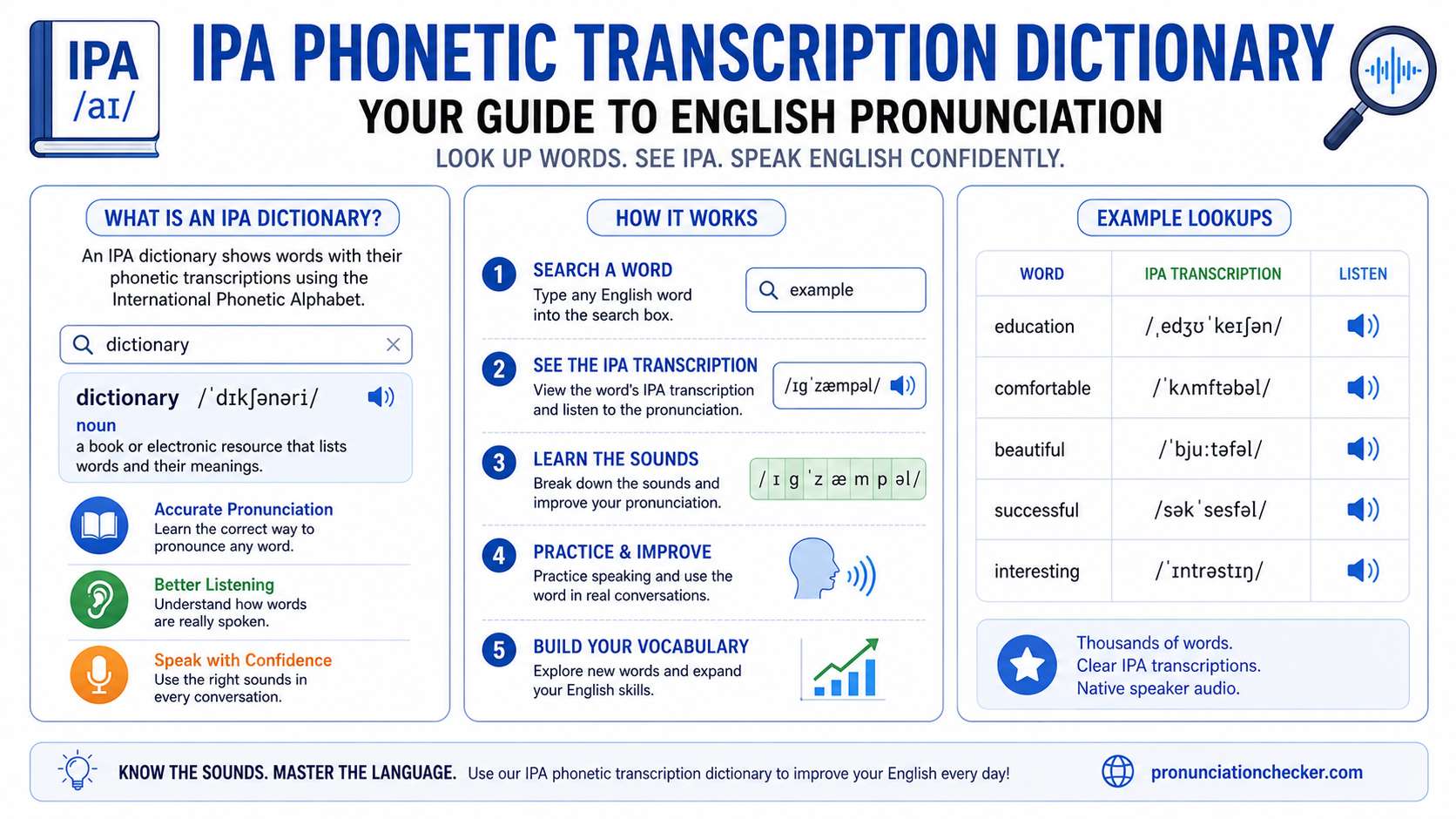
Now for the practical part. Let's use the excellent resource from Pronunciation Checker, their Phonetic Transcription Dictionary, as our example tool. The process is similar for most online dictionaries.
Step 1: Find the word Navigate to the tool and type your word into the search bar. Let's use the word "epitome."
Step 2: Locate the transcription The tool will provide the phonetic transcription. For "epitome," you will see something like: /ɪˈpɪt.ə.mi/.
Step 3: Break it down symbol by symbol Don't try to read it as a whole word. Break it into its individual sounds, using your knowledge of the IPA chart.
/ɪ/ - This is the short "i" sound from "kit."
/ˈpɪ/ - The /ˈ/ means the stress is on this syllable. /p/ is the normal "p"
sound. /ɪ/ is
the same short "i" sound again.
/t/ - The normal "t" sound.
/ə/ - This is the schwa, the neutral vowel sound (like the 'a' in
"about").
/m/ - The normal "m" sound.
/i/ - In this context, it represents the long "ee" sound (as in "fleece").
Step 4: Say it slowly, then blend Put it all together slowly: ih - PIT - uh - mee. Notice how the stress on the second syllable changes the word from how it's often mispronounced. It's not "EP-i-tome," but "ih-PIT-uh-mee."
Step 5: Check for variants A good dictionary like the one linked will also show pronunciation variants, such as differences between General American and Received Pronunciation (British English). For example, the word "water" is /ˈwɔː.tər/ in British English and /ˈwɑː.t̬ɚ/ in American English. Pay attention to which dialect you want to learn.
Practical exercises to master the IPA
Theory is nothing without practice. Here are some exercises to build your skills.
Exercise 1: Transcribe simple words Try to write the phonetic transcription for simple words you know. For example, try "cat" (/kæt/), "dog" (/dɒɡ/ or /dɑːɡ/), and "see" (/siː/). Then, check your answers in the dictionary.
Exercise 2: Decode "problem" words Look up words that have always confused you. Some great examples are:
Colonel: (/ˈkɜː.nəl/) - Where did those 'l' and 'r' sounds come from? The IPA
tells you!
Worcestershire: (/?w?s.t?.??/) - A classic. The IPA reveals it's
"WUSS-ter-sher."
Rendezvous: (/ˈrɒn.deɪ.vuː/) - The IPA shows the silent 'z' and the
French-inspired ending.
Exercise 3: Practice with homographs Look up words that are spelled the same but pronounced differently based on meaning.
Lead: (/liːd/ as in to lead a team) vs. (/lɛd/ as in the metal lead)
Wind: (/wɪnd/ as in the wind blows) vs. (/waɪnd/ as to wind a clock)
Why an online phonetic transcription dictionary is your best tool
While physical dictionaries are great, online tools like the Phonetic transcription dictionary from Pronunciation Checker offer distinct advantages:
- Audio pronunciations: Most online dictionaries provide audio clips. You can hear the word spoken in different accents, reinforcing the visual IPA symbols. This is invaluable for training your ear.
- Instant results: No more flipping pages. Get transcriptions for any word in seconds.
- Dialect variations: They easily display American, British, and other English variants side-by-side.
- Always updated: New words enter the language constantly. Online dictionaries are updated regularly to include them.
Common pitfalls and how to avoid them
- Assuming spelling equals sound: This is the biggest hurdle. Train yourself to ignore the spelling and trust the symbols.
- Ignoring stress: Misplaced stress is a major cause of unclear pronunciation. Always note the stress marker /ˈ/.
- Trying to learn everything at once: Focus on the sounds of your target dialect first. You don't need to learn the entire IPA chart for clicks and implosives to speak English well.
Conclusion: Unlock a world of clear communication
Mastering the IPA and learning to use a phonetic transcription dictionary is like learning to read a map for the spoken word. It empowers you with self-sufficiency and confidence. You will no longer have to guess how a word is pronounced or rely on awkward phonetic spellings that don't quite work.
It’s a skill that requires a small initial investment of time but pays dividends for a lifetime. So, the next time you encounter a new or tricky word, embrace those curious symbols. Head over to a tool like the Phonetic Transcription Dictionary, decode the sounds, and speak with clarity and confidence. Your journey to perfect pronunciation starts now.
Frequently asked questions
What does a phonetic dictionary tell me that a normal one does not?
The stressed syllable, which vowels are reduced, and which sounds are actually present regardless of spelling. Those three facts predict most of how a word is pronounced. A normal dictionary entry gives you the meaning; the transcription gives you a specification you can produce from.
Why do the slashes and square brackets differ?
Slashes mark phonemic transcription, which shows which sound categories a word contains without exact realisation. Square brackets mark phonetic transcription, which records physical detail such as aspiration and nasalisation. Learner dictionaries use slashes almost exclusively, which means predictable details — the aspiration in pin, for example — are not written down.
Does a transcription tell me how the word sounds in a sentence?
No, and this is its main limitation. A dictionary gives the citation form: the word said alone and carefully. And is transcribed /ænd/ but is usually /ən/ in speech, and to is /tuː/ in the dictionary and /tə/ in nearly every real utterance. Transcription is a tool for individual words, not a description of connected speech.
What should I look at first in an entry?
The stress mark, ˈ, which appears before the stressed syllable. Stress errors cost more in intelligibility than segment errors, and the stress also tells you which vowels will reduce. After that, scan for the two or three symbols you are currently working on rather than reading the whole transcription carefully.
Disclosure: this page links to Preply, a tutoring marketplace. If you book a lesson through that link we may earn a commission, at no extra cost to you. It does not change what is recommended here. See our disclaimer and privacy policy.
Search the dictionary
Type a word to get its IPA in American and British English with audio.
Open the IPA dictionary