Decoding the International Phonetic Alphabet: your interactive learning tool
Have you ever felt lost trying to pronounce a new word? You see the letters, but the sounds they’re supposed to make seem mysterious. English is a prime culprit—why does "c" sound different in "cat" and "ice"? Why do "through," "tough," and "though" look so similar yet sound so different?
For language learners, actors, singers, and anyone passionate about clear speech, this spelling puzzle is a constant challenge. But what if you had a key? A universal decoder ring that could unlock the precise pronunciation of any word in any language?
That key exists, and it’s called the International Phonetic Alphabet (IPA). Often perceived as a complex code for linguists, the IPA is, in fact, the most practical and powerful learning tool you’re not yet using. And the best way to learn it isn't by staring at a static chart; it's by interacting with it.
This guide is your decoder. We will break down the IPA into understandable parts and introduce you to an essential interactive resource that will transform how you hear and produce sounds. Get ready to turn a confusing chart into your most trusted pronunciation partner.
What is the International Phonetic Alphabet (IPA)?
The International Phonetic Alphabet is a standardized system of phonetic notation. Created in the late 19th century, its goal was simple yet ambitious: to create a unique symbol for every distinct sound used in human speech. Unlike the regular alphabet, where one letter can represent multiple sounds (the 'a' in 'father,' 'cat,' and 'ace'), each IPA symbol has a one-to-one relationship with a single sound, or phoneme.
Think of it as a map for your mouth. Where English spelling gives you a rough destination ("pronounce this word kinda like this"), the IPA gives you turn-by-turn GPS directions for your tongue, lips, and vocal cords.
Why the IPA is a game-changer for learners
Accuracy and consistency: With the IPA, there is no guesswork. The transcription /fəˌnɛtɪks/ tells you exactly how to pronounce "phonetics," regardless of how tricky the spelling seems.
Universal application: The IPA isn't just for English. It can transcribe any language on Earth. The subtle trill of a Spanish ‘r’ (/r/), the nasal vowels of French (/ɑ̃/), and the tonal sounds of Mandarin all have their precise IPA symbols. This makes it the ultimate tool for polyglots.
Solves the "spelling vs. sound" problem: The IPA liberates you from the inconsistencies of English spelling. It allows you to see the sound structure of a word directly.
Cracking the code: a guide to the IPA chart
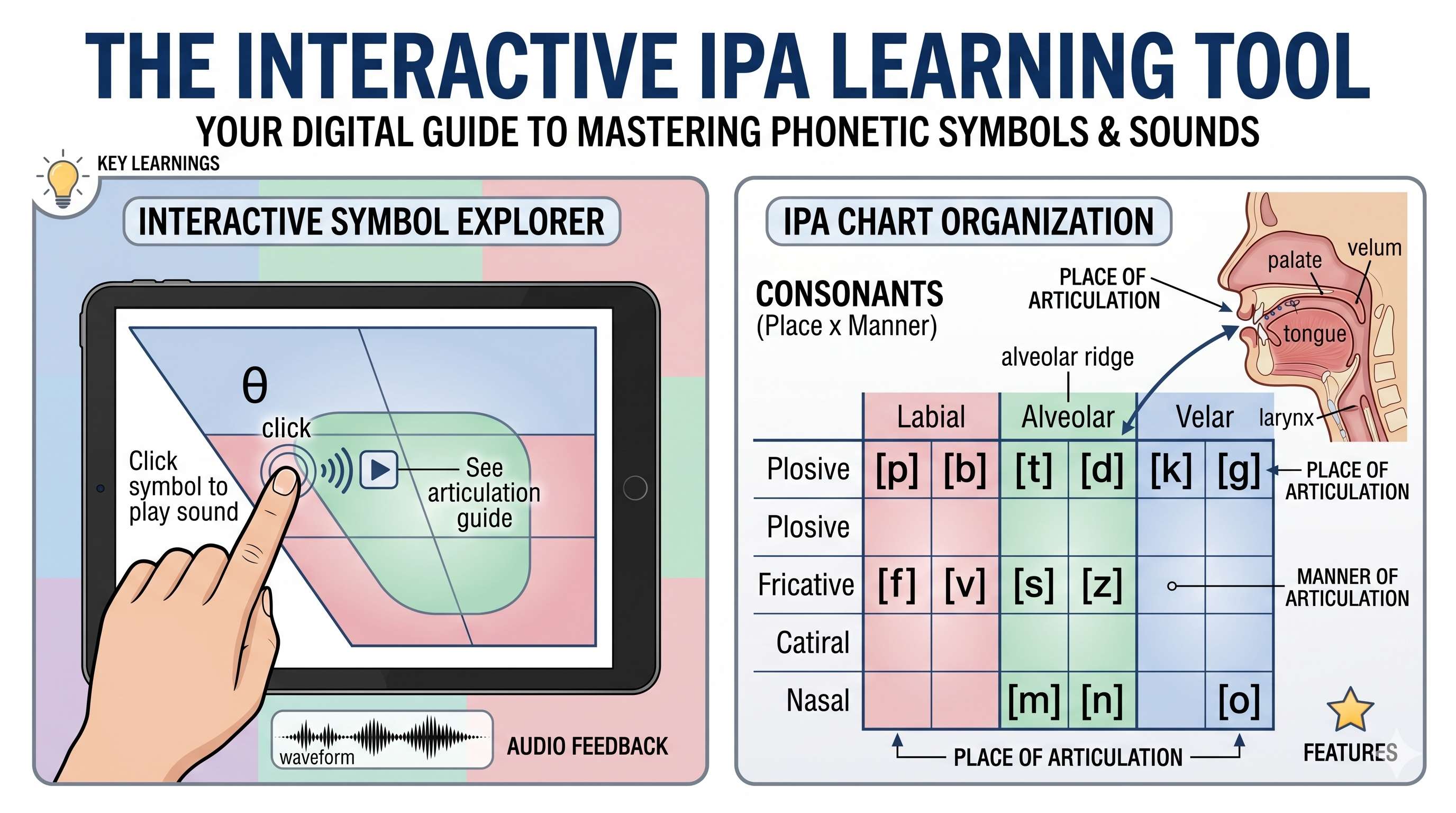
The full IPA chart can look like a grid of alien symbols. But its organization is brilliantly logical. It’s based entirely on the physics of sound production—where and how you create the sound in your vocal tract. Let's decode its structure.
Deciphering consonants: the "where" and "how"
Consonants are sounds created by obstructing airflow in some way. The IPA chart classifies them using two main features: place of articulation (WHERE the obstruction happens) and manner of articulation (HOW the obstruction happens).
Place of articulation (the columns)
Bilabial: Both lips come together. Examples: /p/ (pat), /b/
(bat), /m/ (mat).
Labiodental: Lower lip touches upper teeth. Examples: /f/
(fan), /v/ (van).
Dental: Tongue touches the upper teeth. Examples: /θ/ (thin),
/ð/ (then).
Alveolar: Tongue touches the alveolar ridge (the bumpy area
right behind your upper teeth).
Examples: /t/ (tap), /d/ (dap), /s/ (sip), /z/ (zip).
Postalveolar: Tongue is near or touching the area just behind
the alveolar ridge. Examples:
/ʃ/ (ship), /ʒ/ (measure), /tʃ/ (chip), /dʒ/ (jam).
Palatal: The body of the tongue approaches the hard palate.
Example: /j/ (yes).
Velar: The back of the tongue touches the soft palate
(velum). Examples: /k/ (kite), /g/
(good), /ŋ/ (sing).
Glottal: The sound is made at the glottis (the space between
your vocal cords). Example: /h/
(hat), /ʔ/ (the catch in your throat in "uh-oh").
Manner of articulation (the rows)
Plosive: A complete blockage of airflow, which is then released
with a puff. Examples: /p, b,
t, d, k, g/.
Nasal: The airflow is diverted through the nose because the
velum is lowered. Examples: /m,
n, ŋ/.
Fricative: A narrow constriction creates a turbulent, hissing
sound. Examples: /f, v, θ, ð,
s, z, ʃ, ʒ/.
Approximant: The articulators approach each other but not
enough to create turbulence.
Examples: English /ɹ/ (red), /j/ (yes), /w/ (wet).
Lateral Approximant: Air flows around the sides of the
tongue. Example: /l/ (light).
The final piece: voicing
This is a simple but critical distinction. Place your fingers on your throat and make a "ssss" sound (/s/). Now make a "zzzz" sound (/z/). Feel the vibration for /z/? That’s voicing.
Voiceless: Vocal cords are open, no vibration. (/p, t, k, f, θ,
s, ʃ/)
Voiced: Vocal cords vibrate. (/b, d, g, v, ð, z, ʒ/)
By combining these three features, the IPA chart precisely defines every consonant. For example, /v/ is a Voiced Labiodental Fricative.
Decoding vowels: the vowel quadrilateral
Vowels are sounds made with an open vocal tract. Instead of place and manner, they are mapped on a trapezoid shape representing the mouth, viewed from the side. The chart is based on the position of the tongue.
Vowel height (vertical axis): How high or low is the
tongue?
Close (high): Tongue is close to the roof of the mouth. (/i/
as in beet, /u/ as in boot)
Open (low): Tongue is low in the mouth. (/æ/ as in bat, /ɑ/
as in father)
Vowel backness (horizontal sxis): Which part of the tongue is
raised?
Front: Front of the tongue is raised. (/i/ as in beet, /e/ as
in bait)
Central: Center of the tongue is raised. (/ə/ the "schwa"
sound in about)
Back: Back of the tongue is raised. (/u/ as in boot, /ɔ/ as
in bought)
Lip rounding: Are the lips rounded or unrounded?
In English, front vowels are typically unrounded (lips spread, like in "see"), and back vowels are rounded (lips circled, like in "sue").
The decoding breakthrough: from static chart to interactive tool
Reading about the IPA is a good start, but true decoding happens when you connect the symbol to the sound. This is the fundamental limitation of a paper chart. You can read that /θ/ is a "voiceless dental fricative," but how do you know if your tongue is in the right place? How do you hear the subtle difference between /ɪ/ (sit) and /i:/ (seat)?
This is where interactive learning transforms the process. Instead of passive reading, you engage in active listening and imitation. An interactive IPA chart acts as your personal pronunciation coach, providing immediate auditory feedback that is essential for mastering these sounds.
Your ultimate interactive decoding tool
To truly crack the code of the IPA, you need to hear it in action. We highly recommend using the powerful and user-friendly resource available at Pronunciation Checker's Interactive IPA Sounds page.
This tool is your decoder ring. Here’s why it’s so effective:
Click to hear: The core feature is simplicity itself. You click
on any
symbol on the full, official IPA chart and hear a clear, native-speaker
pronunciation of
that sound. This instantly builds the connection between the abstract symbol
and the real
sound.
Contextual learning: For sounds used in English, the tool
provides example
words. Hearing /ʒ/ in isolation is helpful; hearing it in "treasure,"
"vision," and
"measure" helps you understand how it functions in real speech.
Compare and contrast: The ability to quickly click between
two similar
sounds is invaluable for training your ear. Is it /b/ or /v/? /l/ or /r/? /æ/
or /ɛ/? The
interactive chart lets you A/B test these sounds effortlessly, highlighting
the distinctions
that matter.
A trustworthy source: The chart is based on the official IPA,
ensuring you
are learning accurate, standardized pronunciations.
A step-by-step guide to using the interactive IPA tool
Approach this tool not as a passive webpage but as an active learning lab. Follow these steps to decode sounds like a pro:
Step 1: isolate and imitate. Start with a sound you find
challenging. Let’s
use the voiced ‘th’ /ð/ as an example.
Click the symbol on the interactive chart. Listen carefully.
Imitate the sound in isolation. Don’t worry about words yet. Focus on the
physical feeling:
your tongue touching your teeth, the vocal cord vibration.
Repeat this several times until you feel comfortable producing the sound
alone.
Step 2: practice in context. Now, use the example words provided
by the
tool.
Listen to "this," "that," and "other."
Repeat each word slowly, ensuring you are correctly producing the /ð/
sound.
Try making up your own sentences: "This and that are over there."
Step 3: master minimal pairs. Minimal pairs are words that
differ by only
one sound. They are the ultimate test of your decoding skills. Use the
interactive chart to
find and practice pairs like:
/ʃ/ vs /s/: "sheep" vs "seep"
/ɪ/ vs /i:/: "ship" vs "sheep"
/θ/ vs /s/: "think" vs "sink"
Click back and forth between the two problem sounds, then practice saying the word pairs aloud. This sharpens both your listening comprehension and your speech production.
Step 4: apply your knowledge. Find a word you’ve always struggled to pronounce. Look up its IPA transcription in a good learner's dictionary. Then, use the interactive chart to break it down sound by sound. For example, the word "phenomenon" is transcribed as /fəˈnɒmɪnən/. Click on each symbol (/f/, /ə/, /n/, etc.) to hear its component parts, then blend them together slowly.
Decoding languages beyond English
The true power of the IPA is its universality. Your interactive tool isn't just for English.
Learning French? Practice the difference between the nasal vowels /ɛ̃/ (in
"vin"), /ɑ̃/ (in
"sans"), and /ɔ̃/ (in "son").
Learning German? Master the front rounded vowels /y/ ("über") and /ø/
("schön") and the
voiceless velar fricative /x/ ("Bach").
Learning Spanish? Perfect the trilled /r/ ("perro") versus the tap /ɾ/
("pero").
The interactive chart gives you access to this entire international sound inventory.
Conclusion: you hold the decoder key
The International Phonetic Alphabet is not a secret code for experts. It is a logical, structured system that, when approached with the right tools, becomes an incredibly empowering skill. By moving from a static chart to an interactive learning tool, you change the game. You move from theory to practice, from confusion to clarity.
Decoding the IPA is the first step toward confident, accurate pronunciation in any language. It gives you the freedom to see past inconsistent spelling and connect directly with the music of speech.
Your interactive decoding tool awaits. Click the link below to start your journey to pronunciation mastery: https://pronunciationchecker.com/tools/interactive-IPA-sounds.html
Ready to perfect your pronunciation?
Type any word into our free tool to hear exactly how it sounds in American, British, Australian, and Indian English.
Try PronunciationChecker Now