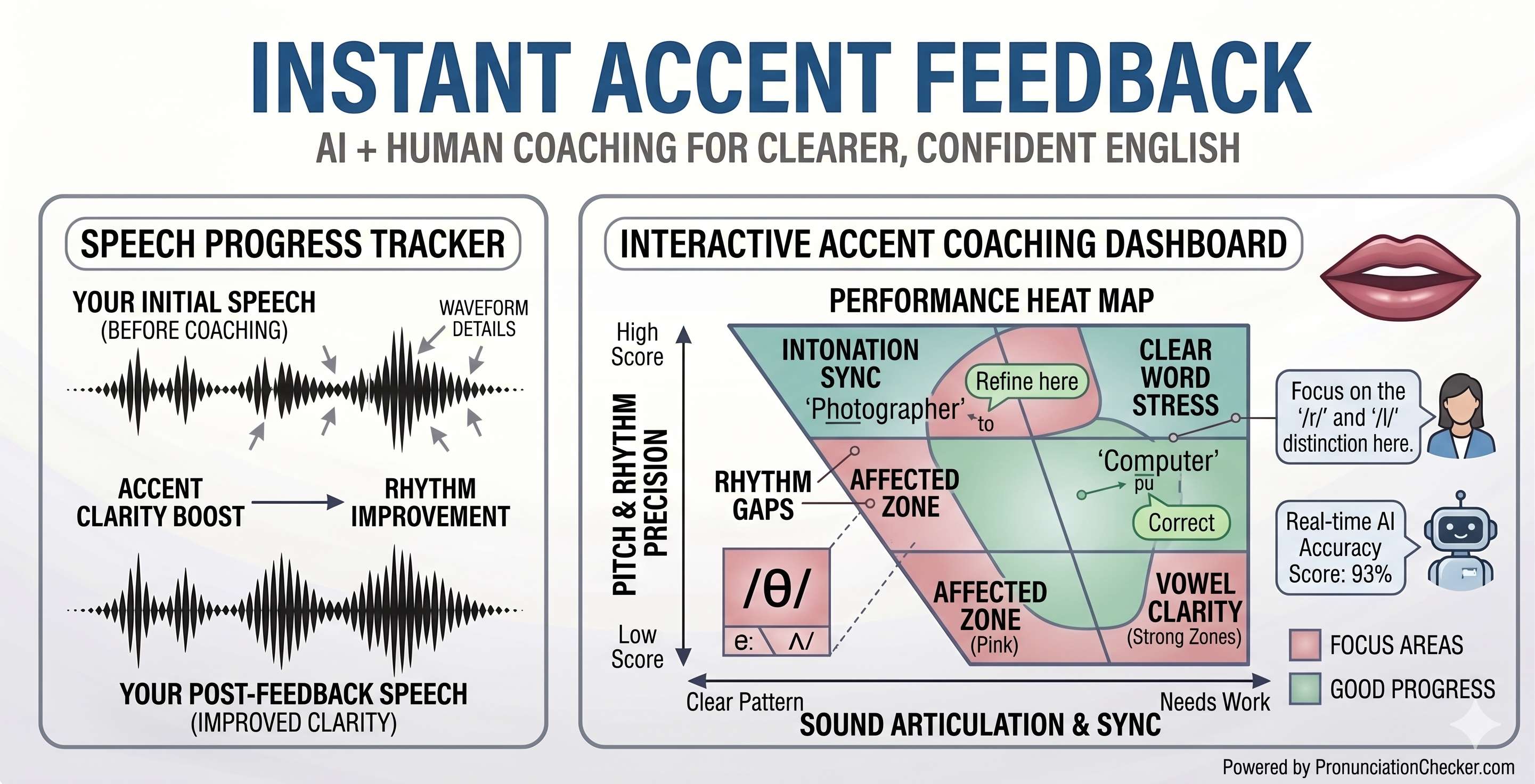
How to get instant feedback on your English Accent with an online coach
You’ve practiced English phrases in front of the mirror. You’ve repeated dialogues from movies. But a lingering question remains: “Am I actually saying this correctly?”
For generations, language learners were left unsure whether their pronunciation was clear or filled with hidden errors. Waiting for a weekly class—or hoping a native speaker corrects you—is slow and uncertain. But today, you can receive precise, immediate feedback the moment you speak.
This guide explains how AI-powered online accent coaches work and how you can use them to build clear, confident English pronunciation faster than ever before.
The feedback gap: why traditional learning leaves you guessing
Most English learning methods are excellent for vocabulary and grammar—but weak in pronunciation.
Passive learning: Listening alone doesn’t guarantee accurate
reproduction of
sounds.
Delayed correction: In classrooms or casual conversations,
many errors go
unnoticed and become habits.
Lack of specificity: Being told “that sounds off” doesn’t
explain whether
the issue is vowel quality, consonant clarity, or stress placement.
This feedback gap creates uncertainty. Instant, specific correction closes that gap and accelerates improvement.
What is an online Accent Coach? Your 24/7 feedback machine
An online accent coach is a digital platform—often powered by Artificial Intelligence—that analyzes your speech in real time. Unlike simple speech-to-text tools, it evaluates pronunciation accuracy at the sound level.
Think of it as a high-tech mirror for your speech. You speak, and it instantly reflects your pronunciation performance, highlighting exactly what needs adjustment.
The magic of instant feedback: how it accelerates your learning
Immediate feedback is essential for mastering any skill. In pronunciation training, it creates a powerful learning loop:
Speak → Get instant feedback → Adjust → Repeat
This loop helps your brain build muscle memory quickly. Instead of practicing mistakes for days, you correct them instantly.
Online accent coaches provide:
Granular analysis: Detailed insights on specific vowel sounds,
consonants,
and stress patterns.
Objective scoring: Data-driven feedback removes
guesswork.
Confidence-building repetition: You can practice difficult
words privately
without fear of judgment.
A step-by-step guide to getting your first instant feedback
Step 1: Choose the right tool
Look for platforms that specialize in accent training and phonetic-level
analysis, not just
general language learning.
Step 2: Create a quiet environment
Use a stable internet connection and a good microphone to ensure accurate
analysis.
Step 3: Take a baseline assessment
Most tools begin with a diagnostic test to identify your pronunciation
strengths and
weaknesses.
Step 4: Practice with focused exercises
Listen to a model, record your voice, review instant feedback, and repeat
until accuracy
improves.
Step 5: Track your progress
Monitor improvements over time to stay motivated and focused.
Maximizing your results: Pro tips for using an online coach
Understand the “why” behind corrections: Pay attention to mouth position, tongue placement, and airflow.
Use minimal pairs: Practice words that differ by one sound (ship/sheep, bed/bad) to sharpen accuracy.
Practice consistently: 10–15 minutes daily is more effective than occasional long sessions.
Record yourself independently: Test your improvement without relying on visual feedback.
The human touch: blending AI with real-world practice
An online accent coach is a powerful training tool, but it works best when combined with real conversations.
Use AI as your daily practice gym—where you refine technique and build muscle memory. Then apply those skills in real-life discussions with colleagues, tutors, or language partners.
Your journey to accent clarity starts now
Instant feedback transforms pronunciation learning by eliminating uncertainty. Instead of guessing, you receive clear direction and measurable progress.
With an online accent coach, you’re not just studying—you’re training with precision. The technology is already available. The only step left is to speak.
Why feedback is the bottleneck
Motor learning of any kind depends on a loop: attempt, receive information about the result, adjust, attempt again. The speed and accuracy of that loop determines how fast the skill develops. Pronunciation is unusual in that the loop is broken by default, because the one thing you cannot do is hear yourself the way others hear you.
Two obstacles compound this. You hear your own voice partly through bone conduction, so your internal monitoring is unreliable. And if two sounds belong to a single category in your first language, the difference is inaudible to you regardless of how carefully you listen. Feedback from outside is therefore not a convenience; it is what makes the loop function at all.
| Feedback source | Speed | Precision | Availability |
|---|---|---|---|
| Automated tool | Immediate | Word-level; no explanation | Unlimited |
| Own recording | Minutes to hours | Good for rhythm; blind to your merged contrasts | Unlimited |
| Native-speaker friend | Immediate | Notices problems, rarely diagnoses them | Limited, and socially awkward |
| Trained teacher | Immediate | Diagnosis plus articulatory instruction | Scarce and expensive |
What automated feedback is genuinely good for
The advantage of an automated tool is not that it is better than a teacher. It is that it will let you attempt the same word forty times in a row without impatience or embarrassment, and that volume matters for motor learning in a way that a weekly lesson cannot replicate.
Concretely, the pattern that works is: a teacher or a good explanation tells you what to change and how, and the automated tool provides the hundreds of repetitions needed to make the change automatic. Using either alone is much less effective — repetitions without diagnosis entrench errors, and diagnosis without repetition never transfers.
The number that matters. Making a new articulation automatic takes hundreds to thousands of correct repetitions. A weekly lesson provides perhaps twenty. The gap between those two figures is exactly the space that self-directed practice with immediate feedback fills.
Interpreting automated feedback correctly
An automated result is a mismatch signal rather than a grade, and reading it as a grade leads people to abandon tools that were working.
- A failure is a hypothesis, not a verdict. Repeat five times. Four failures out of five is a finding; one is noise.
- Test contrasts, not words. Whether the tool recognises ship matters less than whether it distinguishes ship from sheep. If both return the same word, you have located a genuine merger.
- Single words are more informative than sentences. In a sentence the recogniser uses context to guess, which can hide a poor pronunciation.
- The pattern across items beats any individual score. Four failures sharing one vowel is one problem, not four.
Where automated feedback goes silent
Everything above the word level is largely invisible to recognition-based tools: rhythm, the length contrast between stressed and unstressed syllables, weak forms, pitch range, and the intonation patterns that carry attitude. These are also, for many learners, the features that most affect how their English is received.
Cover that gap with self-recording. Record a fixed passage monthly and listen specifically for rhythm and pitch, using separate listening passes for each. The two methods are complementary: the tool handles segments with unlimited repetition, and recording handles prosody with delayed but honest evaluation.
A practical weekly combination
- Once: get a diagnosis, from a teacher, a structured test, or a careful self-audit of a recording. This identifies the target.
- Daily, 10 minutes: automated feedback on the target, single words then minimal pairs, five attempts each.
- Twice weekly, 5 minutes: the target in sentences, recorded and reviewed the following day.
- Weekly, 3 minutes: free speech recorded, listened to for the target only.
- Monthly: the fixed passage, for prosody and for comparison over time.
The structure matters more than the specific minutes. Diagnosis identifies the target, high-volume feedback makes it automatic, and periodic recording checks whether it has transferred into real speech — which is the step that determines whether any of the rest of it mattered.
Frequently asked questions
Why is feedback so important for pronunciation specifically?
Because the normal learning loop of attempt, evaluate and adjust is broken by default. You hear your own voice partly through bone conduction, so your internal monitoring does not match what listeners hear, and if two sounds belong to one category in your first language the difference is inaudible to you no matter how carefully you listen. External feedback is what makes the loop function at all.
Can an automated tool replace a teacher?
No, but it supplies something a teacher cannot. A teacher diagnoses the problem and explains what to change; an automated tool provides the hundreds or thousands of correct repetitions needed to make the change automatic, without impatience or embarrassment. A weekly lesson offers perhaps twenty repetitions, and that gap is exactly what self-directed practice with immediate feedback fills.
How should I read a failed result from an automated checker?
As a mismatch signal rather than a grade. Repeat the word five times, since recognition is probabilistic and a single failure means little. Test contrasts rather than individual words: whether the tool distinguishes ship from sheep is far more informative than whether it recognises either one. And look for patterns, because four failures sharing one vowel represent one problem, not four.
What will automated feedback never tell me?
Anything above the word level — rhythm, the length contrast between stressed and unstressed syllables, weak forms, pitch range, and the intonation that carries attitude. For many learners these features affect how their English is received more than individual sounds do. Cover the gap by recording a fixed passage monthly and reviewing it specifically for rhythm and pitch.
Disclosure: this page links to Preply, a tutoring marketplace. If you book a lesson through that link we may earn a commission, at no extra cost to you. It does not change what is recommended here. See our disclaimer and privacy policy.
Get feedback on one sentence
Say a sentence and see, word by word, what the speech recogniser understood.
Open the accent coach