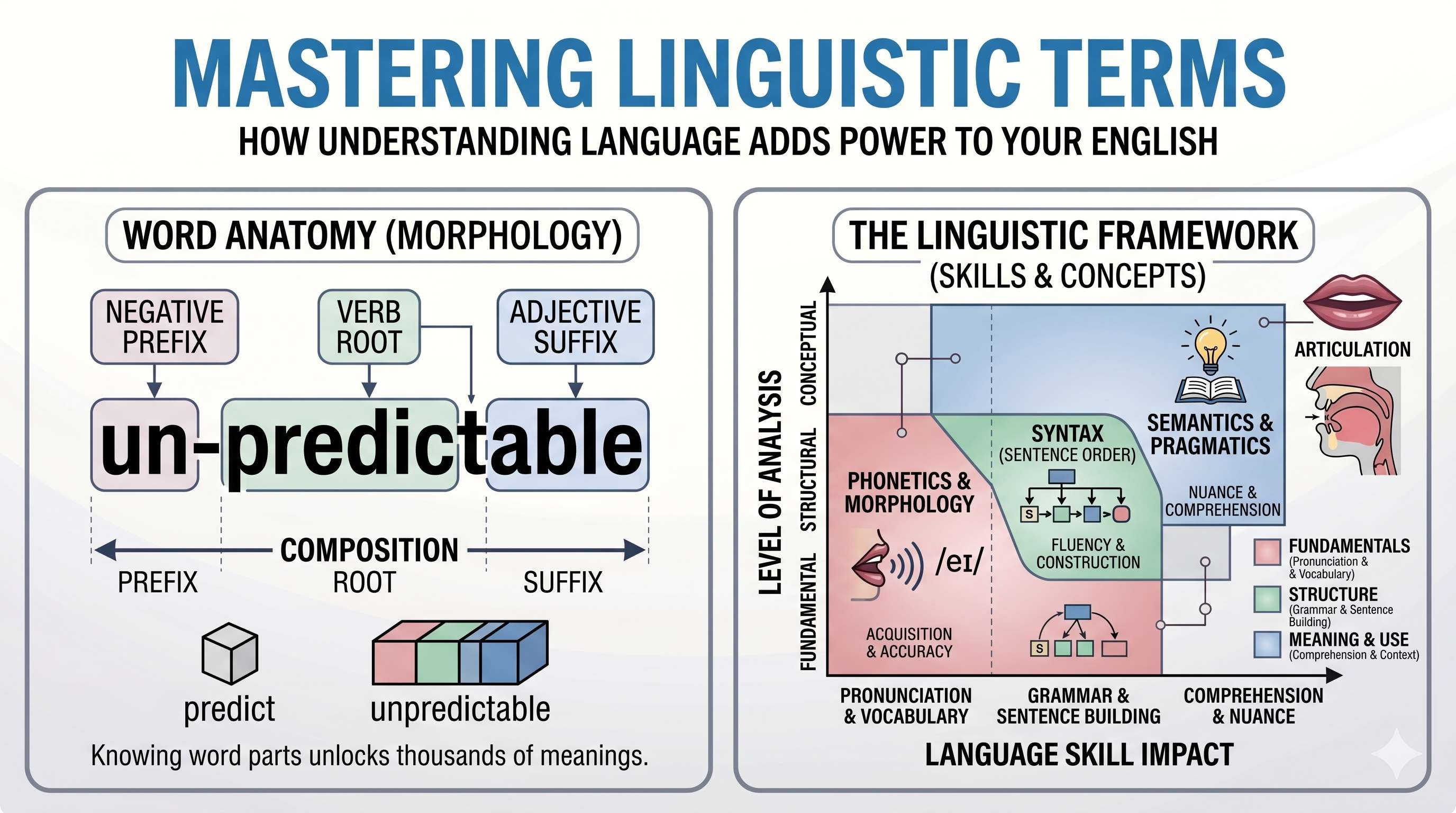
Speak smarter: How understanding linguistic terms improves your English
Have you ever felt stuck in your English learning journey? You know plenty of vocabulary and grammar rules, but when you speak, something doesn't quite click. The missing piece might not be more practice, but a different kind of knowledge: understanding how language actually works.
Learning linguistic terminology isn't about becoming a academic linguist—it's about getting the instruction manual for English. When you understand terms like "phoneme," "intonation," and "morpheme," you stop guessing and start understanding exactly what to fix in your pronunciation and speech patterns.
This knowledge transforms you from a passive learner to an active problem-solver. Let's explore how understanding key linguistic terms can help you speak smarter, not just harder.
The problem: the plateau effect in language learning
Most English learners hit a plateau where additional vocabulary study and grammar exercises stop yielding significant improvements in speaking ability. This happens because:
You can't fix what you can't name or identify
Pronunciation errors become fossilized through repeated practice
You lack the vocabulary to research specific solutions
Native speakers understand you despite errors, missing correction opportunities
Understanding linguistic terminology provides the precise vocabulary needed to diagnose issues and find targeted solutions, breaking through this plateau effectively.
Essential linguistic terms and their practical applications
1. Phonemes: The sound foundation
What they are: Phonemes are the smallest units of sound that can change a word's meaning. English has approximately 44 phonemes, depending on dialect.
Practical application: The difference between "ship" and "sheep" isn't just spelling—it's the vowel phonemes /ɪ/ and /i:/. Knowing this distinction helps you:
Identify exactly which sounds challenge you
Search for targeted exercises ("/ɪ/ vs /i:/ practice")
Understand why native speakers hear these as different words
Common challenge: Many languages have fewer vowel phonemes than English, making distinctions like "cat/cut/cot" particularly challenging. Without knowing these are different phonemes, you might not realize you're merging distinct sounds.
2. Morphemes: Your vocabulary multiplier
What they are: Morphemes are the smallest meaningful units in language. "Unbelievable" contains three morphemes: "un-" (not), "believe" (root), and "-able" (capable of).
Practical application: Understanding morphemes helps you:
Decode unfamiliar words by breaking them down
Expand vocabulary systematically
Understand word families and relationships
Example: Knowing that "-tion" creates nouns from verbs helps you recognize connections between "activate" and "activation," "organize" and "organization."
3. Intonation: The music of English
What it is: Intonation refers to the rise and fall of pitch in speech. It's crucial for conveying meaning, emotion, and sentence type.
Practical application: Proper intonation helps you:
Sound more natural and engaging
Distinguish questions from statements
Convey confidence and clarity
Example: "You're coming." (falling pitch = statement) vs. "You're coming?" (rising pitch = question). Without correct intonation, even grammatically perfect sentences can sound awkward or confusing.
4. Word stress: The rhythm key
What it is: English is a stress-timed language, meaning stressed syllables occur at regular intervals. Each multi-syllable word has a specific stress pattern.
Practical application: Correct word stress is often more important for intelligibility than perfect individual sounds. Consider:
REcord (noun) vs. reCORD (verb)
PHOtograph vs. phoTOgrapher vs. photoGRAPHic
Misplaced stress can make words unrecognizable to native listeners, even if all sounds are pronounced correctly.
5. Connected speech: The secret to natural sounding English
What it is: Native speakers don't pronounce each word separately. Sounds change, link, and disappear in predictable patterns.
Practical application: Understanding connected speech phenomena helps you:
Decode fast, natural speech
Sound more fluid when you speak
Master reductions like "wanna" (want to) and "gonna" (going to)
Examples of connected speech:
Linking: "an_apple"
Assimilation: "ten pounds" → "tem pounds"
Elision: "chocolate" → "choc'late"
The gap between knowledge and application
Understanding these concepts theoretically is one thing—applying them to your speech is another. This is where many learners struggle. You might know what word stress is, but how do you know if you're stressing the correct syllable? You might understand the difference between phonemes, but can you hear when you're producing them incorrectly?
This self-awareness gap is why pronunciation often lags behind other language skills. What you hear when you speak isn't what others hear. This is where technology becomes your most valuable ally.
Bridge the gap with targeted pronunciation technology
While understanding linguistic terms gives you the roadmap, you need tools to help you navigate. This is where pronunciation technology creates the crucial feedback loop missing from traditional learning methods.
How pronunciation tools complement linguistic knowledge
1. Phoneme-level precision Advanced pronunciation apps can analyze your production of specific phonemes. If you're struggling with the /θ/ sound in "think," these tools can detect whether you're producing a proper dental fricative or substituting it with /s/ or /t/.
2. Objective stress and intonation feedback These applications provide visual feedback on your word stress and intonation patterns. You can see whether your pitch rises appropriately for questions or if you're stressing the correct syllable—something difficult to self-assess accurately.
3. Immediate correction Unlike human conversation partners who might prioritize understanding over correction, pronunciation tools give you instant, objective feedback on every attempt. This prevents error fossilization.
4. Progress tracking Many tools track your improvement over time, allowing you to see measurable progress in specific areas like vowel accuracy or word stress mastery.
Creating your personal learning system
Combine your new linguistic knowledge with technology for maximum impact:
Step 1: Diagnose your challenges
Use your understanding of linguistic terms to identify specific areas for improvement. Ask yourself:
Do I struggle with specific phoneme pairs (/ɪ/ vs /i:/, /b/ vs /v/)?
Is my word stress consistently accurate?
Does my intonation sound natural?
Can native speakers understand me easily?
Step 2: Target your practice
Focus on one specific area at a time using your new terminology to find targeted exercises:
Search for "minimal pairs practice" for challenging phonemes
Practice word stress patterns with vocabulary lists
Record and analyze your intonation in different sentence types
Step 3: Get immediate feedback
Use technology like the English Pronunciation Test App Voice Online to:
Verify your self-assessment
Get specific feedback on problem areas
Practice until you achieve consistent accuracy
Step 4: Integrate into natural speech
Once you've mastered a sound or pattern in isolation, consciously integrate it into your everyday speech. The goal is automatic, correct production in spontaneous conversation.
Real-world benefits of speaking smarter
When you combine linguistic knowledge with targeted practice, you experience tangible improvements:
Increased confidence Knowing exactly what to work on and seeing measurable progress builds speaking confidence significantly.
Better communication Clearer pronunciation and more natural rhythm make you easier to understand, reducing communication breakdowns.
More efficient learning You stop wasting time on irrelevant exercises and focus on what actually improves your intelligibility.
Deeper language understanding You start noticing patterns and understanding why English works the way it does, making learning more engaging and effective.
Overcoming common obstacles
"This sounds too technical"
Linguistic terminology might seem intimidating initially, but start with the most practical terms first. Focus on phonemes and word stress—these will give you the biggest immediate returns. Think of it as learning the controls of a complex machine: once you know what each button does, you can operate it much more effectively.
"I don't have time for theory"
The time invested in understanding these concepts pays for itself through more efficient practice. Thirty minutes of targeted phoneme practice is more effective than three hours of unfocused repetition.
"I'm not good with technology"
Modern pronunciation tools are designed for ease of use. Most require just a smartphone and a few minutes daily practice. The learning curve is minimal compared to the benefits.
Your action plan for smarter speaking
Learn the key terms: Start with phonemes, word stress, and intonation
Identify your personal challenges: Record yourself speaking and analyze using your new knowledge
Find targeted resources: Use your terminology to search for specific exercises
Integrate technology: Use pronunciation tools for objective feedback
Practice consistently: Short, daily practice sessions yield better results than occasional marathons
Track your progress: Celebrate improvements to stay motivated
Conclusion: Knowledge + practice = transformation
Understanding linguistic terms transforms you from a passive language learner to an active problem-solver. It's the difference between randomly adjusting dials and knowing exactly which controls affect which outcomes.
When you can identify that your challenge isn't just "pronunciation" but specifically "word stress in three-syllable nouns" or "the /θ/ phoneme in initial position," you unlock targeted solutions that create real improvement.
Combine this knowledge with modern pronunciation technology that provides the feedback loop missing from traditional learning methods, and you have a powerful system for rapid improvement.
Speaking smarter isn't about innate talent—it's about understanding how language works and using the right tools to bridge the gap between knowledge and ability. Start applying these concepts today, and you'll be amazed at how quickly your English transforms from technically correct to naturally fluent.
Remember: The goal isn't perfection—it's progress. Every phoneme mastered, every stress pattern corrected, and every intonation improvement brings you closer to the clear, confident English speech you're working toward.
Ready to perfect your pronunciation?
Type any word into our free tool to hear exactly how it sounds in American, British, Australian, and Indian English.
Try PronunciationChecker Now