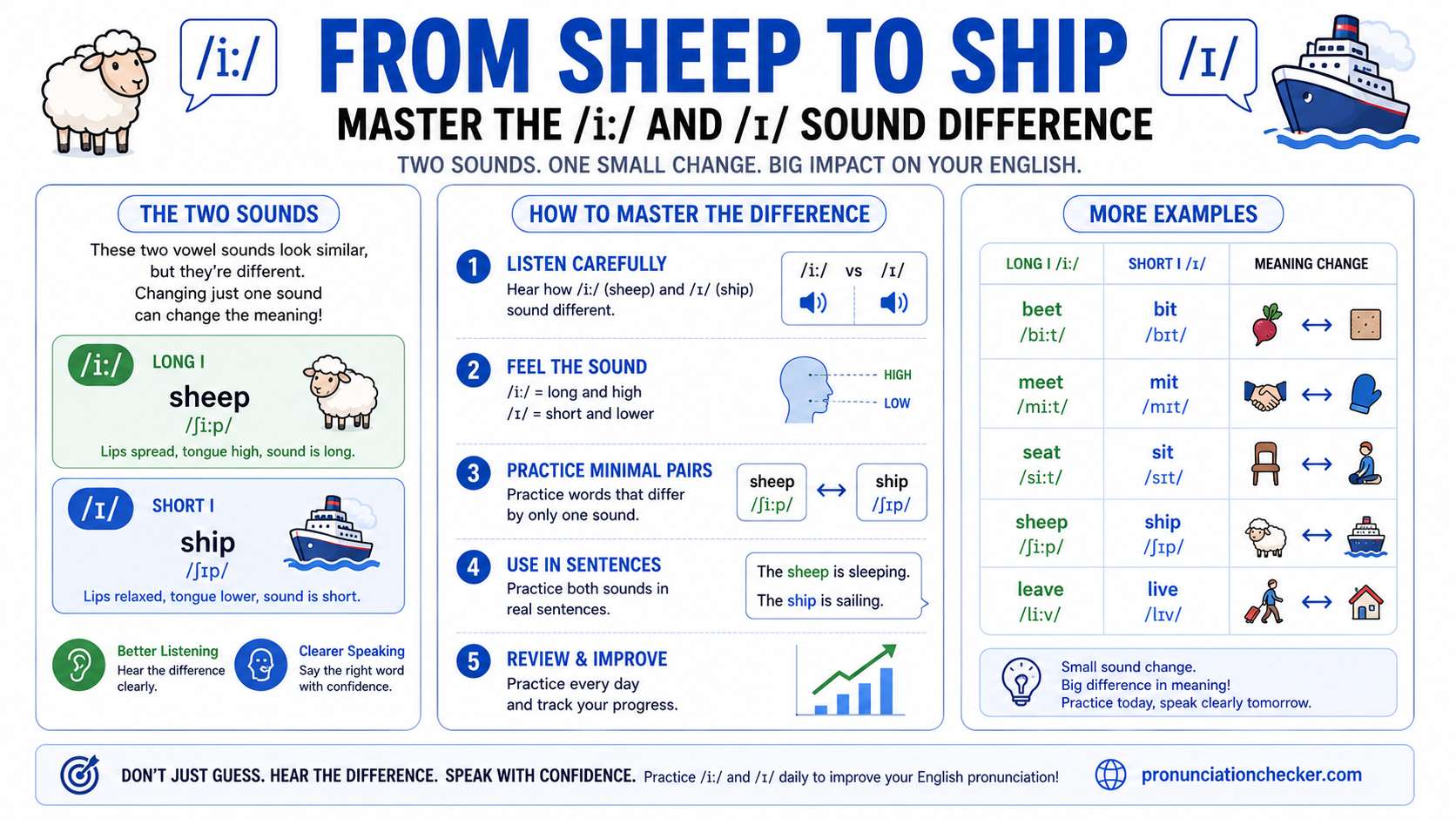
Have you ever meant to say you "arrived on a ship" but your listener heard "arrived on a sheep"? While the image of disembarking onto a fluffy animal is amusing, this small slip in pronunciation can lead to big confusion. This tiny difference between words like "sheep" and "ship" is the cornerstone of a powerful linguistic tool called the minimal pair.
If you’re on a journey to improve your English clarity, mastering minimal pairs isn't just a helpful tip—it's a fundamental step. It’s the bridge between being vaguely understood and speaking with precision and confidence. In this comprehensive guide, we’ll explore why minimal pairs are so crucial and how you can use them to transform your pronunciation from good to great.
What are Minimal Pairs? The building blocks of clear speech
Let's start with the basics. A minimal pair is a set of two words that are identical in every way except for one sound. This single sound difference occurs in the same position in each word.
Take our title example:
Sheep /ʃiːp/
Ship /ʃɪp/
These two words are identical in their consonants: both start with the "sh" sound (/ʃ/) and end with the "p" sound (/p/). The only difference is the vowel sound in the middle: the long "ee" sound (/iː/) in "sheep" versus the short "ih" sound (/ɪ/) in "ship."
This seemingly small distinction changes the entire meaning. Our brains are wired to latch onto these phonetic differences to decode language instantly. For native speakers, this process is automatic. For English language learners, however, the sounds of their native language can interfere, making it difficult to even hear the difference, let alone produce it.
Why your brain struggles with new sounds
This challenge is explained by the fascinating Perceptual Magnet Theory. Essentially, when you’re a baby, your brain creates a "sound map" for your native language. As you grow, your brain becomes exceptionally efficient at categorizing the sounds relevant to your language, but it starts to ignore subtle distinctions that aren't important.
For example, a Spanish speaker’s brain has a single category for the "ee" vowel sound (like in "si"). When they encounter English, they might perceive both the /iː/ in "sheep" and the /ɪ/ in "ship" as just variations of their familiar "ee" sound. Their brain, trying to be helpful, pulls both sounds towards the one category it knows—making "sheep" and "ship" sound the same. The same happens for a Japanese speaker struggling with "r" and "l," or an Arabic speaker with "p" and "b."
Minimal pair training is like recalibrating your brain’s sound map. It forces you to pay attention to distinctions you’ve been ignoring, moving you from a state of "perceptual confusion" to "phonetic clarity."
The Domino Effect: How mastering Minimal Pairs improves everything
You might think, "It's just two sounds. How important can it be?" The answer is: incredibly important. Mastering minimal pairs creates a positive domino effect across your entire spoken English.
1. Prevents miscommunication
This is the most immediate benefit. Confusing minimal pairs can lead to awkward, confusing, or even embarrassing situations.
"I need to leave at three (θriː)/" vs. "I need to leave at tree (triː)/." (Confusing time
with a plant).
"That's a long wait (weɪt)/" vs. "That's a long weight (weɪt)/." (Confusing time with
heaviness).
"He has a bad (bæd)/ heart" vs. "He has a bed (bɛd)/ heart." (A serious medical condition
becomes nonsensical).
By sharpening your pronunciation, you ensure your message is received exactly as you intended.
2. Builds listening comprehension
The process works both ways. As you train your mouth to produce different sounds, you are simultaneously training your ears to hear them. When you actively practice distinguishing "beat" from "bit," you’ll start to hear that difference clearly in fast, natural conversations, movies, and podcasts. This dramatically improves your overall listening skills.
3. Increases speaking confidence
There’s nothing more empowering than being understood. When you know you can pronounce tricky sounds correctly, the fear of being misunderstood or having to repeat yourself melts away. This confidence allows you to engage in conversations more freely, express complex ideas, and present yourself more professionally.
4. Lays the foundation for accent eeduction
While having an accent is a beautiful part of your identity, reducing a strong accent can improve intelligibility. Accent reduction isn't about erasing your background; it's about modifying specific sound productions for clearer communication. Minimal pair practice is the primary tool used by speech therapists and accent coaches to target and refine these specific sounds systematically.
Your practical guide to training with Minimal Pairs
Knowing why minimal pairs are important is only half the battle. The real transformation happens when you put this knowledge into practice. Here is a simple, effective four-step method you can use daily.
Step 1: Diagnosis - Identify your trouble sounds
The first step is to figure out which sounds are tricky for you. This often depends on your native language. A great starting point is to consult a comprehensive list of minimal pairs tailored to specific language challenges.
For an extensive and well-organized resource, I highly recommend this English Minimal Pair List from Pronunciation Checker (https://pronunciationchecker.com/tools/minimal-pair/english-minimal-pair-list.html). It’s an excellent tool that categorizes pairs by vowel and consonant sounds, making it easy to find the areas you need to work on most.
Step 2: Perception - Learn to hear the difference
Before you can say it, you must hear it. This is the "ear training" phase.
Find a pair: Let's use "ship" and "sheep."
Listen: Use online dictionaries like Cambridge or Oxford Learner's Dictionaries that have
audio pronunciations. Listen to each word carefully, back-to-back. Close your eyes and focus
on the vowel sound. What do you notice?
Discriminate: Have a friend (or a recording) say one of the words at random. Your job is to
point to the word you hear. This active listening is crucial for rewiring your brain.
Step 3: Production - Learn to say the difference
Now it’s time to train your mouth. This requires patience and physical awareness.
Understand the mechanics: Look in a mirror. To say /iː/ (sheep), your tongue is high and
forward in your mouth, and your lips are spread wide, almost like a smile. To say /ɪ/
(ship), your tongue is slightly lower and more relaxed, and your jaw drops a tiny bit more.
Understanding this physical placement is key.
Imitate and record: Listen to the native pronunciation and try to imitate it exactly. Then,
record yourself saying both words. This can feel awkward, but it’s the fastest way to hear
the gaps between your pronunciation and the target sound.
Exaggerate: At first, exaggerate the differences. Make the "ee" in "sheep" very long and
smiley. Make the "ih" in "ship" very short and crisp. This helps build muscle memory.
Step 4: Practice in context - Move beyond single words
The ultimate goal is to use these sounds correctly in flowing speech. Practice saying sentences and tongue twisters that contain your target minimal pairs.
Sentences: "The sheep on the ship felt cheap."
Tongue twisters: "I slit the sheet, the sheet I slit, and on the slit sheet I sit." (This
one is notoriously difficult!)
Beyond the basics: Advanced Minimal Pair challenges
Once you’re comfortable with basic pairs, you can level up your training.
Minimal sets: Instead of just two words, practice with three or four that all have slight
variations (e.g., beat, bit, bet, bat).
Sentence stress: Practice saying sentences where the meaning changes based on the minimal
pair. "I said I want a light bulb, not a white bulb!"
A treasure trove of practice material
To get started on your journey, you need a reliable source of minimal pairs. As mentioned earlier, the resource page at Pronunciation Checker is an fantastic place to begin. Their English Minimal Pair List (https://pronunciationchecker.com/tools/minimal-pair/english-minimal-pair-list.html) is meticulously organized, offering:
Vowel sound pairs: Categorized by specific vowel challenges (/iː/ vs. /ɪ/, /æ/ vs. /ɛ/,
etc.).
Consonant sound pairs: Targeting common issues like /r/ vs. /l/, /v/ vs. /w/, and /p/ vs.
/b/.
Word lists and examples: Providing ample material for focused practice sessions.
Bookmarking a resource like this gives you a structured path forward, turning the daunting task of pronunciation improvement into a manageable, step-by-step process.
Your journey from sheep to ship starts now
The path to clear pronunciation isn't about a magical fix; it's about focused, consistent practice. Minimal pairs are the most targeted and effective tool for this journey. They are the microscopic key that unlocks macroscopic improvements in your clarity, confidence, and comprehension.
By learning to hear and produce the critical difference between sounds like the one in "sheep" and "ship," you are not just learning words—you are retuning your ears and retraining your speech muscles. You are moving from being a passive participant in conversations to an active, confident speaker.
So, don't let a simple sound sink your message. Embrace the power of minimal pairs. Dive into the lists, practice daily, and watch as the world starts to understand you, clearly and effortlessly.
Ready to perfect your pronunciation?
Type any word into our free tool to hear exactly how it sounds in American, British, Australian, and Indian English.
Try PronunciationChecker Now