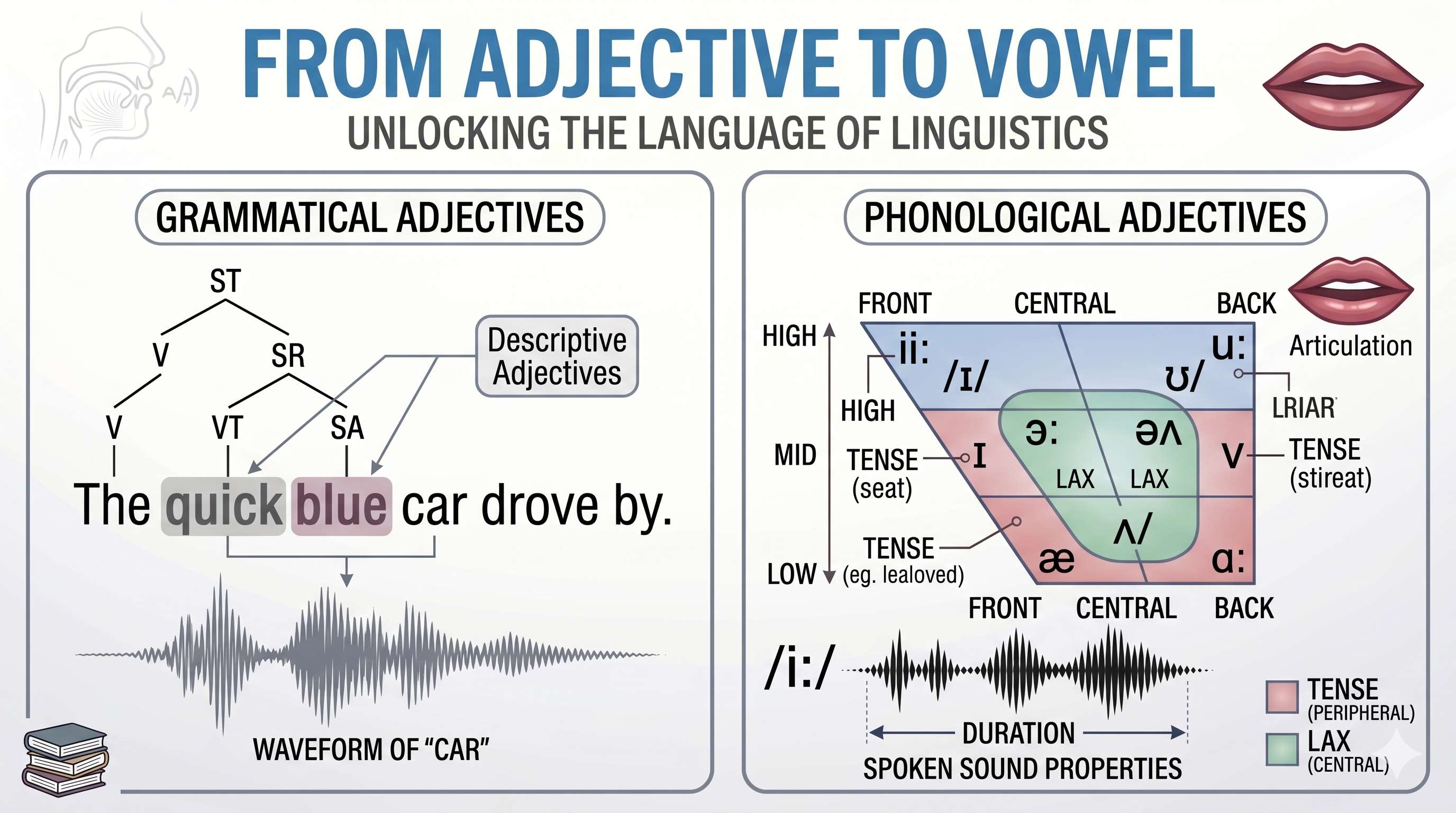
From adjective to vowel: Unlocking the language of linguistics
Have you ever wondered why you can understand a sentence like "The quick, brown fox jumps over the lazy dog," but a jumbled version like "Dog lazy the over jumps fox brown quick the" feels like nonsense? The answer lies not just in the words themselves, but in the hidden rules and structures that govern them—the world of linguistics.
For language learners, this world can seem like an impenetrable fortress of jargon. But what if you had a key? What if understanding terms like "adjective," "vowel," "syntax," and "phoneme" could dramatically accelerate your journey to fluency?
This guide is that key. We will journey from adjective to vowel, unlocking the essential language of linguistics. This isn't about academic theory; it's about practical knowledge that will transform how you hear, speak, and understand English. By the end, you'll see that linguistics isn't a barrier—it's the ultimate cheat code for language learning.
Part 1: The building blocks of meaning (the "adjective" side)
Let's start with the elements you're likely more familiar with: the parts of speech and how they combine to create meaning.
1. Adjective & Adverb: The describers
Adjective: A word that describes or modifies a noun. It answers questions like "What kind?" "Which one?" or "How many?"
Example: "She bought a red car." / "It was an incredible performance."
Adverb: A word that describes or modifies a verb, an adjective, or another adverb. It often answers questions like "How?" "When?" "Where?" or "To what extent?" Many adverbs end in "-ly."
Example: "He ran quickly." (modifies the verb 'ran') / "She is exceptionally smart." (modifies the adjective 'smart')
Why it matters for learners: Understanding the difference ensures you place words correctly. Saying "She sings beautiful" is incorrect because the adjective "beautiful" cannot modify the verb "sings"; you need the adverb "beautifully."
2. Syntax: The architect of sentences
Syntax is the set of rules that governs the structure of sentences—the order of words and phrases. It's the reason "The cat sat on the mat" makes sense, while "Mat the on sat cat the" does not.
English typically follows a Subject-Verb-Object (SVO) order.
Why it matters for learners: Mastering syntax is the foundation of grammatical accuracy. It helps you automatically construct sentences that sound natural to a native speaker, moving beyond simple phrases to complex expressions.
3. Morphology: The science of word parts
Morphology is the study of the structure of words and how they are formed from smaller units of meaning called morphemes.
A morpheme is the smallest meaningful unit. For example, the word "unbelievable" has three morphemes:
un- (a prefix meaning "not")
believe (the root word)
-able (a suffix meaning "can be done")
Why it matters for learners: Understanding morphology is like having a vocabulary multiplier. If you know the root "code" and the morphemes de- (reverse) and -able (can be), you can decipher "decode," "codable," and "decodable" with ease.
4. Semantics: The realm of meaning
Semantics is the study of meaning in language. It deals with the literal meaning of words, phrases, and sentences.
This is where we understand the difference between "He was feeling blue" (sad) and "She painted the wall blue" (the color). It also covers relationships like synonyms (words with similar meanings) and antonyms (words with opposite meanings).
Why it matters for learners: A strong grasp of semantics prevents misunderstandings and helps you choose the precise word to convey your intended message.
Part 2: The building blocks of sound (the "vowel" side)
Now, let's dive into the aspect of language that often proves most challenging for learners: the sound system. This is where pronunciation lives.
5. Vowel & Consonant: The yin and yang of sound
Vowel: A speech sound produced with an open vocal tract, without any significant obstruction of airflow. Vowels are the core, or nucleus, of every syllable. English has a complex system with many vowel sounds (like the distinct sounds in "beat," "bit," "bait," "bet," "bat").
Consonant: A speech sound produced by partially or completely blocking the airflow. Consonants shape the vowels and define the edges of syllables (e.g., /p/, /b/, /t/, /d/, /k/, /s/, /z/).
Why it matters for learners: Mispronouncing vowels is a primary source of a "strong accent." Confusing the vowel in "ship" with the vowel in "sheep" can lead to confusion. Consonant errors, like not voicing the /z/ sound in "bags" (making it sound like "backs"), are equally critical.
6. Phoneme: The sound that changes meaning
A phoneme is the smallest unit of sound in a language that can distinguish meaning. Changing a single phoneme changes the word.
Example: The words bat, cat, hat, and fat are distinguished by their initial phoneme: /b/, /k/, /h/, and /f/. The /p/ and /b/ sounds are distinct phonemes in English, which is why "pat" and "bat" are different words.
Why it matters for learners: If your native language does not distinguish between two English phonemes (like /l/ and /r/ for Japanese speakers, or /v/ and /w/ for German speakers), you will likely struggle to hear and produce the difference. This is a core pronunciation challenge.
7. IPA (International Phonetic Alphabet): Your pronunciation rosetta stone
The International Phonetic Alphabet (IPA) is a standardized system of symbols that represents every sound in every human language. It is the ultimate tool for cutting through the chaos of English spelling.
Example: Consider the "o" sound in "do," "go," and "not." It's different each time! The IPA shows you the exact sound:
"do" → /duː/
"go" → /ɡoʊ/
"not" → /nɒt/
Why it matters for learners: Learning the basic IPA symbols for English allows you to look up any word in a dictionary and know its exact pronunciation, independent of its unreliable spelling.
8. Intonation: The music of speech
Intonation is the rise and fall of the pitch of your voice across a phrase or sentence. It's not about the words you say, but how you say them.
Example:
A falling intonation (It's raining. ↘) typically indicates a statement.
A rising intonation (It's raining? ↗) typically indicates a yes/no question.
Why it matters for learners: Using flat or incorrect intonation can make you sound bored, rude, or uncertain, even if your grammar is perfect. It's crucial for expressing emotion and intention.
9. Stress: The rhythm of language
Word Stress is the emphasis placed on a particular syllable within a word. Stressed syllables are longer, louder, and higher in pitch.
Example: RE-cord (noun) vs. re-CORD (verb).
Sentence Stress is the emphasis placed on certain words within a sentence (usually content words like nouns, main verbs, adjectives), which gives English its rhythm.
Why it matters for learners: Incorrect word stress is a major barrier to being understood. Native listeners rely on stress patterns to decode speech quickly.
Bridging the gap: from knowledge to practice
Understanding the concept of a vowel or intonation is a crucial first step. But the real challenge is the feedback gap. How do you know if you're actually producing the /ɪ/ sound in "ship" correctly and not accidentally saying /i:/ as in "sheep"? You can't correct what you can't hear accurately.
This is where theoretical knowledge meets practical technology.
Your personal pronunciation coach: Applying the language of linguistics
A specialized tool like the English Pronunciation Test App from Pronunciation Checker acts as your personal linguistics lab. It provides the immediate, objective feedback that is so difficult to get otherwise. Here’s how it directly relates to the terms we’ve unlocked:
Phoneme-level analysis: The app's advanced speech recognition is designed to analyze your production of individual phonemes. It can give you specific feedback on whether your /v/ sound is clear or if it's blurring into a /w/. This turns the abstract concept of a phoneme into a tangible, measurable skill.
Suprasegmental feedback: The best tools go beyond single sounds. They can analyze the music of your speech—the suprasegmentals. The app can provide visual feedback on your intonation, showing you a pitch graph so you can see if your question truly rises. It can also assess your word stress, indicating if you're emphasizing the correct syllable.
Objective measurement: It turns subjective feeling into data. Instead of wondering if you're improving, you can see scores and visual representations of your pronunciation over time, allowing you to target your practice effectively.
Think of it as the practical application of everything you've just learned. You can test your understanding of vowel sounds, consonant clarity, and sentence rhythm in a supportive, tech-driven environment. Ready to put this linguistic knowledge into action? You can test your skills with the English Pronunciation Test App Voice Online.
Conclusion: You hold the key
The journey from Adjective (the world of meaning and grammar) to Vowel (the world of sound and pronunciation) is the journey to true language mastery. Linguistics provides the map for this journey.
These terms are not just for academics; they are powerful tools for any dedicated learner. They allow you to diagnose problems with precision, seek out targeted solutions, and understand the hidden architecture of English.
So, unlock the door. Use this linguistic vocabulary to deepen your understanding, and leverage modern tools to bridge the gap between knowledge and fluent execution. Your path to clearer, more confident English starts here.
Ready to perfect your pronunciation?
Type any word into our free tool to hear exactly how it sounds in American, British, Australian, and Indian English.
Try PronunciationChecker Now