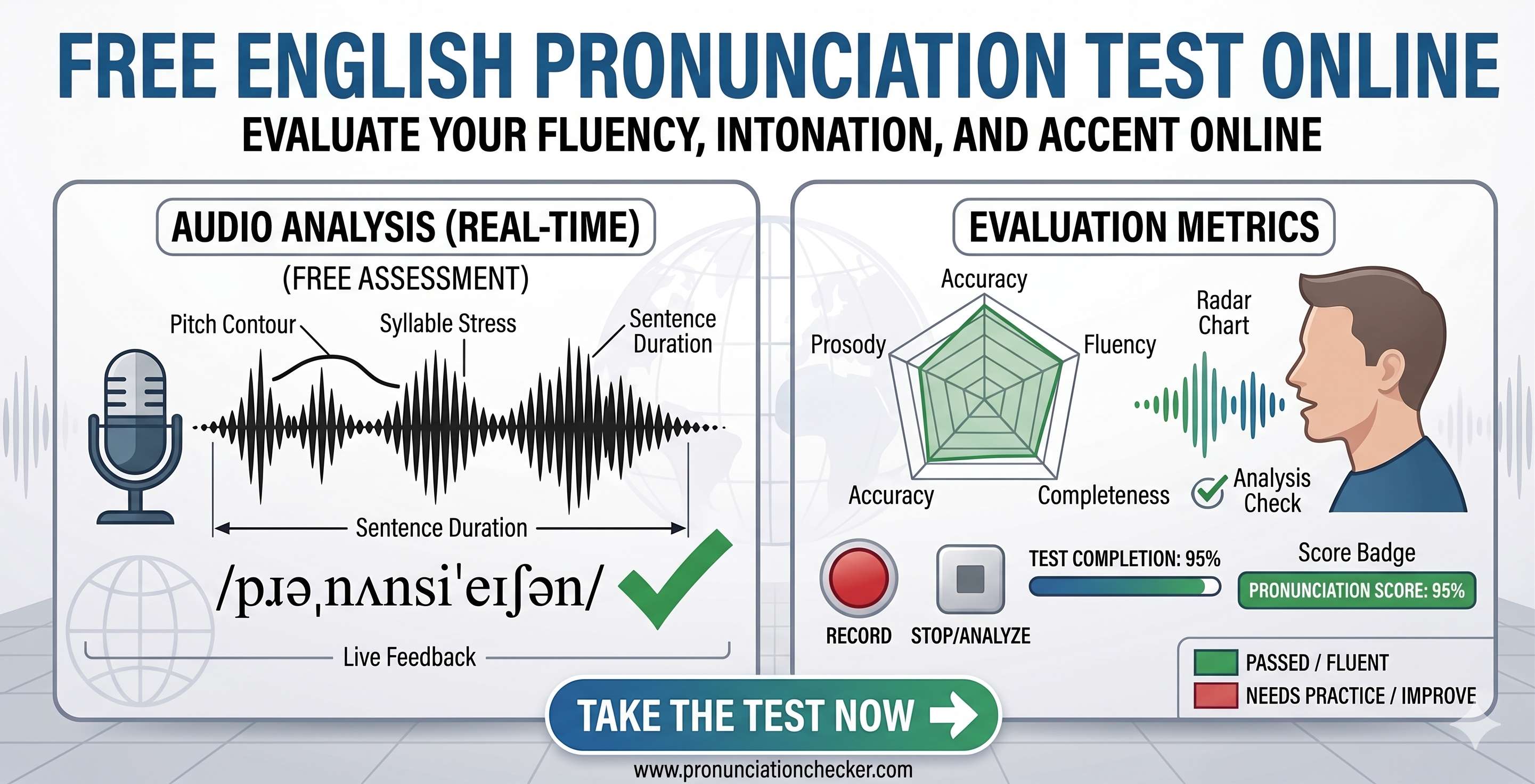
Find your accent origin: take the free English Pronunciation test online
Have you ever been asked, "Where are you from?" based solely on how you speak English? Your accent is a unique part of your identity, a vocal fingerprint that hints at your history, your travels, and your linguistic journey. Whether you're a non-native speaker aiming for clarity or a native speaker curious about your regional quirks, uncovering the roots of your accent can be a fascinating adventure.
This comprehensive guide will explore the world of English accents, why they matter, and how you can discover your own accent origin. Plus, we’ll point you directly to the best tool for the job: a free online English pronunciation test.
What exactly is an accent?
Before we dive in, let's clarify what we mean by "accent." Your accent is the distinct way you pronounce words. It's influenced by two primary factors:
Regional origin: This is the most common understanding of an
accent. It’s
the specific pronunciation patterns associated with a geographic area, like a
Texan drawl, a
London cockney, or an Australian twang.
Native language influence (foreign accent): For non-native
speakers, your
first language (L1) profoundly shapes how you produce English sounds. A
Spanish speaker
might struggle with the "th" sound, while a Japanese speaker might find
distinguishing
between "r" and "l" challenging.
Your accent is a blend of melody, rhythm, and specific speech sounds that makes your English uniquely yours.
Why should you discover your accent origin?
You might wonder, "Why does it even matter?" Understanding your accent origin is more than just a party trick; it has practical and personal benefits.
For non-native english speakers:
Targeted improvement: Identifying the specific sounds you
struggle with
(e.g., the short "i" in "ship" vs. the long "ee" in "sheep") allows you to
focus your
practice efficiently. Instead of trying to improve everything at once, you can
zero in on
your personal trouble spots.
Boosted confidence: When you understand the why behind your
pronunciation
challenges (e.g., "My native language doesn't have this vowel sound"), it
reduces
frustration. This knowledge empowers you to work on it systematically, leading
to greater
speaking confidence.
Enhanced clarity and communication: The ultimate goal isn't
necessarily to
sound like a BBC newsreader. It's to be easily understood. By softening the
strongest
features of your foreign accent that cause miscommunication, you ensure your
brilliant ideas
aren't lost in translation.
For native English speakers:
Linguistic self-awareness: You might not even realize you have
an accent
until you travel! Discovering your regional dialect features can be a fun
exploration of
your own identity and heritage.
Professional preparedness: If you work in a global
environment, being aware
of how your regional accent might be perceived or misunderstood by others is
valuable. You
can learn to "code-switch" or moderate your speech for better international
communication.
Pure curiosity: Language is fascinating. Understanding
whether you have a
Northern Cities Vowel Shift or if you pronounce "merry," "marry," and "Mary"
the same way is
a deep dive into the living, evolving nature of English.
The key elements that define your accent
An accent is a complex system. When you take a pronunciation test, it typically analyzes these core components:
1. Vowel sounds: the heart of your accent
English is notorious for its large vowel inventory. Many miscommunications
stem from vowel
sounds. Key differentiators include:
The /æ/ sound in "bath" (does it sound more like the "a" in "cat" or the "a"
in
"father"?).
The /ɑː/ vs. /ɒ/ distinction in words like "cot" and "caught" (do you
pronounce them the
same or differently?).
The pronunciation of the diphthong in words like "goat" or "face."
2. Consonant sounds: the clarity makers
Consonants are crucial for intelligibility. Common points of analysis
are:
The "TH" sounds: Both the voiced /ð/ (as in "this") and the voiceless /θ/ (as
in "think")
are rare globally and often replaced.
The /r/ sound: Is it a rolled 'r,' a tapped 'r,' or the English approximant?
Is it
pronounced after a vowel (e.g., in "car")? This is a major difference between
rhotic (e.g.,
American, Irish) and non-rhotic (e.g., British, Australian) accents.
The /l/ sound: The clear 'l' (at the start of words like "light") vs. the dark
'l' (at the
end of words like "full") can be very distinctive.
3. Prosody: the music of your speech
This is the rhythm, stress, and intonation of your speech. It's often the
hardest thing to
change but the biggest giveaway of a non-native accent.
Stress-timing: English is a stress-timed language, meaning we squish
unstressed syllables to
keep a regular beat between stressed syllables. Other languages are
syllable-timed, giving
each syllable equal weight.
Intonation: The melody of your sentences—the rise and fall—can convey meaning,
emotion, and
whether you're asking a question or making a statement.
How a free online pronunciation test works
Modern technology has made accent analysis accessible to everyone. A sophisticated online test uses your device's microphone to record your speech. Here’s what happens behind the scenes:
Recording: You are prompted to read specific sentences or words
aloud. These
sentences are carefully designed to contain a wide range of English sounds and
phonological
processes.
Analysis: Advanced speech recognition software analyzes your
recording. It
compares your pronunciation to standard models (like General American or
Received
Pronunciation).
Diagnostic report: The software generates a detailed report
highlighting
your strengths and weaknesses. It pinpoints which vowel and consonant sounds
you produce
accurately and which deviate from the standard.
Accent origin insight: Based on the patterns of deviations,
the test can
make an educated guess about your linguistic background. For example, if you
consistently
substitute /v/ for /w/, it might suggest influence from a Germanic or Indian
language
background. If you flap your 't's in the middle of words, it might point to a
North American
accent.
It’s a quick, painless, and incredibly insightful process.
Your direct link to discovery: the ultimate free Pronunciation Test
Ready to uncover the secrets of your speech? The most effective way to get a clear, immediate analysis is to use a dedicated tool designed for this exact purpose.
We highly recommend the comprehensive English Accent and Pronunciation Test available at Pronunciation Checker.
>> Click here to take the free English Accent and Pronunciation Test now!
This tool stands out because it provides a thorough, feature-by-feature breakdown of your pronunciation. It doesn't just give you a score; it gives you a roadmap. You'll receive specific feedback on the exact sounds you need to practice, offering a direct path to improvement if that's your goal.
What to do with your test results: a practical guide
Congratulations, you’ve taken the test and have your results! Now what? Here’s a step-by-step action plan.
Step 1: analyze the report without judgment. Look at the feedback as data, not as criticism. Identify your top 2-3 most challenging sounds or patterns. These are your primary targets.
Step 2: isolate the sounds. Find minimal pairs—words that differ
by only one
sound—to practice the distinction. For example, if you struggle with /ɪ/ and
/i:/, practice
saying:
ship / sheep
bin / bean
rid / read
Use online dictionaries that provide audio recordings (like Forvo or Cambridge
Dictionary)
to hear the correct pronunciation repeatedly.
Step 3: practice in controlled sentences. Once you're
comfortable with
individual words, put them into sentences.
"The sheep was on the ship."
"I need a bin for my coffee beans."
Step 4: record and compare. This is crucial. Use your phone's voice memo app to record yourself saying the practice words and sentences. Listen back and compare your recording to the native speaker model. Be your own critic.
Step 5: integrate into spontaneous speech. This is the final and most challenging stage. During your day, make a conscious effort to use your target sounds correctly in normal conversation. It will feel forced at first, but with time, it will become more natural.
Beyond the test: other ways to explore your accent
While the pronunciation test is the most direct method, you can supplement your discovery with these activities:
The "word" test: Ask friends from different regions how they
pronounce
specific words like "water," "route," "scone," or "pecan." Your own choices
will reveal your
accent biases.
Listen to yourself: Record yourself speaking naturally about
your day.
Listen back—what sounds stand out to you?
Travel (virtually or physically): Pay close attention to how
people speak
in different parts of the world through movies, TV shows, and podcasts. Notice
how your
accent compares.
Embrace your unique voice
Discovering your accent origin is a journey of self-discovery. Whether the test reveals the subtle influence of your hometown or the clear markers of your native language, this knowledge is power. It allows you to celebrate the diversity of English and gives you the tools to communicate with the world more effectively.
Your accent is a story. Let’s hear it.
Ready to start your journey? Discover your accent origin now with the free test from Pronunciation Checker.
Frequently asked questions
What does an online pronunciation test actually measure?
Whether a speech recogniser trained largely on native speech produces the expected transcription of what you said. That captures word recognisability, consistent phoneme substitutions and word stress reasonably well, but captures rhythm, intonation and naturalness poorly. The useful output is the list of items that failed, not the overall score.
Why did I score badly when people understand me easily?
Check three things before concluding it is your pronunciation. Recording conditions matter, since reverberation and microphone distance both degrade recognition. The accent setting matters, because a test configured for British English penalises consistent American pronunciations. And speaking unusually slowly often lowers scores, since recognisers are trained on ordinary conversational tempo.
How many times should I take the test?
Three times on different days, under the same conditions, and treat only items that fail consistently as real findings. Speech recognition is probabilistic, so any single attempt can fail for reasons unrelated to your speech. Items that fail once are noise.
What should I do with the results?
Sort the failures by what they have in common rather than reading the score. If ship, bit, fill and live fail while sheep, beat, feel and leave pass, you have one merged vowel contrast rather than four separate problems. If the failures are all long words, the issue is word stress. Scattered failures with no pattern usually indicate a recording problem.
Disclosure: this page links to Preply, a tutoring marketplace. If you book a lesson through that link we may earn a commission, at no extra cost to you. It does not change what is recommended here. See our disclaimer and privacy policy.
Take the test now
It takes about a minute and needs only a browser and a microphone.
Start the free test